Monthly Archives: October 2012

Making the most of parent-teacher relationships

There comes a moment for all teachers when we realize both the power and absolute horror of parent-teacher conferences. Jonny is misbehaving, we meet with his mom and the next day he is a delight – no problems ever again. Alternately, Jonny is misbehaving, we meet with his mom and completely understand why he is the way he his – Jonny’s behavior does not change and we are traumatized from the meeting.

This past Friday there was a great blog post at Education Week about how to have more meaningful parent-teacher conferences. The article is geared more towards elementary teachers but is well-worth reading even if you teach secondary students. But let’s be honest – the game changes when you have 130+ students instead of 30. Below are my top 5 tips on meeting with and leveraging parent relationships:

  1. Start off on the right foot: Identify 30 students who you know will either struggle with academic performance or behavior in your class and as soon as you possibly can call home with a positive message. Build your relationship with these parents by continuing to call home or send brief, positive notes home when things are going well. This way, you build up positive capital for when the time comes you need to make a phone call asking for a change in student behavior. Actually, I’ve often found that by building a positive relationship with parents I actually end up never having to make a difficult call because the student is so grateful to me for calling home with good news that they always behave and do their work in my class.
  2. Send home a classroom newsletter: Take a couple of pictures of your students doing something neat (a lab, performance, debate, presentation, etc.) and add to it a caption explaining what when on in class. Include upcoming test and project due dates as well as possible discussion questions to ask students (i.e. “Ask your student about what happened to Japanese-Americans living in the US during World War II”). The newsletter could be as short as 1/2 a page and could even be printed out on the back of weekly grade reports. If you really wanted to save time, assign a student the task of writing the newsletter for extra credit and then rotate the job from month to month.
  3. Physically meet your students’ parents: This should happen beyond just the traditional Back To School Meet the Teacher night. Some good ideas include: home visits, hosting an event at school like a concert or art show, attending sporting events and meeting the parents in the stands and after the game, and loitering around the pick-up area after school to see if you can stick your head in a car window or two and make a strategic connection.
  4. Hold individual parent-student conferences as a grade team: Some of the most transformative, positive meetings I’ve ever been a part of took place with a student, her parent/guardian and all 5 – 8 of the teachers she had in class. “Come on Abby!” you say, “When the heck do you do this?!?!” Great times are during lunch (because the meeting can’t go longer than 25 minutes) and right after school so the parent can take the student home afterwards. Here is one agenda the meeting could follow: every teacher goes around and quickly says something positive about the student, then one teacher sums up the 1 – 3 issues the student needs to address, the student is then given time to reflect on the root causes of these issues, the parent then comments on what she sees as the root causes, then the teachers, parent and student collectively agree on concerte steps everyone will take to ensure there is change. The meeting ends with one teacher agreeing to email and/or print notes from the meeting that summaries the issues, steps each party will take and a time/place when one or two teachers will follow up (either in person or on the phone) with the parent. I love group parent-teacher conferences!!
  5. Bring parents in to the classroom: Either literally as guest presenters, volunteers, observers or through take-home surveys. Surveys can be very helpful ways to gather information about students’ study habits as well as parent’s expectations for your subject.

What else can we do to ensure positive and productive parent-teacher relationships?
Helping students deal with test anxiety

In the era of high-stakes exams, our students must develop the ability to sit down, focus and perform on exams under timed conditions. I don’t know about you but I personally find test taking to be an incredibly intimidating task. Our students take exams with real implications for their promotion, their future college prospects, their placement in various academic tracks, and for college credit. It is no wonder many develop a tremendous, and often crippling, anxiety around testing.

I decided to tackle test anxiety after the first year I taught Advanced Placement World History to 10th grade students in La Joya, Texas. When students who passed our practice exams ended up getting scores of 2 on the real exam I was baffled – what the heck happened?!? I KNEW they knew the information and had the skills to be successful. “I just got so nervous Miss,” one said. “I couldn’t think straight and when I looked up I’d wasted 30 minutes so I just gave up,” said another. In my reflection and personal research that summer I dug into test anxiety causes and solutions. Here are some ideas I’ve used in my classroom in the 5 years since to help students reach their top performance on high-pressure exams:

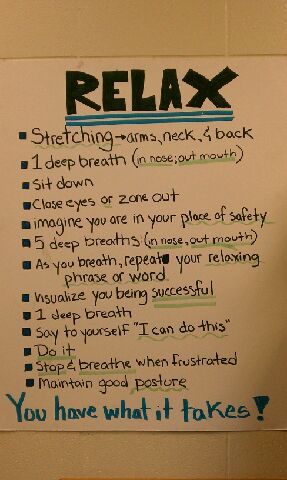
  • Develop a pre-exam relaxation routine: (see picture above) Before every exam and/or quiz I would lead students through the routine listed on the poster. We began by standing up and stretching in order to 1) get the blood flowing and 2) activate both sides of the brain by doing some cross body reaching and moving. The next part involves success visualization which is a strategy used by world class altheles like Michael Jordan and Tiger Woods. It involves seeing yourself be successful at whatever task you about about to do (ex. make a free-throw or putt a ball into the hole) and mentally accessing a place of calm (often mocked as “going to your special place” but it works!). Breathing is also a key part of successful relaxation and is closely linked to posture. I teach students to sit up straight and take deep breaths as they take an exam. This way, they are fully oxygenating their brains by breathing with full lung capacity. When you slump or slouch you sort of crumple or fold your lungs which hinders your ability to take a full breath.
  • Practice using real testing conditions: If the exam is timed then time almost everything else you do in class. Use the paper, font and headings (if you can) that the exam will use – make your practice exams look as close to possible like the real exam.
  • Teach students the procedural part of the exam a least a month before testing day: What will happen in the morning when they arrive at school? What forms will they need to fill out? What does the answer document look like? Often it is during the time right before the exam when students work themselves up – empower them by giving them a very clear idea of what will actually happen before, during and after the exam. This allows students to feel like they know what’s going on even before their knowledge is being tested.
  • Give them a strategy for what to do if they become frustrated: I have students stop and breath as well as check their posture. Another good idea is to take a drink of water from a bottle (if allowed) or pop in a mint or piece of gum. Draw a star next to the confusing question and come back to it after a few more questions or at the end.
  • Constantly send and reenforce the message “If you work hard, you can do this.” Students need to believe they have what it takes to be successful in order to even attempt to study or learn material. I explicitly teach my belief that the brain is like a muscle – if you work out you get stronger – if you stick with something difficult, you will understand it better in the end. I teach lessons on role models who showed resilience and I cover the classroom in quotes that underscore the importance of working hard. However, it is also important to teach students the difference between trying hard and effective effort.

What do you do to help students with testing anxiety?


Ms. Thompson’s Classroom

The classroom tour is back this week with the amazing Heather Thompson! I met Heather two years ago when we both worked the same summer job. I immediately gravitated towards her because she’s an incredibly knowledgable educator and she’s an all around fun person. Our coolest connection is that we taught about 5 or 6 of the same students; Heather had them in 1st grade and then I taught them in 12th grade. In addition to being a great teacher, Heather also writes the funny (and helpful!) fashion blog Regular People Wear Their Clothes. She and another fellow teacher take pictures of their outfits everyday, write a highly readable reflection and post sourcing information. I’ve written about their blog in a past post about what teachers should wear and I highly recommend checking out their site. I am so excited to share her dynamic classroom today, thanks Heather!

My classroom door is a little dark and uninviting, so here’s a picture of me in the classroom library instead. This is where the magic happens anyway! Welcome to third grade!

Where do you teach? Oakland, CA.

Who are your students? The student population at my school is primarily low-income and English language learning. Our school’s instructional program values and focuses on critical thinking skills and curiosity. We have a very stable school community with low student turnover, so most of the students have been at the school since Kindergarten. This means that by third grade they are amazingly deep thinkers.  My class this year is also very creative and artistic.

What do you teach? I teach third and fourth grade.

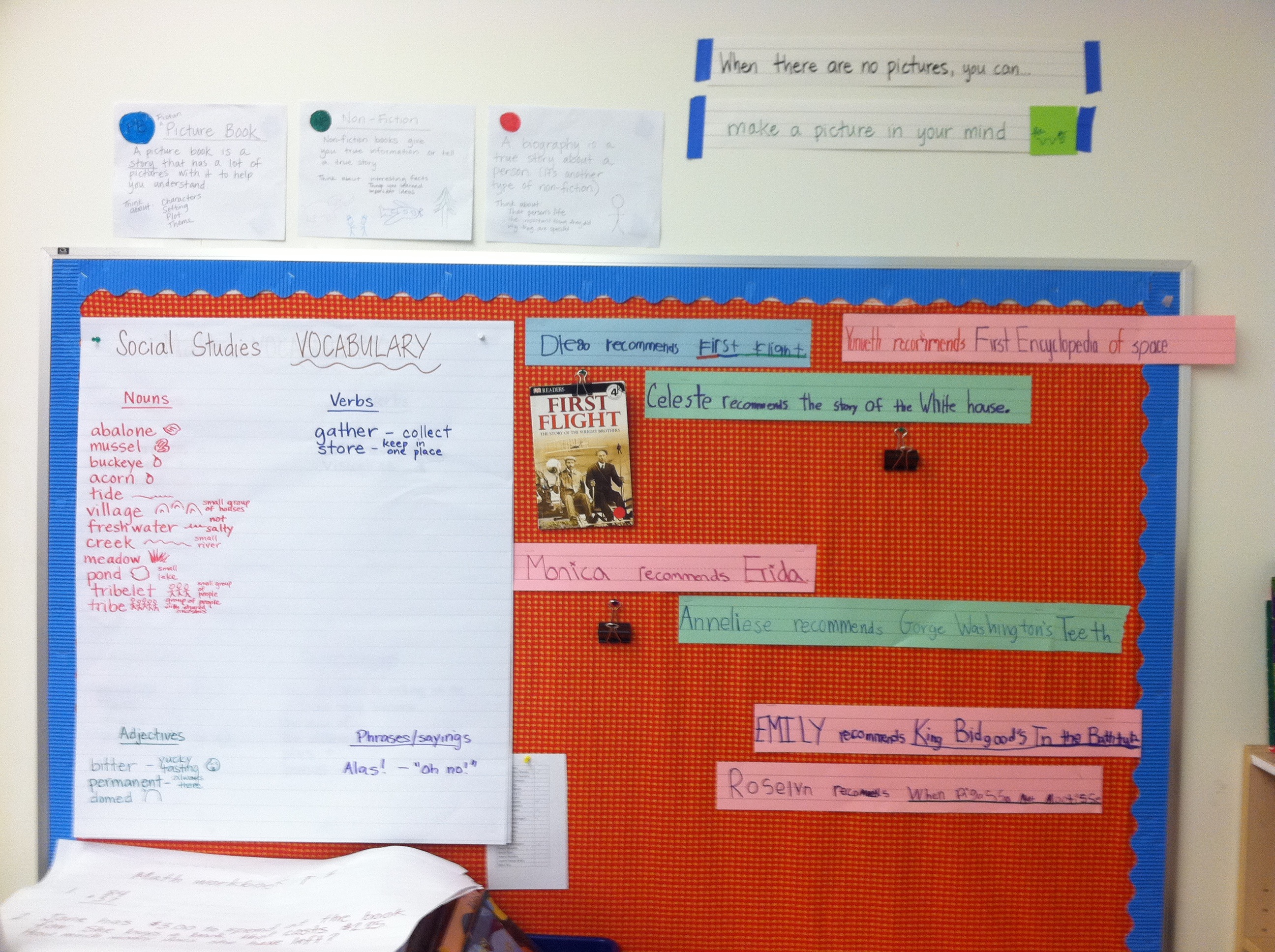
This is one of two bulletin boards at the front of my classroom. I use this one for vocabulary and book recommendations. You can see that a lot of the recommended books have been checked out by other students! The vocabulary is organized on posters by subject, so I can easily swap the posters out depending on what lesson I’m teaching.

We’re lucky to have giant windows in our classrooms. A lot of teachers cover them with posters or put furniture in front of them. I understand this, since wall space is at a premium, but my aesthetic sensibilities have over-ruled my desire to be able to keep posters up. Instead, I hang student work from the windowsill. (It’s magnetic!) And yes, we have pet birds. Word to the wise: birds are much easier classroom pets than hamsters or turtles. I should know—I’ve tried all three.

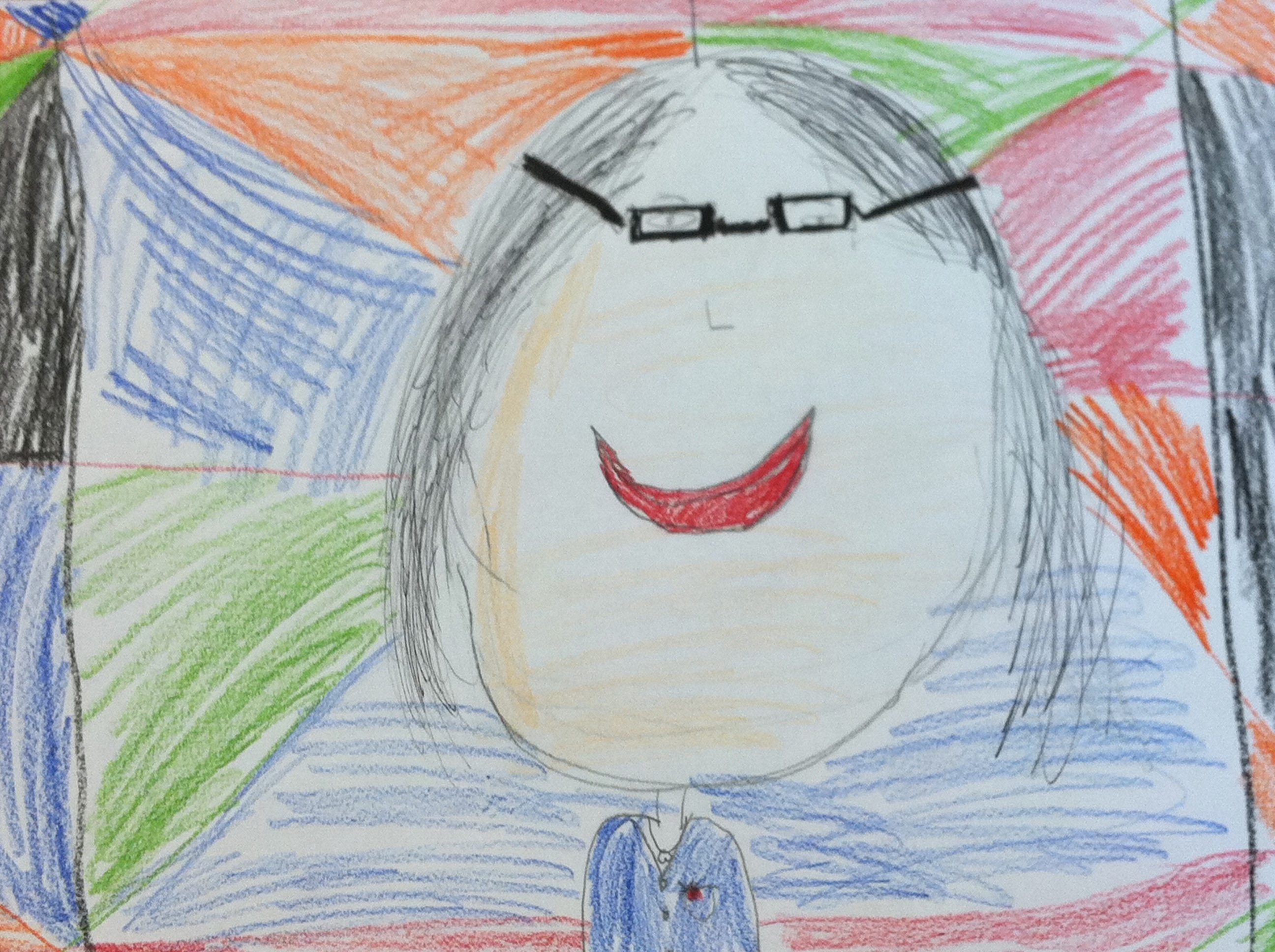
Don’t worry, someone made a portrait of me, too

Describe your teaching style in one word. I would describe my teaching style as “professorial.” We definitely have fun, but I also really try to help students develop the habit of thinking carefully and thoroughly about each task they do.

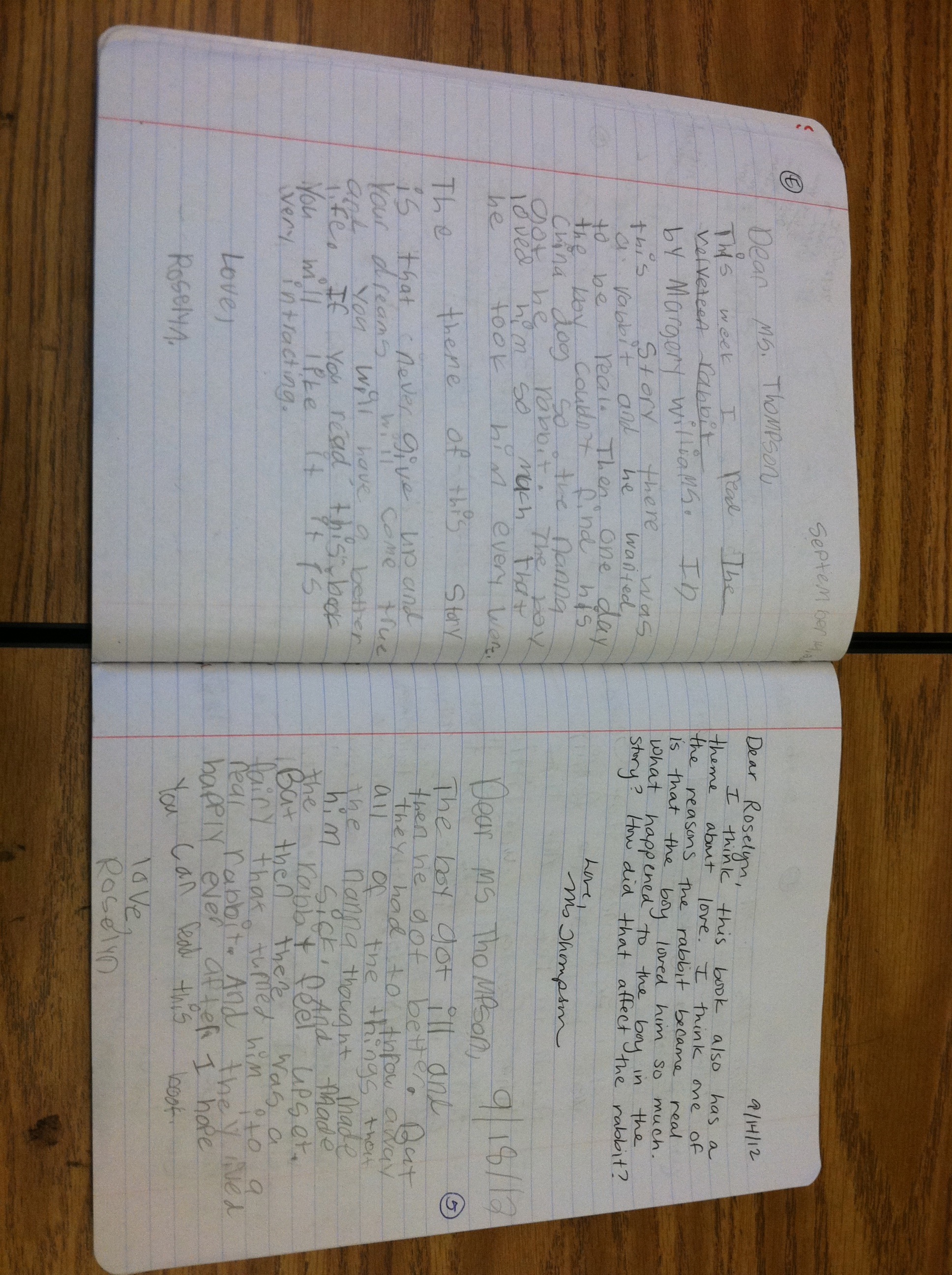
What is your go-to literacy strategy? Reading notebooks (see below)

We also use a notebook for most of our reading assignments. I love reading notebooks! My students write a short entry (1-2 sentences) every day, and then on Fridays they write me a letter about what they’ve been reading that week. I write them back over the weekend, and on Monday their entry is a response to me. When I grade their notebooks, I give grades based on the quality of their entries, and I also keep a running list of who has demonstrated understanding of key learning targets. For example, this student is starting to show an understanding of theme, although it’s not solid yet.

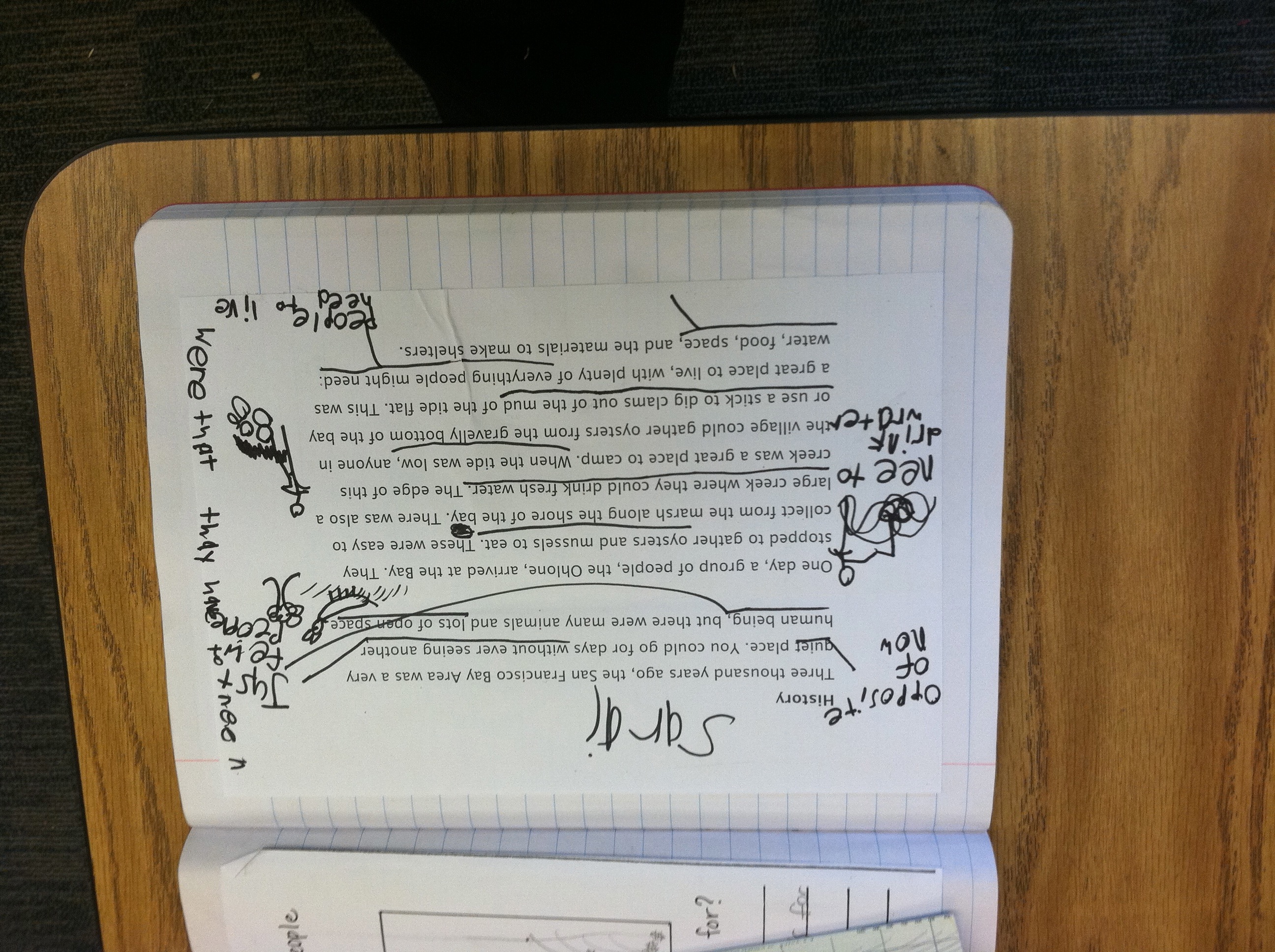
Here’s an example of a social studies reading assignment. We read and annotated the passage together. I always integrate reading and content whenever possible! Because my class loves art, we also do a lot of reading and sketching to help us visualize. *Abby’s Note: Annotating primary sources in 3rd grade = Common Core compliance and general butt-kicking awesomeness

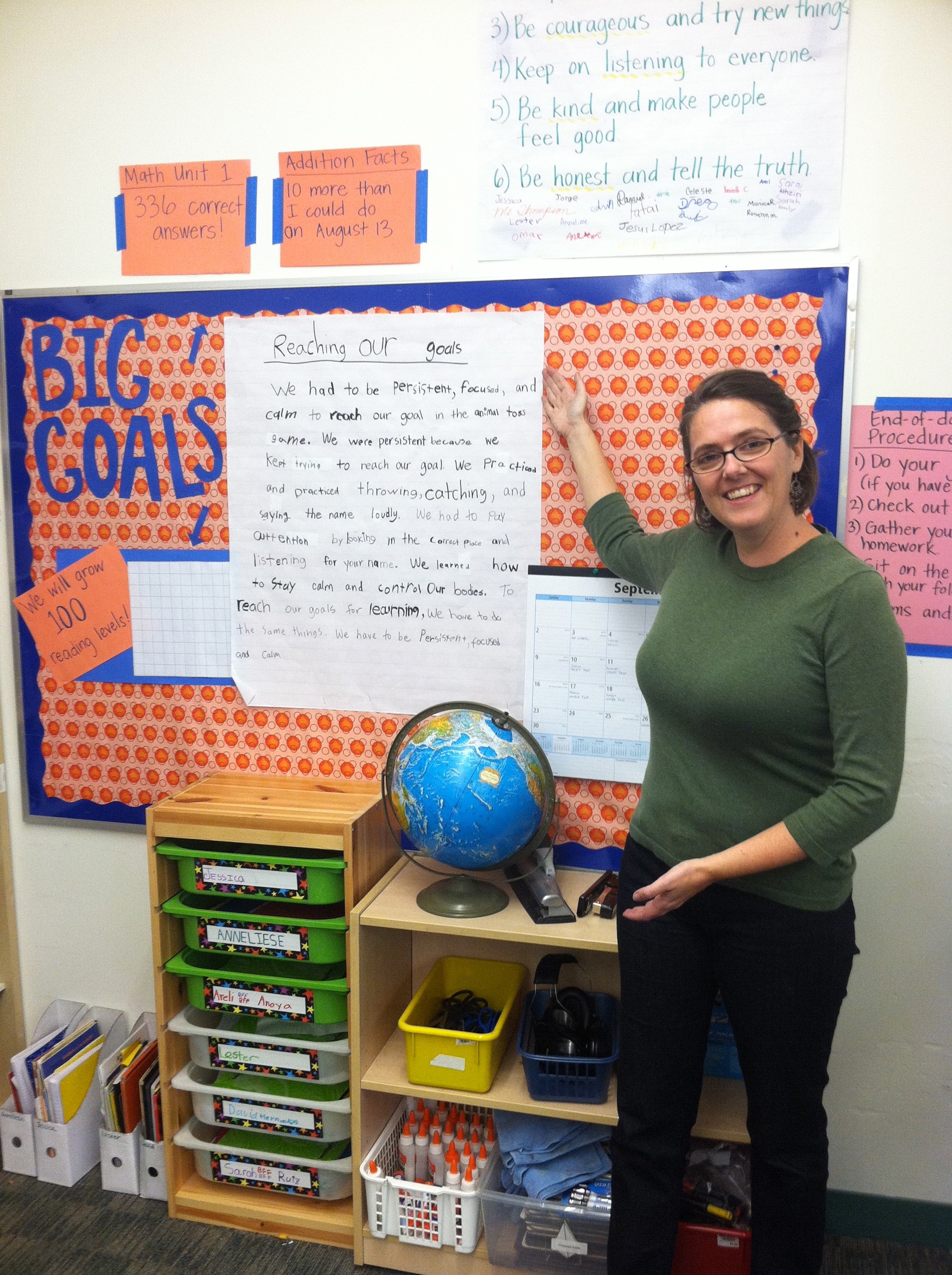
How do you motivate your students? I try to set goals that help us compete against ourselves and celebrate improvement, rather than goals for absolute mastery, which can feel scary to kids who are struggling. I assess student reading levels each month, and when they grow a level they color in a square on the reading level chart.  For the math goal, I add up how many correct answers the students get on a pre-test, and then figure out how many answers we would need to get correct if everyone grew 20 percentage points.

To help students learn what it takes to reach a goal, I start every year with a group game we call “Animal Toss.” It’s a bit complicated, but basically it involves throwing multiple stuffed animals around at the same time while trying not to drop them. We set a goal for how many animals we can get going simultaneously, and then practice every day. After the game we talk about what we did to get us closer to the goal, and what we still need to work on. When we finally reach the goal (it took us four weeks this year—not gonna lie, I was starting to wonder), we write a paragraph about how to reach goals.

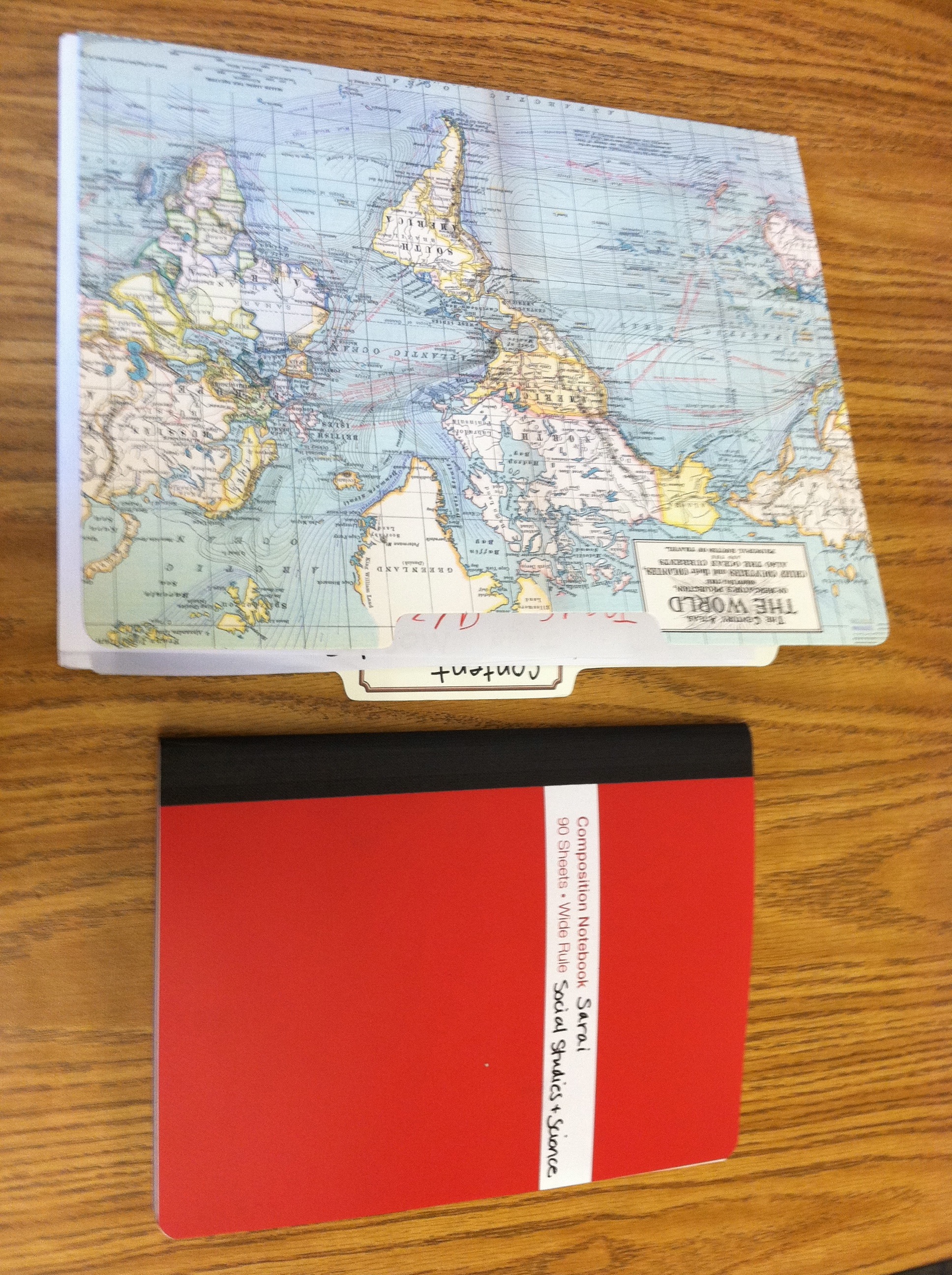
What is your favorite way to check for understanding? I am constantly assessing my students. As a multiple subject teacher, it’s especially hard to keep 4 or 5 assignments a day organized.  Here are my two best organization tips (see below):

When students turn work in, they turn it in to a folder labeled with the subject area. This way at the end of the day I just pick up the folders, and all the work is organized by assignment. If someone turns something in late, they just find the correct folder and put it in, which saves me a lot of time. Most ongoing work is kept in a notebook. Third graders have a hard time keeping track of papers, so if things are glued down they can easily refer back to them. Additionally, I know that if I need to look back at a student’s work, it will be in the notebook.

Classroom rules, signed by all students.

Romney: A weaker federal government . . . except in education?

As a social studies teacher, there are few things I love more than the presidential debates. I love that the challenger can stand on the same stage as the leader of the free world and make snarky comments! I love how the audience promises to be silent! I love the procedure of it – the moderator uses a timer! The candidates have notes! The questions are not released before hand! In the era of canned sound bites and identical stump speeches (seriously, check it out) it is enormously refreshing to hear the candidates speak about domestic issues without teleprompters or handlers. We know what Obama would do with education because, in some way or another, we have all felt the impact of Race To The Top and NCLB wavers over the past four years. Let’s take a deeper look at Romney’s ideas on education.

First of all, they’re pretty similar to the president’s. Romney praised the work of Arnie Duncan in last night’s debate and expressed his support for the work the Department of Education has done with “raising the bar” for states and local school districts by providing incentives at the federal level. However, he was also adamant about the key role state and local government play in making decisions about schools. Romney suggested a few different ideas but let’s look at two: 1) federal funding “following” students from one school to another and 2) grading schools, as Florida under Jeb Bush did, on an A – F scale inorder to “give parents options for their kids.”

We have a decentralized education system in the United States. In the same way local government, often school boards, are the main decision-makers for US schools, state and local governments also raise most of their schools’ funds. Only about 10 cents of every dollar spent on schools actually comes from the federal government. Additionally, federal funds – unlike state and local funds – are given out on a per student basis. Federal monies are often attached to specific programs like Title 1 or legislation like IDEA and therefore those funds would be really difficult to tease out on a student by student basis. This gets tricky because federal funds are more frequently linked to students with special needs or circumstances (disabilities, poverty, ELL, etc.) – students are not receiving equal amounts of money from the federal government. Typically this isn’t a problem: a student with Down syndrome has very specific needs that make her more expensive to educate than her classmates without IEPs. While this is certainly not equal it is fair; it make sense. But what happens to the special education teacher that supports the student with Down syndrome on a one-to-one basis when another child’s parents in the same school choose to move him to a school across town? As someone who has spent 7 of my 10 years in a charter school I am certainly for some school choice, but I think money must be moved at a local, not federal, level.

I am also extremely wary of a federal grading system for schools. I deeply believe parents and students should be the evaluators of the education they receive (see my reflection on teacher evaluation and the possible role of parents here). While districts and potentially states might be able to release comparisons of various schools within their jurisdictions, comparing across state lines in a simplified letter grade system seems like creating a letter grade system for athletes across all sports. Lebron James and Gabby Douglas are both world class athletes but for hugely different reasons and in vastly different sports. Can you image one rubric that would effectively encompass all of what makes them exceptional at their respective sports? And now consider one rubric for all schools across the United States. Would the grade be linked to test scores? If so, which tests? ACT or SAT? Then what does that mean if my kid is in elementary and I want to know if my daughter’s teacher is any good?

What I find so surprising about Romney’s proposals is how much they rely on the power of the federal government. He’s a Republican for petesake! What happened to returning power to the states? I certainly think the federal government can play an important role in raising the bar for states who are reluctant to takle education reform – as Race To The Top did and as Common Core implementation will – but that role should be limited. Let’s leave funding and evaluation largely in the control of the people who have the most to gain or lose from their children’s schools.

What if teachers ran their own PD?

“How many billions of dollars of public money have we spent on motivational speakers, experts, and “learning experiences” for teachers? And what good has it done? What results do we have to show? Nothing.”

– Mayor Michael Bloomberg, at Education Nation

One of the skills teachers quickly learn to master is that of appearing to pay attention during professional development while actually grading papers, or inputting grades, or writing lesson plans, or creating handouts, or any number of tasks that are 100 times more pressing than listening to a presenter read her power point slide after Comic Sans font slide. Who hasn’t been asked a question out of the blue? You look up from your 2nd period quizzes, meet the eyes of the presenter and watch a little smile spread across her face – “Gotch ya.” Indeed.

If you’re anything like me, you’ve attended some (LOTS!) of not-so-amazing PD sessions. What if teachers could create, run and then choose what sessions to attend? This is the gist of the idea behind what is called EdCamp, a “non-conference” run by teachers and for teachers that centers around the main belief that teachers (not venders or PD companies looking to make a quick buck) have knowledge worth sharing with each other. Check out this provocative article from Harvard’s Education Letter to read more about EdCamp.

Shout-out from ED’s Teaching Matters

I want to send a huge thank you to Laurie Calvert, the Teacher Liaison at the Department of Education, for recommending The Sacred Profession in today’s Teaching Matters newsletter. This newsletter is a great source of information about education and you can sign up here if you don’t receive updates already. Also, welcome to those of you who have jumped over from Teaching Matters!

“Won’t Back Down” is Not a Teacher Bashing Movie

One of the events I attended last week at Education Nation in New York was the premiere of the movie Won’t Back Down. As a high school teacher, you might be surprised to learn it was the first time I’ve ever been to a movie premiere complete with a red carpet, actual movie stars, and outraged protestors. In order to get into the theater I had to weave my way around a police line and a large (50+/-) group of protestors wearing AFT shirts and chanting, among other things, “Don’t Back Down, get out of town.” There was all the free popcorn you could eat and big cups of Coke. I sat within sight of education stars like Michelle Rhee (7 seats away!) and actual stars Jake Gyllenhaal (10 rows away!).

Earlier that day I listened to a pannel discussion with Viola Davis (who stars as a teacher), Maggie Gyllenhaal (who plays an activist parent), Rosie Perez (who also plays a teacher), and the director of Won’t Back DownDaniel Barnz.

My less-than-amazing cell-phone picture of the panel discussion on Won’t Back Down

Much of the conversation centered around accusations the film is “anti-union” and “teacher bashing” – claims everyone on the panel adamantly denied. The director is the son of a teacher and long-time New York city principal and was inspired to co-write the film in part by his mother’s work. Likewise, Gyllenhaal and Davis seemed a little stunned to find themselves in the middle of controversy. They both said something to the effect of “this is a film about two people who decide to change things for the better . . . it isn’t a political statement.” Needless to say, as I pushed through the protestors I was interested to see if the movie would live up to the negative hype. And the verdict? This is not a teacher bashing movie.

The movie follows the struggles of teacher and a parent trying to takeover their local school through parent trigger laws. There are heart-wrenching scenes between mothers and children, there are quirky line-dance numbers involving tipsy teachers, there are several scenes of Hollywood-awesome classroom instruction, and there is a sexy, ukulele-playing love interest teacher. I laughed, I cried; granted, I do both of the above really easily but overall it was an enjoyable flick. What is was not was a carefully orchestrated piece of propaganda designed to disempower teachers everywhere. There were numerous scenes where characters discussed the critical importance of both teachers and their unions. Was it oversimplified? Yes. But when was the last time you went to the movies for a carefully articulated explanation of anything? We did not go see The Pirates of the Caribbean to learn about the historical issues surrounding 19th century buccaneers nor did we see Transformers to gain insight into future technology.

Oversimplification becomes a problem when it has dangerous implications (ex. racist portrayals of slap-happy people of color in early 20th century films like Gone With the Wind); however, Won’t Back Down humanizes teachers and makes us root for parents trying to get a better education for their children. There are even attempts at nuance. For example, the love interest teacher is both a Teach For America alumni AND an adamant supporter of his union – ooh, the complexity! Frankly, it was refreshing to see a teacher movie deviate from the well-worn plot of teacher, often white female teacher, saves students of color (Dangerous Minds, Freedom Writers, Lean on Me, Stand and Deliver, etc.)

On the other hand, the teachers’ union was certainly the bad guy. They actively fought against the heroines and stooped to bribery and slander. I winced when the assistant to the union president recited the quote questionably attributed to the former president of the AFT Albert Shanker: “When children start paying union dues, that’s when I’ll start representing the interest of school children.” This line of thinking assumes what is good for teachers is not always good for children. I would argue the welfare of teachers is inextricably linked to the effective education of children – when we elevate the teaching profession we secure an excellent education for students. Teachers unions play a critical role in advocating for teachers.

Additionally, there is no question in my mind that the movie’s teacher union president Evelyn Riske, played by Holly Hunter, was a caricature of AFT president Randi Weingarten.

Randi Weingarten, president of the AFT

Looks so much like . . .

Holly Hunter as Evelyn Riske, the president of the TAP (the teacher’s union in Won’t Back Down)

The movie’s union president has short blond hair, talks about her union-supporting father (mother in Weingarten’s case), is childless, and is potentially a lesbian; the only piece that was missing was an iPhone in hand to enable the almost omnipotent presence on Twitter for which Weingarten is famous.

It is no spolier to say the school is successfully taken over by the end of the movie. My heart soared as I watched Viola Davis rally her jaded colleagues in the teacher’s lounge and eloquently vanquish her incompetent principal (boom!). Who among us has not dreamed of leading a mob of ruler-waving parents, students and teachers to the steps of our school where we will begin a reign of benevolence, competence and musical education for all?  If you’re looking for a feel-good movie, check out Won’t Back Down; but if you’re looking to gain insight into our country’s complex education issues you’re better off sticking to reliable news sources.

Best Behavior Management Tip of All Time: Give Clear Directions

Student motivation is one of the trickiest pieces of teaching. Building a dynamic classroom culture where all children are delighted to be in your room and are eager to learn is often extremely difficult; however, creating a compliant classroom can be straight forward. The quickest way to an on-task classroom is to give clear instructions. Here are some tips for giving clear directions I’ve put together from various sources including Lee Cantor, Fred Jones, and my own experience of various classroom disasters:

  • Before class, write critical instructions on the board: This can include directions for what students should do when they first come in, step-by-step directions for what they should do during practice time, instructions for what you want them to do when they finish an assessment, etc. Then when you verbally give the instructions, point to what you have written on the board. This way, students who have zoned out are at least watching you point to what you want and will know where to look when they are trying to figure out what they need to do.
  • Provide a visual of what you want next to your written instructions: I always tape an extra copy of the handout we will use on the board or if we’re using our notebooks I’ll draw the notebook page on the board and write in the heading, page number, and other formatting details I want students to be sure to include in their own notebooks.
  • Wait for perfect silence and 100% attention before you begin giving directions: For pete sake do not talk over children. This is a good way to lose your voice and become really frustrated.
  • Deliver your instructions in the front of the class with your shoulders squared, your feet grounded, and your chin titled up: This is the moment to look like the boss. Colleagues, don’t judge me but I remember reading The Dog Whisperer by Cesar Millan when my crazy Australian Sheapard (Jack) was totally out of control and he kept talking about the importance of the quiet authority you needed to project with your body posture in order for your dog to accept you as the alpha. Needless to say I had, as Oprah says, an “aha moment” with lasting positive effects for both Jack and my students.
  • Speak loud enough to be heard but do not yell: This I learned from the brilliant Martin Winchester who said when he really wanted to make a point he lowered his voice to just above a whisper. Don’t misunderstand me, there is a real place for using your “teacher voice” but try the power of the almost-whisper when you really want to drive your point home.
  • Begin instructions with “I am going to give you instructions now. Wait until I say “go” before you start moving.”: Lee Cantor correctly identifies how if you don’t tell students (or a room full of adults) to wait until you are finished, they will stand up, start talking, get out their supplies, etc. and miss the rest of your instructions.
  • Give sequential instructions: Use words like “first, second, third” or “now, then, after” so it is perfectly clear what students should do and in what order. This is also a great moment to use the written instructions on the board so students can follow along visually.
  • When finished, ask if students have questions and pause: When I say “Does anyone have any questions?” I always spread my arms wide and smile. Then I count to five in my head while holding the “I want to hug you all!” pose. I found students are more likely to ask for clarification if I spread my arms, smile and wait. Something about that combo . . .
  • Release students to the task and narrate behavior: Say “go” (or whatever your signal is) and then begin to narrate the behavior of students who are doing what you have asked. “Raul is opening his binder, Janet is getting out her pen, Sarah has begun annotating the poem . . .” This is classic Lee Cantor but holy cow narration works! It give students who have zoned out another chance to hear what they need to do without getting in trouble. Narration should be neutral and not attached to praise “Good job Raul! You opened your binder!”
  • Immediately circle the room or go up and down your rows 1 – 3 times: This lets you make sure all students are following instructions. You can also continue to narrate as you walk. It also gives the impression to the students that you are everywhere – you are physically near all students in the exact moment they need the most incentive to follow instructions. Physical proximity is a great corrective tool that is non-confrontational but certainly puts some physiological pressure on reluctant students.

Ok teachers what have I missed? Other tips for giving clear instructions?