Monthly Archives: October 2012

“Over the partisanship and through the bickering”

We will never solve our education crisis if we meander around the extremes of our party platforms. Rather, we must reward methods that yield success and abandon those that continue to fail, regardless of politics.

– Gabriel Ozuna, college sophomore at Yale University writing for Pass the Chalk

I’m am feeling pretty proud today because one of my former students has a measured, thoughtful and hyperlink-filled posting over at Teach For America’s blog “Pass the Chalk!” After last night’s Presidential town hall/cage fight it was refreshing to hear a call for solutions over partisanship from the next generation.

What I find interesting about education and politics is how everyone agrees reform is urgent and necessary yet there seems to be a lack of creativity in implementing solutions. Certainly NCLB, Race to the Top, and the Common Core represent bold strides into new territory however I also believe the time has come to correct the agressive swing towards frequent high-stakes testing and return to a measured, yet accountable, approach that includes the arts and humanities.

At the same time I am unsurprised by the lack of federal solutions to what I believe is a local problem. If education is the Civil Rights movement of our time we can hardly expect legislatures and bureaucrats to do the work of what must be a grassroots movement. Though it is one small contribution it feels pretty great to have had the privilege of teaching a young man who is already taking part in demanding more from his elected officials. I was once told “our students are the messages we send to a future we will not see.” With former students like Gabriel and his classmates, I am more than hopeful about seeing an education revolution well within my lifetime. Indeed, it is already underway.

“AP Classes are a Scam”

Those of you who know me or who have been reading my blog will know I am an ardent and public enemy of Advanced Placement and so I was delighted to see the article “AP Classes Are A Scam” on The Atlantic website. The article’s author, John Tierney, claims AP classes are “one of the great frauds currently perpetrated on American high-school students.” I would only add that for minority students in under-served schools or areas of high poverty, AP classes become inadvertent tools used to perpetuate underachievement in the communities who need to succeed the most. Students with the highest academic performance are tracked out of mainstream classes and promised a college preparatory curriculum but instead receive a frustrating and ultimately ineffective education in random minutia. Add to this the additional problems brought on by a teacher who teaches her AP class by assigning lengthly readings from a college-level text and lecturing for 40 minutes or more every day and our struggling students are completely left behind and even less ready for the potential rigors of college. I know because this is how I rolled for 5 years – long enough for my students to graduate, spend a year or more in college, drop out and return to campus to ask me why I didn’t prepare them to be successful. Ummm . . . I was too busy teaching you to pass the AP exam?

AP classes are necessarily aligned to AP assessments which do not mirror college-level rigor, require broad and trivial fact memorization (a skill Wikipedia has made obsolete everywhere but on Jeopardy and 3G-less West Texas), and fail to build critical skills like expository writing based on research. Tierney does a nice job outlining the problems with AP courses in his article. Read the full article here and thanks to Jenny Corroy for bringing it to my attention.

What is your experience teaching or taking AP classes?

Popular Pedagogy: Project-Based Learning

Recently there has been a buzz around both flipped instruction (where students are exposed to material at home via online content before practicing in class) as well as project based learning (PBL). I experimented with flipped instruction last year using Edmodo as a launch point for online content I linked to my class. I felt so-so about the experience but chalked it up to being 8 months pregnant and a fist time flipper. However, I’ve never really given PBL a fair shake. But I’ve recently seen more articles and resources out there on project based learning. I wanted to share them here and see if anyone else has advice for teachers who might be considering making the switch to PBL.

  1. “The Flip: The End of a Love Affair” by Shelly Wright – This teacher describes why and how she shifted her instruction from the flipped model to project based learning. It is a quick read but also a well thought out argument in favor of using projects to engage students in authentic learning.
  2. “For Authentic Learning, Start With Real Problems” by Suzie Boss – This is a condensed explanation of what project based learning is as well as some resources for making it work in various types of classrooms.
  3. Project Based Learning at Edutopia – A clearinghouse of examples and tips for teachers looking to try out project based learning.

What is your experience with PBL? Please share links, stories or potential help for others (OK, so help for me) if you have a moment.

Considering the Un-Thinkable

I was a senior in high school the year of the Columbine massacre and I remember thinking it would be an isolated incident that would never occur again. By the time I became a teacher, I realized I should at least think about what I would do if I found myself in a similar situation. Most of us have been trained on some sort of “Code Black” protocol where we lock the door, turn off the lights and get away from windows but yesterday on NPR I heard a story about an alternate approach – fighting back. The report centered around what is called “ALICE” training which stands for Altert, Lockdown, Inform, Counter, and Evacuate.  ALICE trainers assert school shooters end up hitting more people because students and teachers hide and stay still. Instead, they recommend strategies like barricading the door, throwing a large number of items all at once at the attacker to distract from a rushing tackle, and running in zig-zags to avoid being shot.

It is hard to know what you would really do under in an actual situation but I believe it is worth some mental planning. Consider David Benke, the now famous math teacher in Colorado who tackled a gun man at his school in 2010. Benke thought about what he would do if a shooter ever entered his school and he said, “If something happens and there’s something that I can do about it, I want to try and do something about it.”

This is not a topic I have discussed at length with my fellow colleagues but I am interested to hear your thoughts. As teachers, what is our obligation here?

Ms. Scheinfeld’s Classroom

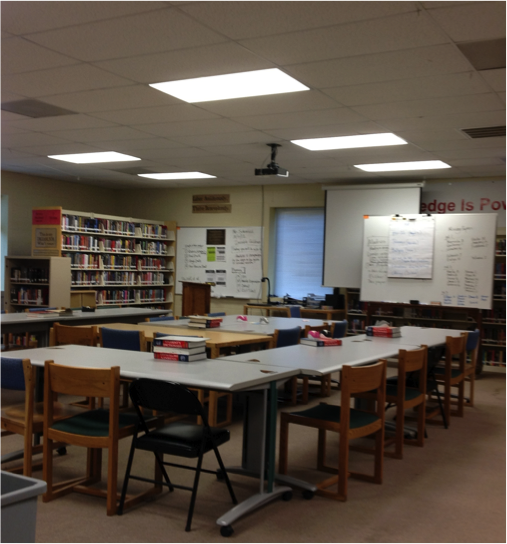
The teaching profession is shifting and more and more of us are taking on split or hybrid roles where part of the day is in the classroom and part is spent coaching or writing curriculum. So what do you do when you have to 1) share your room with a colleague and 2) hold classes in the library because that is the only available space? I am so pleased today to share the multi-functional classroom of my dear friend Melissa Barkin Scheinfeld. Melissa and I were in the same collaborative group at our pre-service teaching institute in 2005 and have been friends ever since. Whenever I have a particularly tricky teaching situation or just need a really brilliant thought partner I ring up Melissa. It is no surprise to see what an amazing classroom she has made despite some logistical challenges. Thank you for sharing your classroom Melissa!

Where do you teach?  I teach in Austin, Texas at KIPP Austin Collegiate.  We are the only KIPP high school in Austin.Who are your students?  My students are seniors who are currently applying to college and getting ready to take over the world.  They are brimming with personality and we will be in good hands when they are the ones making decisions for this city.  The majority of them come from Hispanic, low-income backgrounds and they have been KIPPsters since anywhere from 5th to 9th grade.

What do you teach? I teach Government and Economics.  This is my first year teaching this course after a long stint in World Geography and AP World History.  I am loving the opportunity to write new curriculum and teach Political Science.

The white board floating at the front of the room is on wheels and the English teacher and I rotate it depending on whose class is being taught. For additional writing space, there are packets of poster paper attached to it with binder clips. When there is additional information I want in front of my students, I put it on the chart paper and flip back and forth in the stack to get to the key info. It can be a bit of a challenge as it all adds a few more tasks in order to get set up for class, but for the most part it’s working great this year.

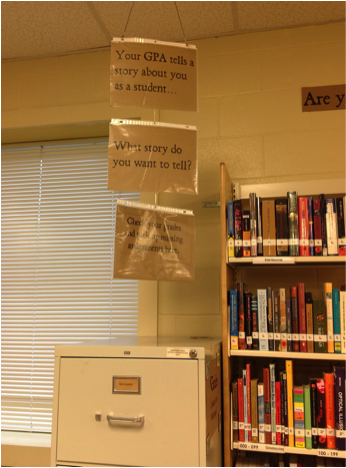
I have a filing cabinet in my classroom for students to pick up anything they are missing. The sign above it says, “Your GPA tells a story about you…what story do you want to tell? Check your grades and pick up missing work here.” The key to this system is that I don’t have to be around for a student to figure out what he/she needs to do to improve their grade or to help him/her find the missing/replacement handouts to get organized. Every teacher in my building has a system like this and we all know that if we’re supporting a student, we can send the student to another room to find extra copies of the assignment that needs additional attention.

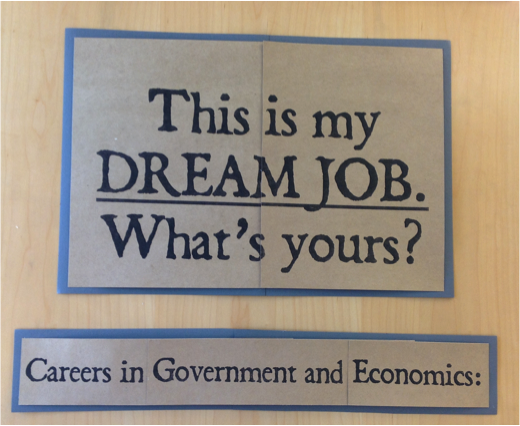
There are two signs that I’ve had up in my room every year since Abby gave me the brilliant idea… “This is my Dream Job. What’s yours?” and “Yes, I really do love you.” It’s incredible how many times students have referenced these two signs when I talk to them about our class years later. They are very empowering messages. And, I love to shamelessly promote careers related to the class I’m teaching, so the rest of the wall includes a list of jobs that this class might lead toward.

Describe your teaching style in one word. Disciplined

What is your go-to literacy strategy? I am a very strong proponent of peer revision in my classroom as a way for students to improve their writing skills.  My go-to strategy (which I, of course, learned from fantastic colleague several years ago) is called “clocking.”  I’m not sure where she got the name for it, but it stuck.  It’s basically speed dating for essay revision.  It requires three planning details:

       1. Clocking worksheet: I give students a document with 5 text boxes, each labeled with a different area from their essay rubric.  Each section has a title (straight from the rubric) and a place for the “reviser” to write his/her name.  In each box there are two sections, one for “This is what you wrote…” and the other, “I think it should be…”

       2. Seating arrangement: I move students into two long rows, or an inner circle or an outer circle, depending on the shape of the room.  The key is that each kid is sitting across from another student and they have a table in between them to work.  After each round, one of the circles or rows stands up and rotates.  Each student then has a new partner and a fresh set of eyes on his/her paper.

     3. Mini-lessons: I do a quick mini-lesson with strong and weak student examples at the beginning of each round.  When students are facing their first partner, I model feedback for the first skill (i.e. thesis statement, citations, claim and evidence in every paragraph, spelling, etc.) by revising 1-3 student examples that are almost perfect, if they just had one more piece of feedback.  Often I make them up myself because I haven’t read everyone’s rough draft.  The ideal examples are those that are mostly strong, but need one piece of clear, specific feedback to improve.  I try to bring samples of the most common student mistakes so students can see a model both for how to write well and how to give good feedback.  Students then pass both their essay and their “clocking worksheet” to their partner.  Each has 5 minutes silently to give feedback on the worksheet, then they have 3 minutes to explain their feedback out loud.  After eight minutes, one of the rows rotates, I give a new mini-lesson, and student trade papers with the new partner.

One of my students e-mailed me this picture last week for us to use on future “clocking worksheets.”  Obviously it’s intended for scientific research, but I like his interpretation of it for our Social Studies essays.

How do you motivate your students? Every single thing we do in class is tied to a college-readiness skill.  Students’ grades are based 100% on their demonstration of that skill by the end of the semester.  I’m experimenting this year with this policy of “standards-based grading” and finding it to be an incredible motivator.  I learned an anecdote a few years ago from an RBT training that I use to explain the concept of grading-for-mastery.  Imagine two students in medical school.  Student #1 scores an 80% on every assignment all year long.  Student #2 scores 50% for the first half of the course, but scores 100% for the second half of the course and earns a 100% on the final, cumulative exam.  With a traditional grading system, the first student’s score in the course is 80% and the second student’s score is 75% for the course.  The next questions is…who do you want performing your open-heart surgery?  I would want the student who performed perfectly by the end of the course.  So in this new grading system, the final grade reflects the 100% at the end of the course, regardless of how long ittook student #2 to get there.

The part of my old classroom that I miss the most is the world map that you can see in the background of this photo. I installed two sheets of metal onto the wall and painted it with a world map. It’s magnetic and visible from all parts of the classroom. The teaching potential is endless…for the new World Geography teacher who has taken over the space.

What is your favorite way to check for understanding? I use a lot of “Cold-Calling”, and “Think-Pair-Shares” during class and an “Exit Ticket” at the end of class.  I would estimate that every 5-10 minutes during class I prompt students to write down an answer to a prompt, explain it to their partner, and then I call on a student randomly to share their thoughts.  It is consistently the most popular aspect of class on student surveys.  And, it takes no prep, gets every student voice in the room, and gives me a ton of information about what is and isn’t “sticky” in my teaching.

       At the end ofclass every day I give an “Exit Ticket.”  It’s a half sheet of paper containing 2-4 questions that prompt students to explain the key concepts from the period.  Sometimes I grade them, sometimes I read them and then recycle them, and sometimes I sort them into piles by right and wrong answers or other general trends to plan for a quick mini-lesson to re-teach something the following day.  This practice holds me accountable to know where I’m headed every day and gives me permission to not give individual feedback if it isn’t a strategic use of my time.

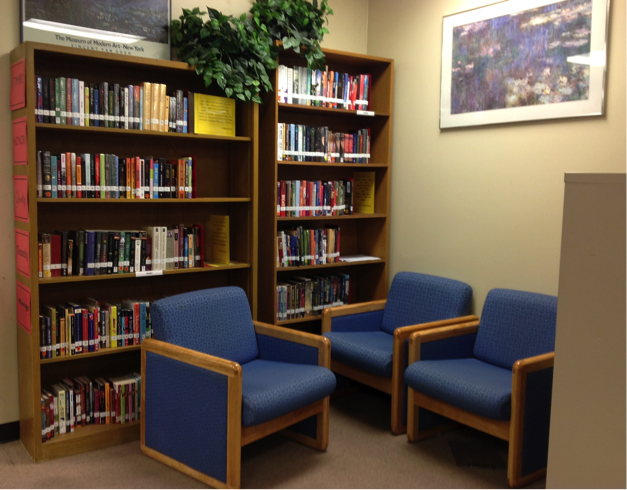
The biggest perk to being in the library is that we have fantastically comfortable furniture that students can use when we’re in small group work or writing independently. It’s pretty awesome to have a couple of nooks like this and for that I’m super grateful.
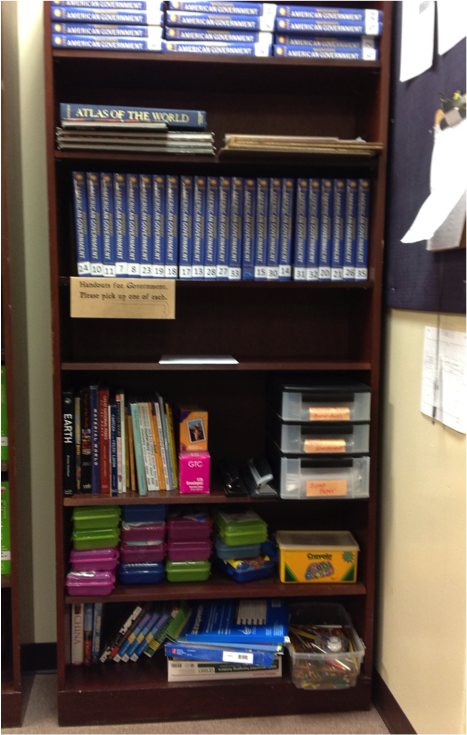
With super limited space this year, I don’t have a table for handouts, but rather an empty shelf. In addition, I leave student supplies on the same bookcase with easy access for students to get to the materials they need.
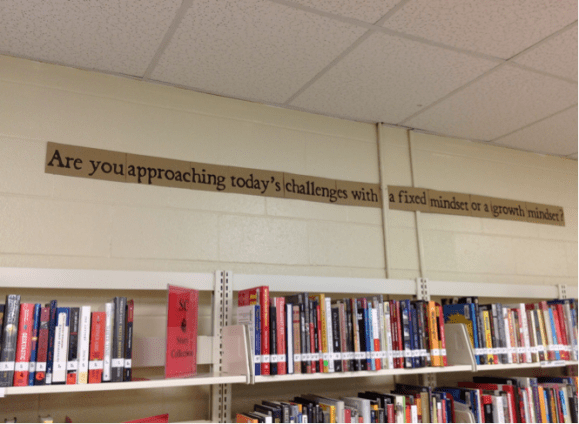
After reading Carol Dweck’s Mindset, I started teaching an annual lesson about fixed and growth mindsets to my students to help them identify both in themselves. I point to this question on the wall every time I return work to students with critical feedback or offer challenging corrections in order to support them moving more often towards embracing a growth mindset.

Salman Khan: “School should be more like summer camp”

“[The school] I imagine has much more open, collaborative workspaces. I imagine the students come in, and they work with their mentors. Their mentors will be both students, possibly older students or students who have shown maturity, and the master teachers. They will set goals. Based on those goals that they are trying to achieve, they have a rough allocation of how they might want to be spending their time. One day a student might want to go deep on trigonometry. Then, he or she might spend two weeks researching some problem in biology or writing a short story.”

– Salman Khan, founder of the online video tutorial site Khan’s Academy

The consensus is building for a new kind of school model! Check out this interview with Salman Khan from The Smithsonian.

Change our schools, or drug our students?

“I don’t have a whole lot of choice. We’ve decided as a society that it’s too expensive to modify the kid’s environment. So we have to modify the kid.”

– Dr. Michael Anderson, a pediatrician for low-income kids in Georgia on why he prescribes Adderal for ADD/ADHD in spite of his belief the disorder is “made up”

Colleagues, I’ve been simmering on an idea for the past couple of years and this morning when I read   the New York Times article containing the above quote from Dr. Anderson that simmer became a boil. The idea is this: school is so crushingly, cripplingly boring. Kids in desks in rows, bells, hour after hour of listening to an adult talk, whole days without going outside (or seeing daylight in some of the windowless schools I’ve been in!), silence while doing worksheets, silence while taking multiple choice exams, speaking to peers only during passing periods or when the teacher turns away . . . I know it isn’t always like this. Still, even the best teacher who’s classroom is dynamic and learner-centered is only functioning as one small piece of a student’s day.

Our’s is a system unfit for children who “can’t sit still” or “who lack focus” – they must be drugged. I recently re-watched Sir Ken Robinson’s TED talk “Do schools kill creativity?” (if you haven’t seen it, please, please take the next 20 minutes and have a look . . . he is so funny! so substantive!):

Although I am tempted to rant for a page or two about how deeply our students crave creative involvement in meaningful art I will save that reflection for another day. Let’s start for now with the structure of a typical school day.

Two years ago the administration at my school took a chance and let my colleagues and I implement something called Working Wednesday for our senior class. This involved not having regular period classes on Wednesdays and instead creating an individualized schedule for each student according to his or her needs. Some students had an entire day of flexible time during which they could work on independent projects and assignments while others had a carefully crafted schedule full of appointments with various teachers for one-on-one tutoring, college counseling sessions, ACT tutorial, and re-testing for failed exams. We also used Wednesday to visit our local library, conduct field research at a nearby lake and listen to guest speakers.

The additional advantage of a flexible schedule is it lets teachers take turns playing catch up. We would rotate tutorial and monitoring duties in such a way as to allow large blocks of time (way more than our usual hour planning period) to grade and plan. At the end of our first year implementing Working Wednesday we saw huge jumps in our student’s achievement. My students’ performance jumped from 32% passing in 2010-11 to 45% on the college-level IB History exam.

I have heard people say that if Rip Van Winkle awoke today from a 100 year sleep the only thing he would still recognize among the iPads, airplanes, cell phones, and internet connect laptops are schools – because they look and operate almost exactly the same as they did 100 years ago. We cannot afford another 100 years under the same system. We must change our schools and teachers, along with parents, must be the ones who demand the change.

How can we make our schools dynamic places of learning? How can we structure our classrooms so that rule-following and sitting still aren’t the qualities we reward most in our students?

Affirmative Action: “Unfinished Work”


The case being argued in front of the Supreme Court today is the result of a lawsuit brought by a white student, Abigail Fisher, who was denied admission to the University of Texas in 2008. That same year a young black woman, Tedra Jacobs, with a similar academic record as Fisher was accepted. My sister-in-law Sarah Garland (who is sitting inside the Supreme Court right now listening to arguments!) has a new article posted over at The Atlantic that looks at Jacobs’ story. She shows how affirmative action can be tremendously helpful as well as explores reasons why it does not always serve as the equalizer it was designed to be (click here to read it).

End of Affirmative Action? What you can do for your students today

Tomorrow the Supreme Court will hear oral arguments on what many believe will be the case that ends affirmative action as we know it in higher education. For those of us who teach students of color this could be a game changer in terms of who will and will not be admitted to universities in the future. I think affirmative action has played a critical role as an equalizing force in our country over the past several decades. Additionally, I know from experience racial diversity increases the richness of any educational experience. However I wonder if affirmative action has been saddled with too much hope and attention. There was a great op-ed piece this week in the New York Times that suggested beginning the work of racial equally at the collegiate level is too late. The author suggested those of us interested in closing the achievement gap begin as early as possible and consider factors beyond education like healthcare, nutrition, and home life.

Given the potential loss of affirmative action, what can we as teachers do today to help our students of color and from low-income backgrounds gain access to college? One of the most popular ways is to splash college paraphernalia – banners, flags, t-shirts, names, mascots, etc. – all over a school. I think this can be helpful but a more authentic way to do this is to promote and talk about the actual college you attended. I hung my matted and framed diploma in my classroom. I made it a point to talk about the activities and clubs I was involved with during college. I kept a copy of my honors thesis in my classroom and often forced students to read a chapter of it. I wore a t-shirt from my college on informal Fridays.

All of the above is becoming more and more standard. One of the most powerful ways I’ve seen to connect students to college is to take them to an actual college campus. Set up a tour, let them do research in the library, ask a professor if they can sit in on a lecture.

Beyond all of these surface connects, the absolute most important thing we can do to get our students started in the direction of college is to demand they do rigorous, college-preparatory work. Conduct socratic seminars and discussions around various texts and problems (even in math!). Assign expository essays that require research (even in art!). Require students to read demanding non-fiction texts (even in everything!). In addition to rigorous work make sure to take some time to build college level organizational skills like time management, productive stress relief, and systems for keeping track of notes and materials. What good have we done if we elevate students expectations about attending college and then do not prepare them for what they will encounter?

How are you preparing students for college?

The Texas Two-Smash: STAAR & Budget Cuts

No, that isn’t the US congressional building – it’s the Texas State Capitol (but Texas’ building is bigger, naturally)

This past year public schools in Texas were hit with the double whammy of a $5 billion dollar cut from education funds as well as the roll out of a new higher stakes testing system called STAAR. Under the new testing system students will be tested more frequently and for more subjects; additionally, results will be linked to promotion and graduation requirements. The exams were developed to align with new “College and Career” standards however from what I’ve seen these standards are a far cry from providing more conceptional learning rooted in critical thinking and strong literacy skills.

At the same time Texas has held off from applying for Race to the Top funds and only just submitted a waver for NCLB; however, many experts predict the waver will be denied due to it’s lack of compliance in terms of standards rigor and teacher evaluations. Add to this the fact Texas is one of only four states not adapting the Common Core Standards and it is sometimes easy to get a little down. Texas Tribune reporter Morgan Smith wrote a great article exploring the relationship between increased testing and decreased funding to teacher burnout (check it out here).

Because of the tight link between eduction and local control and funding Texans, and those living in other states, need to make sure we know how our representatives are voting on education. And so here’s a quick reminder for my fellow Texans: today is the last day to register to vote in Texas. Click here to get it done http://GottaRegister.com/