Link Between Student Achievement and Poverty an “Inconvenient Truth”

“Standing up for Teachers” by Eugene Robinson

This week in the Washington Post columnist Eugene Robinson defended the Chicago teacher’s strike in a thoughtful and compelling opinion article.

My only beef with the piece is the continued use of “hero” language to talk about teaching and teachers. Teachers do critical, even sacred, work but we are not heroes. Being a hero in my mind must involve some kind of personal sacrifice for the greater good beyond what might be considered normal. The bottom line is teachers are paid for what we do. Yes, we all occasionally must work on evenings and weekends but we typically do not have school in the summer months. Unfortunately, most of us work beyond what is required by our contracts – again, not for the money, but because we love what we do. While some may call this heroic because it stems from the noble motivations of teachers I would argue again (click here for my other anti-hero post) that it is actually a tragic misappropriation of resources has lead to teachers working beyond the school day for pay that is often below what might be necessary.

The Key to Smarter Students: Effective Effort

It is not the critic who counts; not the man who point out how the strong man stumbles, or where the doer of deeds could have done better. The credit belongs to the man who is actually in the arena, whose face is marred by dust & sweat & blood, who strives valiantly; who errs and comes short again & again; because there is not effort with out error & shortcomings but he who does actually strive to do the deed; who knows great enthusiasm, great devotion, who spends himself in a worthy cause, who at the best knows in the end the triumph of high achievement & who at the worst, if he fails, at least he fails while daring greatly. So that his place shall never be with those cold & timid souls who know neither victory nor defeat. – Theodore Roosevelt

In 2007 I read a really gripping article from Scientific American Mind called “The Secret to Raising Smart Kids” by Carol Dweck (click here to download the article). Dweck argues the secret is that children learn to believe their effort will determine their outcome. In other words, if they succeed or fail they attribute that result to either hard work or not enough or ineffective effort. This prevents children from becoming defeated when they fail or fatalistic when they don’t reach their goals (ex. “I’m not good at anything! I’m so stupid”).

I like to teach students what effective effort actually involves. The Skillful Teacher (a book that I love and wrote a post about here) identifies the following aspects as qualities of effective effort:

  1. Time
    •Take enough time
    •Too little time = bad job
    •Too much time = wasted effort
  2. Focus
    •Work efficiently (don’t waste time with too much detail or on aspects that don’t matter much)
    •Work without distractions (quiet, no TV, no multitasking, no cell phone)
  3. Resourcefulness
    •Know when to get help
    •Know who to ask for help (or where to go to find help on your own)
  4. Strategies
    •Use smart tactics
    •Know what to do when a strategy isn’t working
    •Keep in mind tips you have learned
  5. Use of Feedback
    •Get feedback (from friend, teacher, etc.)
    •Apply or use the feedback in order to improve your performance
  6. Commitment
    •Don’t give up
    •Find ways to get around problems
    •Try your hardest

I have student evaluate their effort based around these qualities (ex. How well did you use your time?) after we finish a project/paper or in regards to studying for our exams. Although it may seem obvious to you that Bobby failed that test because he didn’t study, Bobby may walk away from the experience believing he failed because he is stupid and just isn’t good at whatever subject you teach. If you’re interested in teaching effective effort to your students I recommend making a poster with the qualities on it and guiding students to reflect on the effectiveness of their effort at least on a weekly basis. I have also uploaded a power point I’ve used to introduce effective effort here – feel free to give it a shot or adapt it so it works for your students.

How does your school district’s performance stack up?

The George W. Bush presidential library has an interesting (although, really over simplified) tool that enables you to compare average math and reading exam results for any public school district (both charter and traditional) with state, national and international figures (see above for an example of my hometown compared internationally). This tool is called “The Global Report Card” and is fun to play around with; but keep in mind that in addition to being a cool little application, the site is definitely promoting a pro-reform agenda.

US Education Spending vs. Performance

The graphic below, from the University of Southern California,  provides a nice comparison of US spending and academic performance as compared to other countries.

A quick social studies teacher note: this figure shows total annual spending and not percentage of GDP or spending in relation to population, etc. Although the US spends way more than Finland I would be interested to see what this looks like in comparison to GDP or spending per pupil.

“Throwing Money”

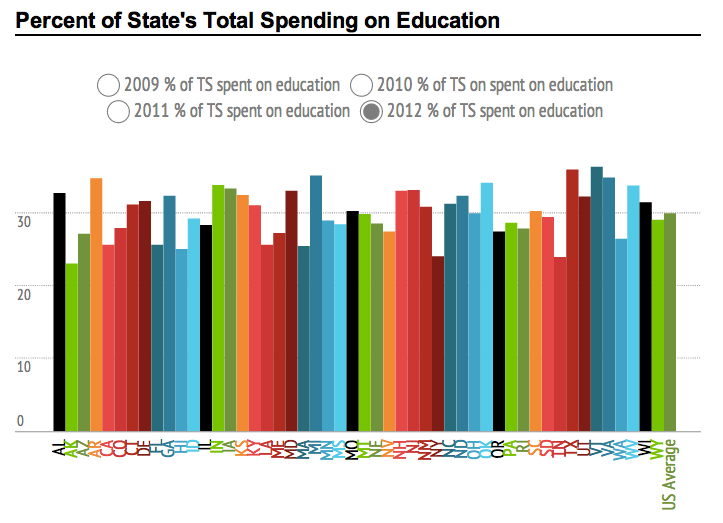
In any education debate, there are always two positions on education spending: 1) throwing money at the problem isn’t making things any better and 2) money is essential for underperforming schools – especially those in poor areas – to succeed. Last week the non-profit group State Budget Solutions released a report with title that left no doubt as to where they stand on the issue:  “Throwing Money at Education Isn’t Working.” Below is a graph of state expenditures as percentage of total budget.

The report shows education budgets have doubled since 1970 and yet the achievement gap by race and social class is still wide while US test scores have failed keep up with those in others countries. It then recommends control over education spending should happen on a local level rather than at a state or national level. This is an interesting argument at a time of Common Core implementation around the country.

As a teacher who has taught in schools where money is tight I have to really scratch my head at this report. I have had class rosters over 40 and not a single textbook in my room because of budget difficulties at public schools – and all of this in the state of Texas which spends near the top in terms of percentage of budget dedicated to education. Here is a look at how the spending per pupil has increased in Texas just since 1998:


To read the full report from State Budget Solutions click here or if you want a snappy little summary check out this article from Education Week.

What do you think about the role of money in education?


Motivating Students Through Role Models

You think school is hard? What if you were blind AND deaf? Hellen Kellen was the first blind/deaf person to earn a Bachelor degree – from Radcliffe no less!

I have read in numerous places about the importance of young people having role models – who look like them and who they related to – who help them see a path towards their goals. Throughout the year, I like to take the time to introduce my students to a person who achieved despite seemingly insurmountable obstacles. The moral of these character studies is always really clear: if you work hard, you can achieve your dreams regardless of potential challenges.

I like like to teach these mini-lessons by either having students read a synopsis of the person’s life, or reading aloud a children’s book about the person or even watching a quick video clip from a movie about the person. Then I show students a quote from the individual that underscores the importance of continuing to work hard regardless of the difficulties. At that point, ask students to connect with the individual on a personal level by journaling either about the quote or about current difficulties in their own lives. Finally, I create some kind of classroom display to help us remember the lesson we learned from the historical figure’s life. Below is a list of people I have covered in the past as well as resources I have used to teach their lives:

  • Hellen Keller: Students can not get over how she actually learned to speak, write (in multiple languages!) and graduated from college. “While they were saying among themselves it cannot be done, it was done.”

  • Nelson Mandela: It is pretty amazing to spend 27 years in prison and then become the first black president of your country. “It always seems impossible until it is done.”

  • Cesar Chavez: Tireless organizing, multiple hunger fasts, long marches in his bare feet – Chavez’s efforts to bring fair treatment to migrant farm workers is inspirational. I love to read the children’s biography of his life “Harvesting Hope” by Kathleen Krull to my students. A portion of this quote is my classroom slogan every year: “There is no substitute for hard work, 23 or 24 hours a day. And there is no substitute for patience and acceptance.” I also love “We cannot seek achievement for ourselves and forget about progress and prosperity for our community . . . Our ambitions must be broad enough to include the aspirations and needs of others, for their sakes and for our own.”

  • Alice Paul: Organized protests and led marches for the right to be able to vote, she was arrested, went on hunger strike and then was force-fed through a tube for over a month! The movie Iron Jawed Angels with Hillary Swank is amazing and I always show the 10 minutes where they are all in prison being force feed and yet singing to keep their spirits up. Also AMAZING is this music video parody of Lady Gaga’s Bad Romance, check it out[youtube http://www.youtube.com/watch?v=IYQhRCs9IHM%5D. “When you put your hand to the plow, you can’t put it down until you get to the end of the row.”

  • Muhammad Ali: The Champion of the World came from humble origins and overcame racism as well as religious prejudice to get and stay on top. What teenager doesn’t love boxing? The Will Smith film is great but I find kids love to look at pictures and read lots and lots of quotes (he was pithy to say the least!). My favorite is “I hated every minute of the training but I said: ‘Don’t quit. Suffer now, and live the rest of you life as a champion.”
  • Other role models can come from specific disciplines (like Madame Curie for science) or be political figures like Mahatma Ghandi or Martin Luther King, Jr.

The key with really leveraging role models in your classroom is not just to teach them once and then forget about them but to keep refering to the lesson you learned through that individual (ex. “You can write this research paper! Hellen Keller did this without being able to hear or see!” or “I know this is hard but think about what Muhammad Ali said . . .”) Doing these mini-lessons doesn’t need to take a long time but the impact can be huge in terms of student investment and motivation in your classroom.

What role models have y’all used in your classrooms?

Headed to NYC Next Week!


I am so honored to be heading to New York next week as a part of my fellowship with America Achieves to participate in NBC’s Education Nation at the downtown Public Library. One of the most exciting events of the conference is the Teacher Town Hall where hundreds of teachers come together and engage a discussion with education leaders. There is always an open mike for questions . . . anyone have ideas about questions I should be asking?


YouTube’s Search to Find the Next Online Teaching Sensation

YouTube is looking to promote what they call “the next generation of online educators” who post online lessons or educational content like the well-know math YouTube channel Khan Academy or the Crash Course in World History videos (posted above). The contest begins today and ends in January when judges will select 10 winners and give them a cash reward as well as videography equipement to help them make more videos. Click here for more details.

Why one Chicago teacher supports the strike

Want to hear why teachers in Chicago are striking from a veteran Chicago teacher? Read Lindsey Rohwer’s moving argument in support of the strike here.

Ode to Office Supplies: Post-It Notes

It’s been a few weeks since I last sang the praises of a particular office supply (the Moleskine, read the post here) so today I thought I’d tackle the ubiquitous and versatile post-it note. Here are my top 5 ways to use that cute little slip of sticky paper:

  1. Student of the Week Shout-Outs: Every week, I pick a student from my homeroom to feature as the “Student of the Week.” I write the student’s name on a 3×5 card and then have him list five things he wants people to know about himself. His classmates and I then write affirmations about him on post-its and we put them on our classroom door around the student’s name and fact sheet. I have post-its available for others to add affirmations throughout the week. My husband does the same thing but takes a picture of the student and puts it in the middle with the affirmation post-its all around – he call is “The Homeroomer of the Week.” As in, when it’s your week you are “homerooming.” Teacher jokes, teacher jokes . . .
  2. Daily Assessment: If my daily assessment involves students writing a 1 – 3 sentence answer I will often have them write the answer and their name on post-it notes and then put them on the white board as they exit the classroom. I can read the entire classes responses quickly and get a clear idea of mastery.
  3. Opinion spectrums or corners: On of my favorite ways to use post-its is to draw an opinion spectrum (strongly disagree to neutral to strongly agree) and have students respond to questions on post-its and then place their responses along the spectrum. I do this for content questions (i.e. Should the US have become involved in Vietnam?) as well as classroom culture questions (i.e. How prepared were you for the exam we took today? Explain your answer.) Opinion corners provides another dimension to the spectrum. Draw a square and divide it into fourths. Each quadrant represents an opinion position. For example, the question “Whose fault was the Kent State Massacre?” could have quadrants named: the protesting college students, the national guard, the Kent state professors, the United States government. Students would write their answers on the post-it and then place them where they belong. This is nice because it allows for multiple answers – you could place a post-it in between the college students and national guard boxes to indicate you blame both or in the middle to indicate you blame all four groups equally.
  4. To make tab dividers in notebooks: You can buy the swoon worthy babies below or just use mini-post-its for the same effect.
  5. To annotate textbooks or other school-owned books: It is so important for students to learn how to annotate properly and to save their annotations for expository essays or research papers. However, it often isn’t possible for all students to buy a copy of the book you are using in class. I have students make notes on post-its and just keep these in the books for the duration of the time we are using a particular text. Then at the end of the unit or year we just take them out. I like the large, lined post-it notes for this task and encourage students to write page numbers on the post-it next to teach of the comments they are writing down or quotes they want to copy/remember.

How do you use post-its in your classroom?