Shout-out from ED’s Teaching Matters

I want to send a huge thank you to Laurie Calvert, the Teacher Liaison at the Department of Education, for recommending The Sacred Profession in today’s Teaching Matters newsletter. This newsletter is a great source of information about education and you can sign up here if you don’t receive updates already. Also, welcome to those of you who have jumped over from Teaching Matters!

“Won’t Back Down” is Not a Teacher Bashing Movie

One of the events I attended last week at Education Nation in New York was the premiere of the movie Won’t Back Down. As a high school teacher, you might be surprised to learn it was the first time I’ve ever been to a movie premiere complete with a red carpet, actual movie stars, and outraged protestors. In order to get into the theater I had to weave my way around a police line and a large (50+/-) group of protestors wearing AFT shirts and chanting, among other things, “Don’t Back Down, get out of town.” There was all the free popcorn you could eat and big cups of Coke. I sat within sight of education stars like Michelle Rhee (7 seats away!) and actual stars Jake Gyllenhaal (10 rows away!).

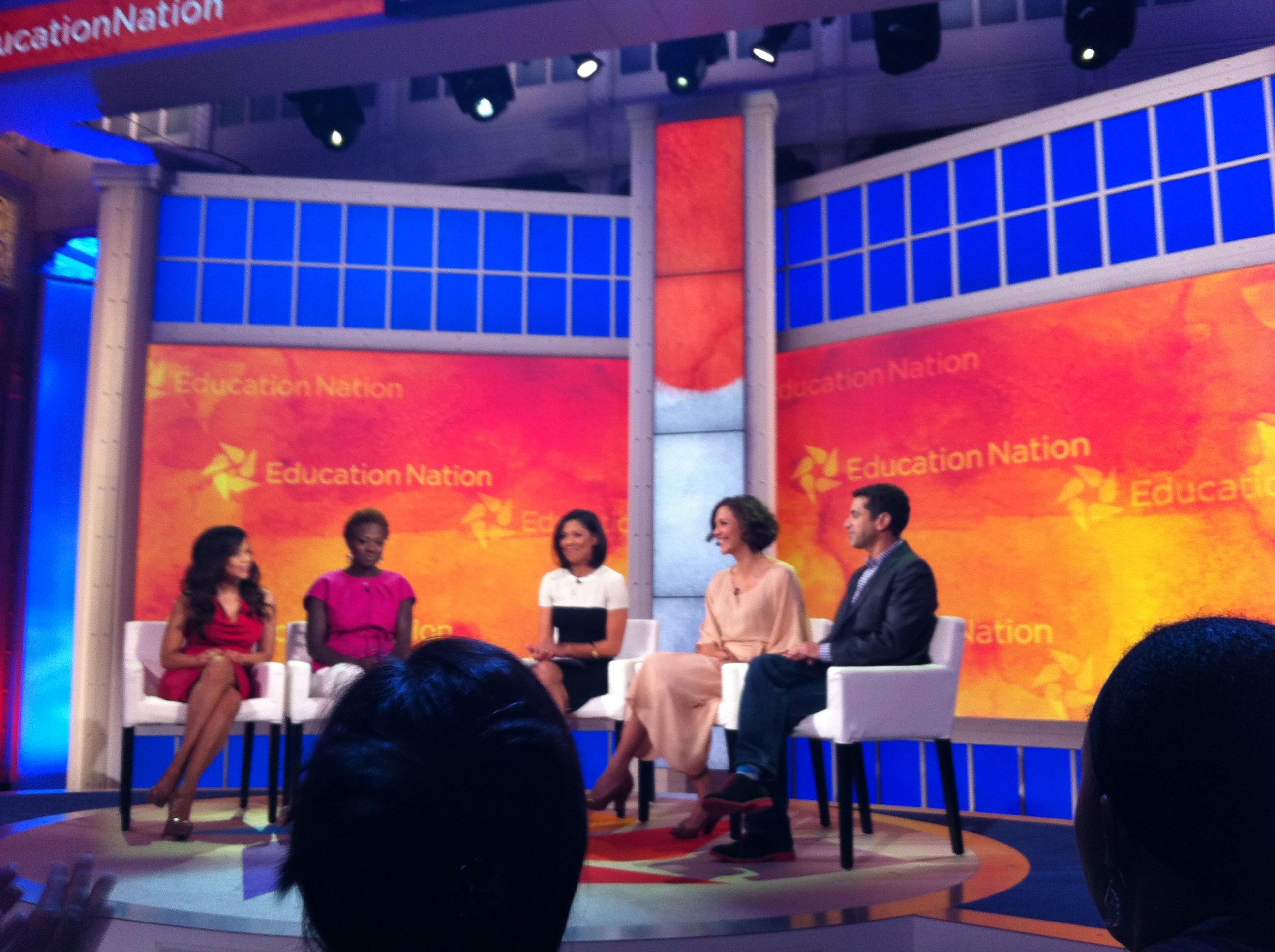
Earlier that day I listened to a pannel discussion with Viola Davis (who stars as a teacher), Maggie Gyllenhaal (who plays an activist parent), Rosie Perez (who also plays a teacher), and the director of Won’t Back DownDaniel Barnz.

My less-than-amazing cell-phone picture of the panel discussion on Won’t Back Down

Much of the conversation centered around accusations the film is “anti-union” and “teacher bashing” – claims everyone on the panel adamantly denied. The director is the son of a teacher and long-time New York city principal and was inspired to co-write the film in part by his mother’s work. Likewise, Gyllenhaal and Davis seemed a little stunned to find themselves in the middle of controversy. They both said something to the effect of “this is a film about two people who decide to change things for the better . . . it isn’t a political statement.” Needless to say, as I pushed through the protestors I was interested to see if the movie would live up to the negative hype. And the verdict? This is not a teacher bashing movie.

The movie follows the struggles of teacher and a parent trying to takeover their local school through parent trigger laws. There are heart-wrenching scenes between mothers and children, there are quirky line-dance numbers involving tipsy teachers, there are several scenes of Hollywood-awesome classroom instruction, and there is a sexy, ukulele-playing love interest teacher. I laughed, I cried; granted, I do both of the above really easily but overall it was an enjoyable flick. What is was not was a carefully orchestrated piece of propaganda designed to disempower teachers everywhere. There were numerous scenes where characters discussed the critical importance of both teachers and their unions. Was it oversimplified? Yes. But when was the last time you went to the movies for a carefully articulated explanation of anything? We did not go see The Pirates of the Caribbean to learn about the historical issues surrounding 19th century buccaneers nor did we see Transformers to gain insight into future technology.

Oversimplification becomes a problem when it has dangerous implications (ex. racist portrayals of slap-happy people of color in early 20th century films like Gone With the Wind); however, Won’t Back Down humanizes teachers and makes us root for parents trying to get a better education for their children. There are even attempts at nuance. For example, the love interest teacher is both a Teach For America alumni AND an adamant supporter of his union – ooh, the complexity! Frankly, it was refreshing to see a teacher movie deviate from the well-worn plot of teacher, often white female teacher, saves students of color (Dangerous Minds, Freedom Writers, Lean on Me, Stand and Deliver, etc.)

On the other hand, the teachers’ union was certainly the bad guy. They actively fought against the heroines and stooped to bribery and slander. I winced when the assistant to the union president recited the quote questionably attributed to the former president of the AFT Albert Shanker: “When children start paying union dues, that’s when I’ll start representing the interest of school children.” This line of thinking assumes what is good for teachers is not always good for children. I would argue the welfare of teachers is inextricably linked to the effective education of children – when we elevate the teaching profession we secure an excellent education for students. Teachers unions play a critical role in advocating for teachers.

Additionally, there is no question in my mind that the movie’s teacher union president Evelyn Riske, played by Holly Hunter, was a caricature of AFT president Randi Weingarten.

Randi Weingarten, president of the AFT

Looks so much like . . .

Holly Hunter as Evelyn Riske, the president of the TAP (the teacher’s union in Won’t Back Down)

The movie’s union president has short blond hair, talks about her union-supporting father (mother in Weingarten’s case), is childless, and is potentially a lesbian; the only piece that was missing was an iPhone in hand to enable the almost omnipotent presence on Twitter for which Weingarten is famous.

It is no spolier to say the school is successfully taken over by the end of the movie. My heart soared as I watched Viola Davis rally her jaded colleagues in the teacher’s lounge and eloquently vanquish her incompetent principal (boom!). Who among us has not dreamed of leading a mob of ruler-waving parents, students and teachers to the steps of our school where we will begin a reign of benevolence, competence and musical education for all?  If you’re looking for a feel-good movie, check out Won’t Back Down; but if you’re looking to gain insight into our country’s complex education issues you’re better off sticking to reliable news sources.


Best Behavior Management Tip of All Time: Give Clear Directions

Student motivation is one of the trickiest pieces of teaching. Building a dynamic classroom culture where all children are delighted to be in your room and are eager to learn is often extremely difficult; however, creating a compliant classroom can be straight forward. The quickest way to an on-task classroom is to give clear instructions. Here are some tips for giving clear directions I’ve put together from various sources including Lee Cantor, Fred Jones, and my own experience of various classroom disasters:

  • Before class, write critical instructions on the board: This can include directions for what students should do when they first come in, step-by-step directions for what they should do during practice time, instructions for what you want them to do when they finish an assessment, etc. Then when you verbally give the instructions, point to what you have written on the board. This way, students who have zoned out are at least watching you point to what you want and will know where to look when they are trying to figure out what they need to do.
  • Provide a visual of what you want next to your written instructions: I always tape an extra copy of the handout we will use on the board or if we’re using our notebooks I’ll draw the notebook page on the board and write in the heading, page number, and other formatting details I want students to be sure to include in their own notebooks.
  • Wait for perfect silence and 100% attention before you begin giving directions: For pete sake do not talk over children. This is a good way to lose your voice and become really frustrated.
  • Deliver your instructions in the front of the class with your shoulders squared, your feet grounded, and your chin titled up: This is the moment to look like the boss. Colleagues, don’t judge me but I remember reading The Dog Whisperer by Cesar Millan when my crazy Australian Sheapard (Jack) was totally out of control and he kept talking about the importance of the quiet authority you needed to project with your body posture in order for your dog to accept you as the alpha. Needless to say I had, as Oprah says, an “aha moment” with lasting positive effects for both Jack and my students.
  • Speak loud enough to be heard but do not yell: This I learned from the brilliant Martin Winchester who said when he really wanted to make a point he lowered his voice to just above a whisper. Don’t misunderstand me, there is a real place for using your “teacher voice” but try the power of the almost-whisper when you really want to drive your point home.
  • Begin instructions with “I am going to give you instructions now. Wait until I say “go” before you start moving.”: Lee Cantor correctly identifies how if you don’t tell students (or a room full of adults) to wait until you are finished, they will stand up, start talking, get out their supplies, etc. and miss the rest of your instructions.
  • Give sequential instructions: Use words like “first, second, third” or “now, then, after” so it is perfectly clear what students should do and in what order. This is also a great moment to use the written instructions on the board so students can follow along visually.
  • When finished, ask if students have questions and pause: When I say “Does anyone have any questions?” I always spread my arms wide and smile. Then I count to five in my head while holding the “I want to hug you all!” pose. I found students are more likely to ask for clarification if I spread my arms, smile and wait. Something about that combo . . .
  • Release students to the task and narrate behavior: Say “go” (or whatever your signal is) and then begin to narrate the behavior of students who are doing what you have asked. “Raul is opening his binder, Janet is getting out her pen, Sarah has begun annotating the poem . . .” This is classic Lee Cantor but holy cow narration works! It give students who have zoned out another chance to hear what they need to do without getting in trouble. Narration should be neutral and not attached to praise “Good job Raul! You opened your binder!”
  • Immediately circle the room or go up and down your rows 1 – 3 times: This lets you make sure all students are following instructions. You can also continue to narrate as you walk. It also gives the impression to the students that you are everywhere – you are physically near all students in the exact moment they need the most incentive to follow instructions. Physical proximity is a great corrective tool that is non-confrontational but certainly puts some physiological pressure on reluctant students.

Ok teachers what have I missed? Other tips for giving clear instructions?

The SAT: Scrap it or Re-Write it?

This past year was the first time more high school seniors took the ACT rather than the SAT. There are two provocative articles out now about the SAT and its future. One is an opinion piece in the Washington Post by Jay Mathews titled “Outdated SAT Needs to be Retired” and the other is a profile of the new CEO of the College Board who is also one of the main authors of the Common Core standards, David Coleman. This article in The Atlantic lay’s out Coleman’s drive to make the SAT a knowledge-based exam that complements the skills built by the Common Core.

As an educator, I find the hoop-jumping and disconnected gibberish of the SAT infuriating – study after study (and college boyfriend after college boyfriend in my case) shows that performance on the SAT does not translate into performance in college courses or even eventual graduation. The ACT seems a slightly more democratic exam; however, even better would be a reliance on exams like those the International Baccalaureate Diploma Program puts out.

Take the history exam for example: instead of a one-shot multiple choice extravaganza, the IB exam is made up of four parts. An out of class research paper on a topic of the student’s choice, a series of timed document based questions, and two timed essays the topic of which the student is able to select from a short list. Similarly in science class the IB exam score is partly based on a student-designed lab. In English a large part of the exam consists of giving an oral commentary on a particular text. Yes, these exams are expensive to grade and require extensive training of teachers before hand. But how well has efficiency and expediency in standardized testing served our kids for the past few decades?

How do you feel about the SAT?

“Why American Students Can’t Write”

This week The Atlantic began a series looking at the question of why students in the US struggle to write coherent sentences. Contributors include experts such as writing guru Lucy Calkins, Erin Gruwell of Freedom Writers fame, and a number of classroom teachers and educators. At the heart of the debate is the question: does favoring personal narratives and creative pieces over expository essays result in students’ inability to write correctly and persuasively? In my experience, yes, yes, yes, yes and YES.

Since Texas adopted the TAKS exams in the early 2000s, students are only required to write one type of essay for state standardized tests – a personal narrative. As a senior high social studies teachers my students needed to be able to write persuasive essays based on textual evidence. Without exception every single child I’ve taught in the past seven years has struggled to do this because until my class (in 10th or 11th grade) they were never asked to write anything besides a personal narrative.  Give them the prompt “What was your best day ever?” and my students could go on for 3 or 4 pages. Ask them to write about the causes of the American Revolution and even though they might have the historical knowledge to answer that question they would struggle to articulate their argument on paper. Throw in 4 or 5 primary sources and things became even more tricky.

Here are my tips for getting students to write expository essays:

  • Use sentence starters and formulas: Instead of telling students to write a thesis, give them a formula. A thesis must 1) answer the question and 2) make 2 – 3 defendable points. If you’re asking them to argue about the legalization of marijuana give them the starter “Marijuana should/should not be legalized because 1)_____, 2)_____, and 3)_____.” For a compare and contrast essay use the formula “A and B have many similarities such as both ____ and both ___; however, there are also many differences such as A is ___ whereas B is ___ and A is __ whereas B is ___.”
  • KETEAL: see my post on this great way to write and structure paragraphs here
  • Bait with non-academic topics to teach the format and then switch to an academic subject: Show students an example of the format you want them to use and then have them write their first essay on a non-academic topic. For example, show a compare and contrast essay on Twilight’s Jacob vs. Edward and then have students write a compare/contrast essay on themselves compared to a partner. Have them focus on getting the structure correct – including supporting details, using transition words, writing an introduction, writing a clear thesis statement, successfully closing the argument, etc. – and compare finished essays among themselves or grade to a rubric. Then have the next essay be on symbiotic vs. parasitic relationships. Bait and switch . . .
  • Always provide an exemplar essay, show how it meets your criteria, and then have students write: If you provide very clear expectations to students they are more likely to produce work at the level you expect. Don’t simply assign the essay – show them an example of what you want. This way, students can craft their own essay with your exemplar beside them. This isn’t cheating or making it easier, this simply allows them to access the format you want and clearly translate it into their own argument. Over time, this support can be pulled away but exemplar models are critical. Piece of advice: don’t write the exemplars yourself! Have a top performing student type up an exemplar a day or so in advance of when you want to show it to your classes. Edit it and print off a class set. Done. The exemplar also allows you to more clearly give feedback to students and show them where their own essay feel short of the expectations.

For more insight into the difficulties around writing, check out The Atlantic’s series on writing here.

The Civil Rights Movement of Our Time

Me on the set of NBC’s Education Nation; I’d probably have a similar expression if I had my picture taken in Buckingham Palace.

To say “education is the civil rights issue of our time” is to say what many, many others have said before and it’s stating the painfully obvious. Thirty years ago the US was rife with major racial inequities but led the world in terms of education; specifically, in the percentage of secondary and post-secondary degrees. Today the US is 14th in post-secondary degrees and 22nd in percentage of high school degrees. In the 1970s, 1 out of every 4 jobs required a college degree and today 2 out of every 3 jobs require some college. As Jon Shnur, the founder of America Achieves, said “Today the minimal ticket to a middle class life is some kind of post-secondary degree.” Our education situation is disconcerting for all Americans; however, for minorities and those from low socio-economic backgrounds the achievement gap is formidable.

At Education Nation this week I heard from some of the most powerful figures in education like Secretary Arnie Duncan, Mayor Michael Bloomberg, and the founder of the Harlem Children’s Zone Geoffrey Canada. Everyone agrees we in a special moment of American history now – we are standing at a crossroads. This is the third time I’ve been to NBC’s education conference but what was different this year, is how everyone kept talking about the significance of teachers – not new curriculum, buildings, supplies or even social services – in solving our eduction crisis. Within the spectrum of “union bashing” to “let’s give teachers more Best-Teacher-Ever mugs!!” I experienced a real shift in my thinking about the achievement gap: when we elevate the teaching profession, we will see student achievement soar.

I’m not the only one who thinks the key is increased respect for teachers. The Gates Foundation has also identified this shift as the main mover in education reform as well. I attended a fascinating presentation by the Gates Foundation on a McKinsey & Co. report they just funded (and is not yet released!) about how to potentially elevate the teaching profession. They studied high-performing countries like Singapore and Finland who recently made big changes in their education systems and looked at how teaching moved from a less to highly respected profession. Additionally, Gates looked at other professions in the US – like engineering and, interestingly, nursing – and studied how these professions rose to prominence. They found that in some cases, like Singapore, changes were implemented from the top down. Officials increased the salary of teachers as well as raised the requirements for becoming a teacher (Singapore only accepts 8% of those who apply to become teachers) and low and behold, a decade later their country is a world leader on almost all measures of student achievement. However most examples of successful professionalization begin within the profession: nurses form an association, lawyers create the LSAT as a gateway to law school, doctors outraged with snake-oil sellers write a code of ethics for their profession. Then, often over the course of 100 years, the professions move from a collection of underpaid, under-educated, and under-respected workers to widely admired experts. Along with this advance comes major leaps in quality as well; higher respect for nurses results in better healthcare.

One exciting development aimed at increasing the respect afforded to teachers is the Department of Education’s RESPECT Project which will (depending on what goes down in November) be tied to a Race To The Top style competitive grant. This money would be used by districts and states to fund new career tracks, master teacher programs, reorganized school days, and other initiatives centered around increasing respect for teachers. All of this interest in teacher effectiveness is really exciting (and potentially damaging, as it was in Chicago) but I believe change will come not from the Department of Ed or the Gates Foundation but from teachers. If education is the civil rights issue of our time then the agents of change will likely look like the Civil Rights movement – a grass roots endeavor comprised of ordinary people who were fed up with an unjust system. For every Martin Luther King, Jr. there were thousands of maids who walked to work everyday for two years in Birmingham, students who sat with quiet dignity at lunch counters, and voter registration workers who set up tables in small towns all across the south.

So colleagues, I ask you: what does it look like for us to remain in our seat at the front of the bus? What does it look like for us to boycott an unjust system? What does it look like for us to carefully prepare to be non-violent when we are attacked by police and dogs so that the rest of the country will be appalled at the resulting images they see on the nightly news?

I suspect a large part of this shift will look like dramatic restructuring of our school day/calendar as well as the power structures within our schools. Principals are a historical hold-over from a time when teachers where groups of women and minorities who needed a white man in an office to keep them in check. Why couldn’t teachers run schools in the same way senior lawyers run law firms? Certainly more people would become teachers and stay in the classroom if there were pathways to authentic power within their schools.

So what do you think? I am deeply interested in other teacher’s thoughts on elevating this profession . . . please leave comment. A great first step in our movement is to begin talking among ourselves.

NBC’s Education Nation: Quick Update

Colleagues, I am bursting at the seems with all of the opinions, studies, and ideas I have heard in the past three days here at NBC’s Education Nation and the America Achieves gathering. I cannot wait to write about what I’ve heard and get your thoughts. I’ve been taking notes in my special edition Education Nation Moleskine (holla! hitting my sweet spot . . .) and meeting some incredible leaders as well as fellow educators who are making real gains for our students.

Later this week, look for a review of the movie Won’t Back Down, new projects around elevating the teaching profession, and some really grainy pictures I tried to take of education luminaries!

“Should teachers be allowed to sell their lesson plans?”

A kindergarten teacher in George has made a million bucks selling her lesson plans online. Holy. Cow. Read about it in Andrew Rotherham’s article here.

The Most Important 10 Minutes of Your Class Time

In my first years of teaching, I often felt unsure at the end of each lesson. Did the students learn? Was my lesson good? But I remember one lesson where I thought I had totally and completely dominated. I mean I just taught the heck out of apartheid in South Africa. We looked at maps, I gave a engaging (even moving!) 10 minute lecture, we did an awesome role play I stole from History Alive!, the kids were digging it, I played mood music during group work – I was basically Robin Williams in Dead Poets Society. I’d planned to have students write a brief essay at the end of class as a daily assessment but we ran out of time. “Oh well,” I thought, “it’s OK because we got through the lesson.” Imagine my total shock when well-over half my class failed to clearly describe the impact of apartheid on our unit exam. “This is not my fault,” I said, “I taught a beautiful lesson – these kids never study!”

The exact situation above played out so many times in my classroom that it became a patter I could not ignore. WTF??! Upon reflection I realized the only thing I wasn’t doing was closing out the lesson. Here is what I now know: how I close my lesson will likely have the greatest impact on whether or not my students learn the objective.

Effectively closing a lesson is critical for two big reasons: 1) it allows students to synthesis or summarize their learning and 2) it allows teachers to know if the lesson was successful and identify misunderstandings and trends in individual as well as overall learning. Below are my top five end-of-lesson strategies:

  1. Written Reflection: This is super easy but such an important skill to develop. I simply take the objective and re-phrase it as a question (ex. SWBAT describe the impact of apartheid. What was the impact of apartheid on South Africa?) and have students spend 5 minutes writing a response. I usually have them attempt to do it from memory and then use their notes or handouts if they need to. I check each of these at the door as they leave and jot down on my all-in-one seating chart (click here to see it) who I need to come back to or what trends I notice.
  2. Draw a picture: Students take the information we studied and draw either one picture or a series of picture illustrating the concept.
  3. Interpret the source given what you now know: I put up a source of some kind – map, political cartoon, graph, written source, etc. – and have students explain it given what we just learned. Why is this cartoon funny? Why is the author of this source angry? What event is this passage referencing?
  4. Three-Two-One: Write down 3 things that really interested you, 2 questions you still have, and 1 idea you are going to write a page on tonight for homework
  5. Give one, get one, move on: Students divide a sheet of paper into nine boxes (three rows and three columns). Have them fill three of the boxes up with three ideas or pieces of information they remember from the lesson. Then have all students stand up and exchange what they wrote with their classmates. For every person they talk to they have to give that individual a new idea or fact, get a new idea or fact in exchange and then find another partner. If they find a classmate that has the exact same facts or ideas as they do then they should move on and find someone else.

Fine, but how the heck do you fit this in when class time is already so stinking short!?! I know, I know. Here’s what worked for me: I had a kid tell me when it was the last 10 minutes of class. I’ve also set a timer to go off at 12 minutes before the end. I also made a big sign that I posted at the back of my room that said “Close Out!” And when the time came, I stopped what we were doing if we weren’t finished and closed the lesson.

Colleagues, this single action was what brought me from interesting teacher to effective teacher. What closing activities do you all use?

“You’re a teacher. Now what?”

Often times a commitment to being a classroom teacher can feel like a vow of insignificance. It’s like promising never to accept a promotion or take on any formal organizational leadership. My buddy Erin Dukeshire (smiling beautifully in the picture above) has written a really thoughtful piece over at the Hechinger Report called “You’re a teacher. Now what?” If this is a question you’ve ever asked yourself, you may be interested to read about the opportunities and choices that have kept Erin in the profession. Click here to access the article.