Ode to Office Supplies: The Moleskine

There is one truth I have found to be universal about teachers: we love office supplies. Tape, post-its, highlighters, and notebooks are the tools of our trade. Want to dive into a never ending rabbit hole of a conversation with a teacher? Ask us about our pen preference (Pilot’s Precise V7 (NOT V5) Fine in blue ink) or our planner. Yes, I know iCal and Google’s calendar tools are amazing and I don’t care. You will have to pry my paper planner out of my cold, dead hands. And for my money, there is no better planner than a Moleskine.

Isn’t that sexy? One of the best parts about the back to school ritual is going and buying a beautiful, cellophane-wrapped Moleskine 18 month academic planner. I draw a line down the middle of the calendar side (on the right-hand page) and write down appointments on one column and the do lesson planning on the other for each day. I then use the lined side of the notebook to make to-do list, put together groups of students, and write down important information I need to remember.

About five years ago I learned about keeping a professional journal from a kindergarten teacher. The basic idea is that everyday at the end of the day, sit at your desk for 5 or 10 minutes and capture what you learned. Some days I have written several pages (mostly about keeping my mouth shut, not making snap judgements, not being an idiot, etc.) and sometimes it’s just one line (ex. “Don’t come to work when you feel this sick ever again.”). I also keep the notes from workshops I’ve attended or books I’m reading so that at the end of the year I have a record of my growth as a teacher.

Anyone else have planner or professional journaling tips? Are there other Moleskine lovers?

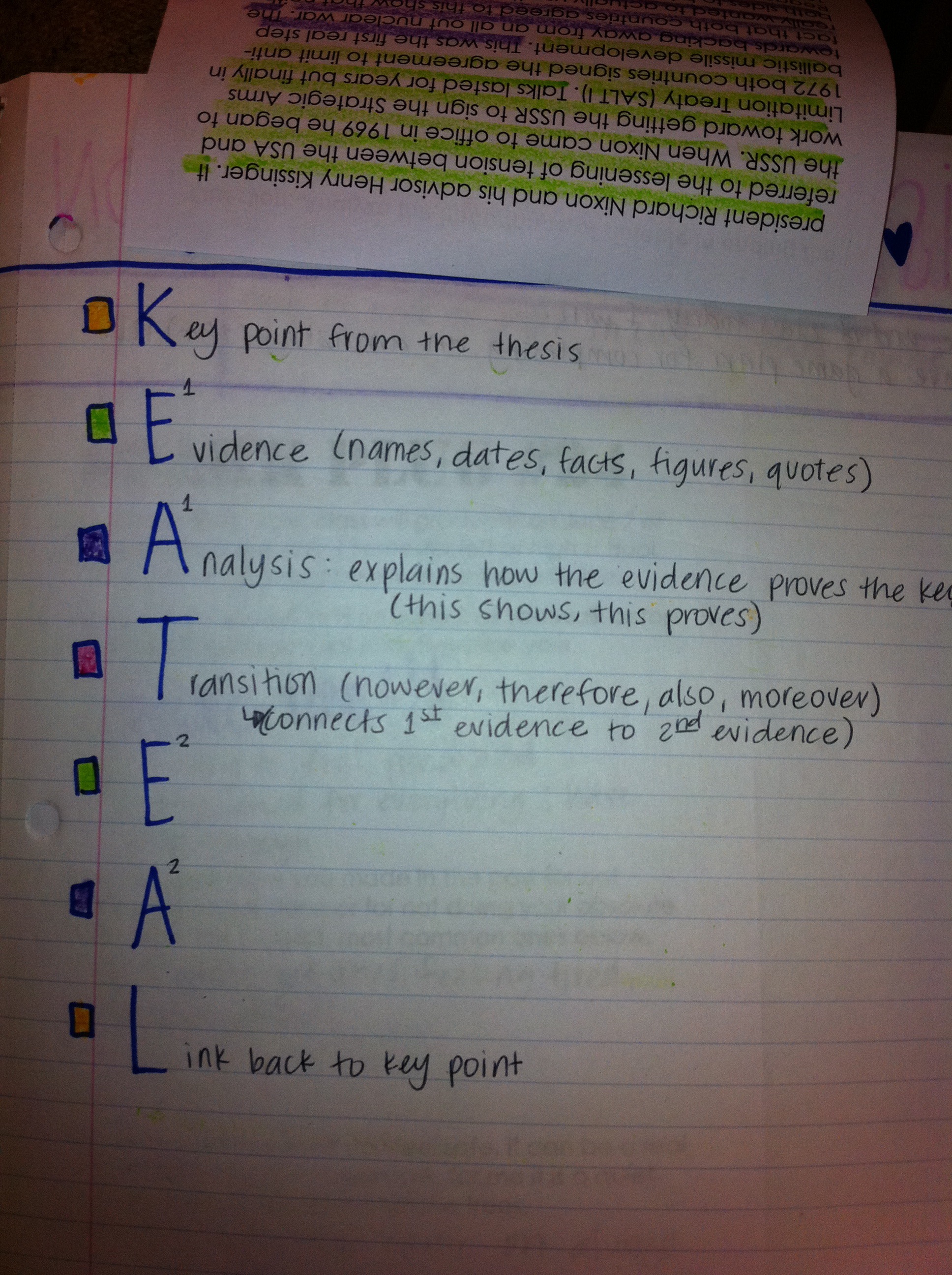
KEATEAL

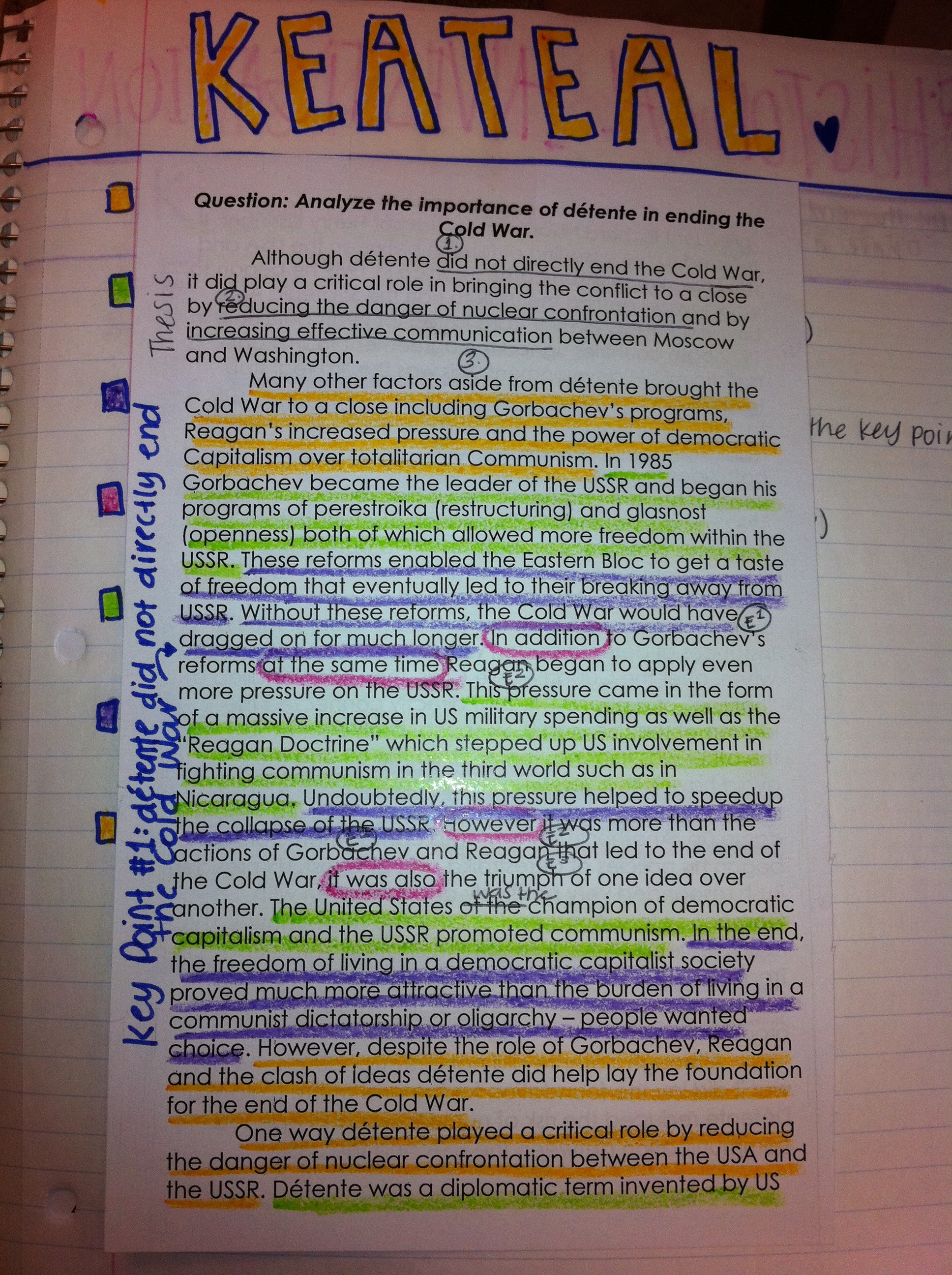
The KEATEAL lesson from one of my student’s interactive notebooks.

One of the most difficult but important skills we teach our students is how to write non-narrative prose. Crafting and defending an argument is an essential skill in many professions but for my first five years of teaching I put it aside in favor of teaching facts and multiple choice test taking tricks.

KEATEAL is one of the most helpful tools I’ve found for helping students write expository essays (shout out to Megan Lowe for introducing it to me – good teachers borrow, great teachers steal).

K – Key point from the thesis statement

E – Evidence (piece of evidence #1)

A – Analysis of the Evidence

T – Transition to piece of evidence #2

E – Evidence (piece of evidence #2)

A – Analysis of the Evidence

L – Link back to the thesis statement

I teach KEATEAL by introducing what the acronym means and then having my students read an essay I wrote about Lady Gaga answering the question: Was Lady Gaga “born that way?” (Born This Way is the title of one of her albums). Here is an example of a paragraph:

Thesis: Lady Gaga was not “born that way” instead she has purposefully spent years creating a “weird” image, her record company employs highly paid professionals who help work to create her image, and she earns millions for being a different, sensational performer.

K: Although she claims to have been “born that way” the strange fashion and behavior of Lady Gaga is actually something she has worked long and hard to create.

E: Stefani Germanotta grew up in a very strict Catholic School (where Ms. Garland’s brother-in-law went to school!) and so she felt the need to “break free” when she graduated. She became a dancer in the underground club scene in New York she adopted the name “Lady Gaga” from the Queen song Radio Ga Ga.

A: This shows that instead of being “born that way,” Lady Gaga took purposeful steps to escape her roots and make herself into something she was not.

T: In addition to changing her name, Lady Gaga has also create a narrative about her high school experience different from the story those who went to school with her tell.

E: High school friends report that she was “a good student” and had a “core group of friends” whereas Lady Gaga claims that although she was “very dedicated . . . studious” she “didn’t fit in” (Wikipedia).

A: This shows that Lady Gaga made up a story about her high school life that seemingly justifies her current image and provocative behavior.

L: Despite Lady Gaga’s claims that she was “born that way” she actually has re-written the story of her high school career as well as changed her name to literally become someone different.

Then I’ll have students color code an academic example of a KEATEAL essay such as the one below:

I have used this strategy successfully in both middle school and high school classrooms. What strategies do you use in your classroom to get your students doing non-fiction writing?


Top 10 Classroom Decor Tips

The ID (name, event, place from history) wall in my classroom spilling out of its butcher paper frame. Each color represents one unit.

1. Turn off the overhead florescent lights: I am a big fan of natural light (what IS it with schools being designed with minimal windows?! Energy efficiency? Re-use of prison blue-prints?) so I actually make it a point to go outside (weather permitting) and open my shades even if it means I have to close them back up when I want to use the projector. I also have several thrift store lamps I spray painted black so they all match and I use these in the corners on top of shelves. I also do a string of fairy-lights around a bulletin board and have one of those paper lanterns with the lightbulb kit. I have one student assigned to turn these on in the morning and another assigned to turn them off – because I would forget and leave them on all weekend/night.

2. Wallpaper the room with butcher paper: Depending on the type of wall material I use either a hot-glue gun on cinderblock or a stapler on drywall and literally go around the room and wallpaper it. This usually takes about 2 – 3 hours depending on the size of the room but it is SO SO worth it! I usually use light blue paper and creates an immediate effect on students when they walk in the room. It shows you care about the space, it makes the room more welcoming, it makes the room less like a cell and more like a place you (and students) might actually choose to be in.

3. Hang up actual art (not cheesy teacher kitch): Resist the urge to hang that motivational poster with the pedestrian nature scene and quote from dead president and instead pick up a giant poster calendar of your favorite artist’s work. I laminated a Frieda Kahlo calendar set seven years ago and have used it ever since – I never get sick of looking at her work (and I suspect my students don’t either).

4. Hang up paper lanterns: I buy a bunch of paper lanterns in different shades of green and blue (to match the butcher paper) and hang them using fishing wire. This so cheap, both in time and money, to do but it is the thing students notice first. It draws the eye vertical (not to get all decorator-y on you).

5. Buy a can of air refreshener OR a reed diffuser OR a bunch of dried eucalyptus branches: Teachers should engage all of their students’ senses. And let’s be honest – sometimes children stink.

6. Ditch your desk: I have found the traditional behemoth-ish teacher desk to just take of valuable space in an already cramped room. Plus, how often do you actually sit down at it? Get rid of it altogether or push it flush against a wall and use it as a table with handy storage space below. I use a smallish round table as a desk where I can both conference with students and parents as well as work during my planning period.

7. Cut out huge letters to spell your classroom motto across the top of your room: The top three feet of space around the room beneath the ceiling are underused – why not use it to display your motto? I do not trace these letters out before hand. I put on You’ve Got Mail and I get my scissors and I cut. They are not perfect and it is OK. Better yet, get a kid to do it for you. When you’ve got your motto, use spray adhesive to glue it to the wall.

8. Use the space above the board in the front of the class to put information you want students to know by heart: I call this the “study while you space-out” area. All students zone out at some point and why not have information they need to know glued/taped to the space they will stare absently at? I have a row of presidents we’re memorizing, important dates, techniques to remember when writing essays . . . sure it sometimes has to be covered during a quiz or test but it works! Every year I have students comment on how there came a point on a test and they just remembered where the fact was on the wall in their mind and immediately wrote down the right answer.

9. Have a word/fact/etc. wall that builds over time: Word walls have the same effect as the tip above and they also allow students to see how their knowledge has build over time. I use a different color sentence strip for each unit and then by the end of the year we have visual record of what we have learned – one whole wall’s worth!

10. When you put up student work, put up everyone’s paper: This sends two messages 1) ooohh! she put up MY paper as well as 2) ahhh!!!! she put up MY paper. The teacher is not playing favorites and if a student produces crap it will be displayed publicly. Also, I only do this with work that does not include a grade directly on the paper itself (so no 100% or 55% in glaring red staring off the wall).

Do you have some excellent classroom decor advice? Share the goods – leave it in a comment.

A little RESPECT

Image

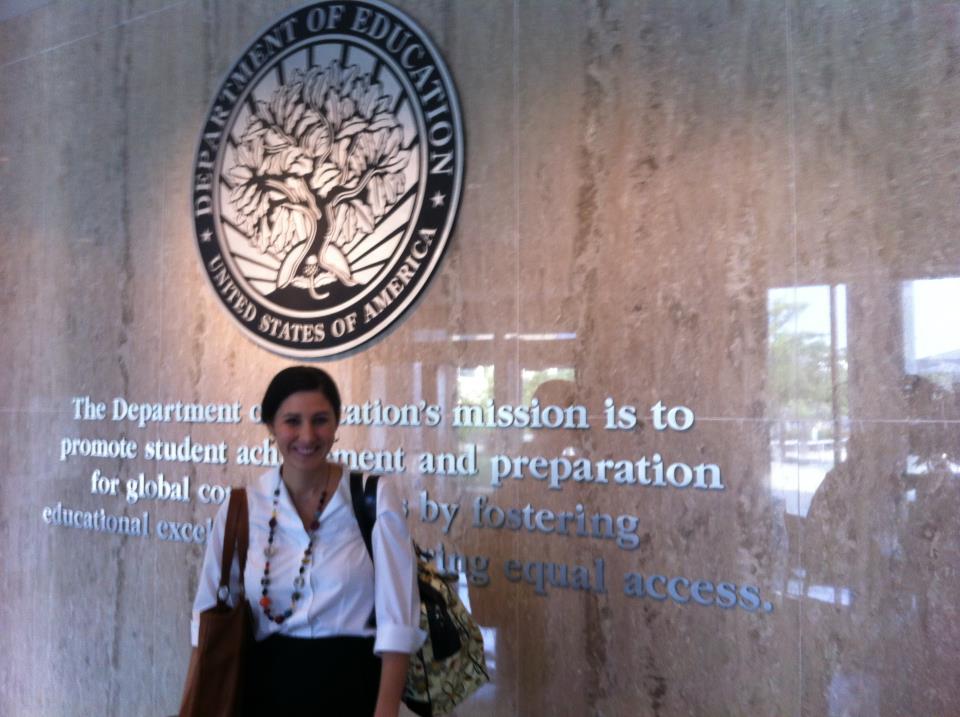
Super grainy photo of me at the Department of Ed (Photo Credit: a really nice security guard who said “Do you want to take another next to the Secretary’s picture?”)

Yesterday I spent the day with teacher leaders from around the country discussing the Department of Education’s initiative called the RESPECT project. The goal is to elevate the teaching profession by completely re-envisioning what it would look like to become, be and remain a teacher in the US. The project is still in its formative stages and today was about getting various groups (including the AFT, NEA, TFA, E4E, and the organization I represented the America Achieves fellowship) together to give feedback on the project’s draft vision statement. The draft is still under wraps  can be read here and the Department of Ed is planning more feedback sessions in the future. If you just want a quick overview, here are a few highlights:

  • reorganized classrooms that move away from a closed door and rows of desks to include open classrooms, integrated technology and schools defined by teacher collaboration
  • an extended school year and day that allows teachers greater flexibility for working with students, planning lessons and collaborating with peers (this also included ideas like moving away from age-based grade levels, hybrid teaching positions with lots of release time, and off-school-site learning)
  • distributed leadership (shared administrative responsibility between principals and lead teachers)
  • teaching career pathways that start out with a Residency (like doctor’s do) and end up with Master Teacher positions where teachers make up to $150,000

Sounds good right? But if you’re any thing like me distributed leadership, hybrid positions and $150,000 salaries seem like pie-in-the-sky. That being said I left the meeting feeling really hopeful that before I retire I might seem some of these changes become reality. There is no question teachers have a public perception problem in this country and unfortunately the effects of that are evident in the achievement gap and under-achieving classrooms. However, one of the biggest messages of the day was that if the teaching profession is going to be overhauled it is going to be done by teachers. As Secretary Duncan said, “The Federal government did not start the Civil Rights movement.”

Economic Integration in Our Schools

I have spent most of my career at IDEA Public Schools where I have had some really amazing colleagues, students and friends. At IDEA College Prep in Donna, Texas over 80% of students receive free or reduced-price lunch. I am committed to a career of serving low-income communities in South Texas but I always wondered what it might look like if there were more economic diversity among my students. At IDEA, 100% of our students have gone on to matriculate to a four-year university and I know many of them have struggled with the class differences between themselves and their peers – perhaps even more so than the racial differences.

My incredible sister-in-law, Sarah Garland, has written a really provocative and interesting article for The Atlantic  about the significance of increased economic integration in schools. It is well-worth the read!

“Faceboard”

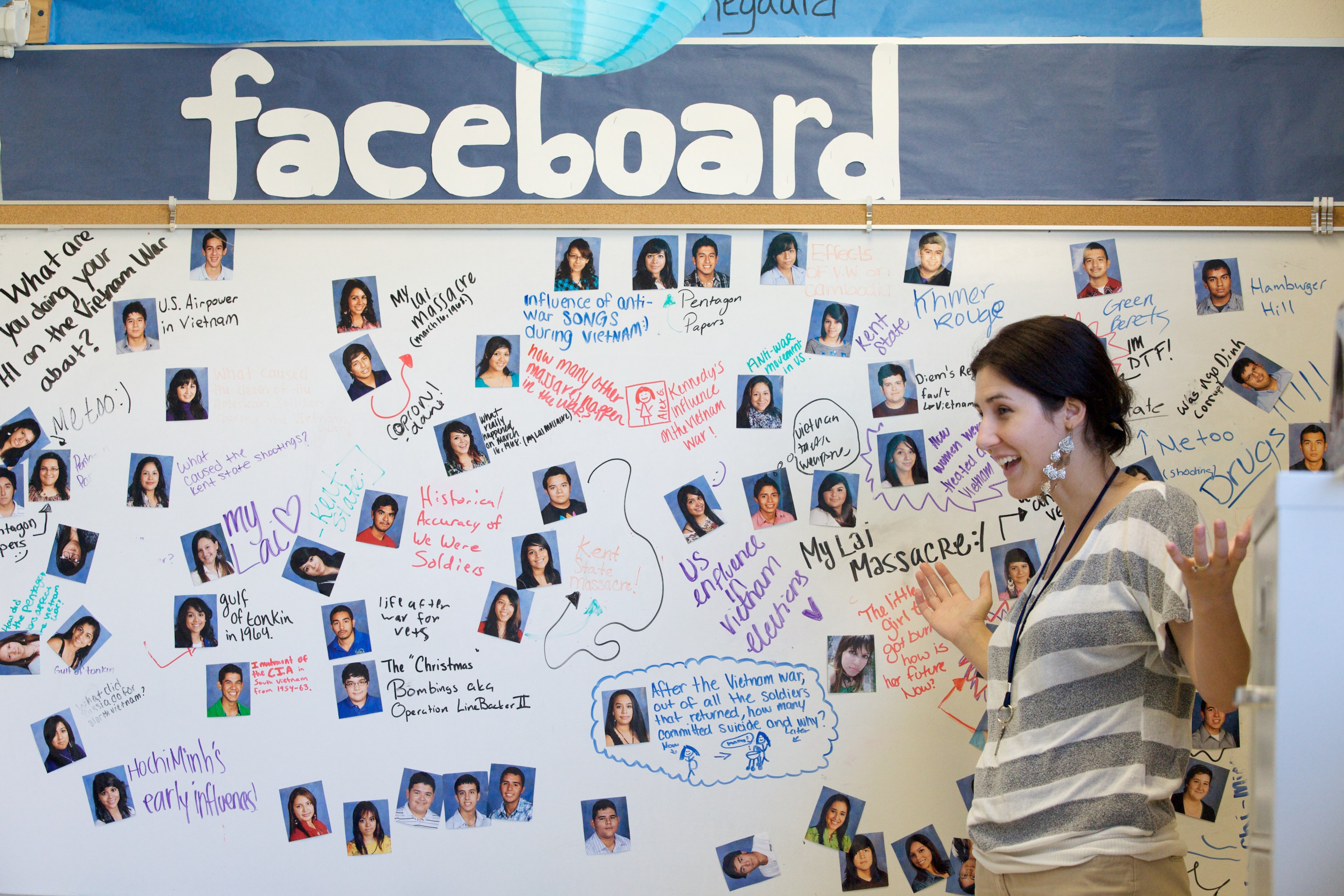
Faceboard set up for students to share their research topics and find others writing similar papers.

For the past several years I have dedicated one of the white boards in my classroom as our class Faceboard. At the beginning of the year I download picture of each student from my schools’ attendance/grades program. I print these out digitally at our local drug store and then crop them to identical squares. I stick a strip of magnetic tape on the back of each and then put them all on the Faceboard. I then use the board to track student progress on big projects (they move their picture as they complete various phases), to schedule student conferences (I put a blank schedule up and students sign up by moving their picture to the time slot they want), have students express their opinion (yes-no spectrums, four corner opinion grids, or even simple written comments), or as a place for them to collaborate on group projects.

Despite the low-tech nature of Faceboard, students really dig it. They love the ironic connection to the social media site they live on and they are always eager to participate when we use it in class. One note of caution: some students really freak out about having their school picture posted for all to see. I allow them to bring in another picture of their choice and, as long as it is appropriate, crop it to size and replace the original picture.

Teaching Rocks My Face Off

2012 IDEA Donna Graduation

Me excited to be at my students’ graduation on June 7, 2012

I love teaching. I have found my biggest professional gains come when I get out of my classroom and fight the isolation that sometimes comes with this profession. This blog is one way I am hoping to breakdown some walls and learn/share/collaborate more around a truly noble profession.