The Best Review Game of All Time

Although there are many elaborate review games out there I only use one – I call it The Game. I did not invent it however I have modified it over the years to be something that works for many grade levels, many contents and many situations. Students always, always love it. The only downside is that it can get so loud your colleagues will wonder what the heck is going on in your room.

Equipment Needed:

  • a small whiteboard for each row in your classroom (like the kind commonly used in math classes)
  • dry erase markers
  • a roll of paper towels to use as cheap-o erasers

The Game:

Teams sit in the same rows (from front of the room to back of the room) and come up with a name for themselves. I give them 90 seconds to think of a name and if they fail to do so or if the name is inappropriate I give them a name (the “electric pink chipmunk eaters” or the “puking pigeons” etc.). Write each team name on the front board and keep a running tally of points under each name. The whiteboards, markers and paper towels are then passed to the very back of the room and held by the last person in each team’s row.

You ask a question and the teams race to write a legible answer on their whiteboards and then pass them to the front of the room. The students in the first row hold up their team’s answer. Anyone on the team can write the answer, not just the last person. So if the last person doesn’t know they just pass the whiteboard up to the teammate that remembers the answer. Two points for the first team with the correct answer at the front and one point for each correct answer that isn’t first to the front. After each questions students move up a desk so that students are constantly on the move both by having to pass the whiteboard and switch desks after each question. This is the beauty of The Game – forced engagement and physical activity.

A few tips: Have students practice with a couple of questions before you start keeping score. This allows them to get the swing of things in a low pressure context. Take off points for trash-talking classmates as well as arguing with you about who was first or legibility issues, etc.

Any other review games folks like to use?

Classroom Management & Kohlberg’s Stages of Moral Development

I read Rafe Esquith’s There Are No Shortcuts and, after getting over my feelings of crushing inadequacy, came away compelled with the need to teach character in my classroom. Rafe uses Kohlberg’s Theory of Moral Development to help children self-identify their current behavioral standards and then seek to grow from that point.

This blew my mind. We differentiate for things like reading levels, learning differences, and the ability to speak English – why not differentiate for students’ level of moral development? I began teaching these stages to my students through content lessons (ex. read historical sources and identify the level of Kohlbergs for each author) and posting them in my class along with the question “Are you moving up?”

This was so helpful for having discipline discussions with students: “So what level were you operating on when you foraged your parents signature on this grade report?” Below are the more student-friendly stage names I used in my classroom (in descending, rather than ascending order like the chart above):

I found it helpful to actually go through my lists of students after about the third or fourth week of school and identify where I though each student was operating. This was really helpful in knowing how to respond to students in terms of motivating them not only to behave but to do their homework, participate and achieve all-around in my classroom. A student who is operating at the Premoral Level (punishments and rewards) is simply not going to be compelled by my Don’t-You-Just-LOVE-History-And-Isn’t-It-Fascinating-And-Great tactics. I need to provide them with various, tangible incentives and, when those don’t work, consequences because that is what they need. It is what is appropriate for them at that moment.

The chart below describes a persons view of others as well as perspective on society at each level:

A word of caution: it is not enough to simply diagnose students’ moral development levels but we also need to help them grow. Key ways to do this are to help students self-identify, to frequently provide them with examples (historical, living and fictional) of people operating at various levels, and to show them the benefits of operating at higher levels (both personally and to our communities). Try bringing the language of Kohlberg in to your classroom and see how your students begin to conceptualize and think holistically about their behavior.

Anyone else use Kohlberg’s Level and have tips for helping students grow?

Tagged

Ms. Corroy’s Classroom

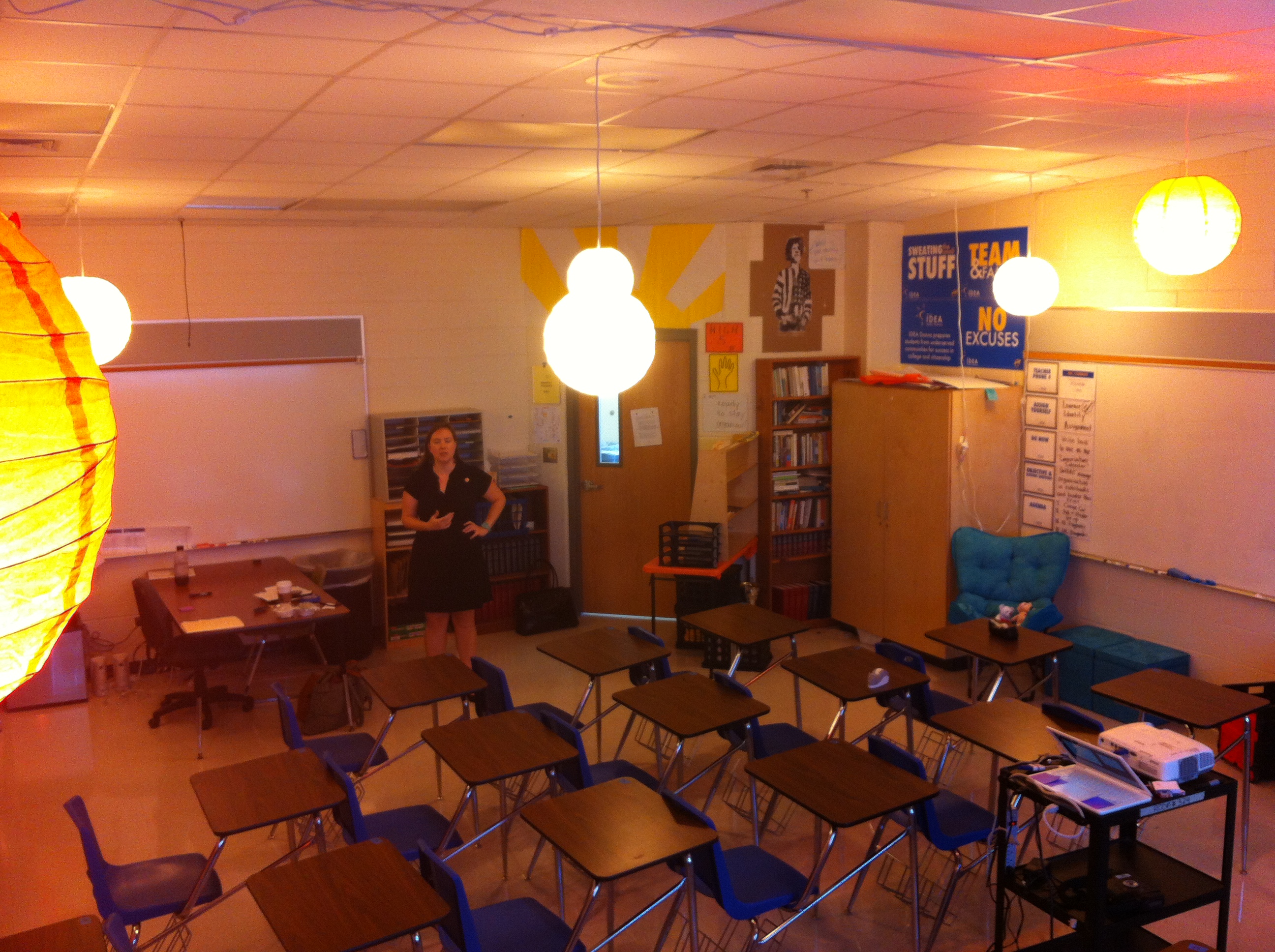
Today’s post kicks-off The Sacred Profession’s weekly classroom tour. Each week I will post an interview with and a photo tour of an awesome teacher’s classroom. To start the series off, we’ve got a teacher who I’ve written about before – Ms. Corroy. To you faithful readers (a.k.a. my mother . . . maybe?) who are wondering if I’m obsessed with Jenny let me be clear: I’m not obsessed with Jenny, I’m enamoured with her.

Ms. Corroy welcomes you to her classroom!

Where do you teach? IDEA Donna College Preparatory in Donna, Texas

Who are your students? My students are 12th graders in their second year of the IB Diploma Programme. They are predominately lower-income, Hispanic students living in the Rio Grande Valley.

What do you teach? Language A English at the Higher Level (an advanced English Literature course)

“Rocking the paper lanters WITH lights in them as well! I haven’t turned my overhead lights on yet this year. It seems dark but actually you get used to the light pretty quickly and students can clearly see. It also casts a nice sun-set glow on everyone in the room.”

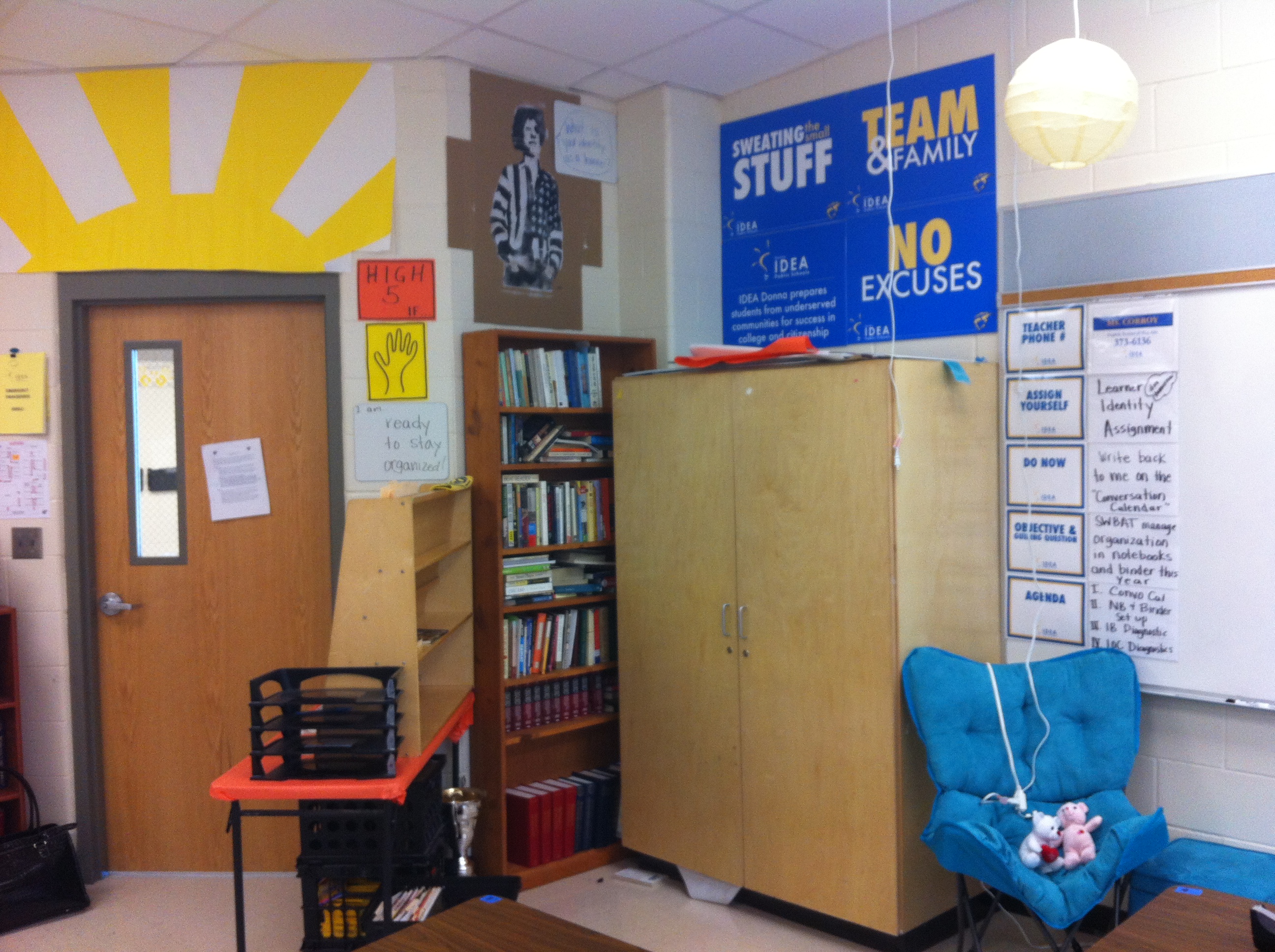
“This is the entrance to the room. The sunburst above the door represents the four major assessments my students will take this year. Every time they complete an exam I will have them place a sticker of their choice on the sunburst thus marking our progress towards earning college credit. Last year, I cut this up into little pieces and framed one for each of my students; some even took it with them to college! Notice the print of Abbie Hoffman above my classroom library – it was made by one of my students last year and says “What is your identity as a learner?” Students pick up papers at the table to the right of the door as they come in.”

“On top of one of my shelves I have a “Shrine to Myself” with my diplomas, certifications, awards, and other special items – like the Wisconsin Badger. This shows students how seriously I take teaching as well as revealing a little of who I am personally.”

Describe your teaching style in one word. Responsive

What is your go-to literacy strategy? Color-marking a text to annotate it

How do you motivate your students? (see below)

“This is a get-to-know-you strategy I use at the beginning of the year. Students write whatever they want for me to read in the top boxes and I write back to them in the bottom box. They ask me random questions, I ask them questions, and we get to know each other on a low-risk yet one-on-one basis without spending too much time outside of class.”

“Every day as students leave my classroom they give a high-five to the yellow hand if they ____. Today it was “I am ready to stay organized” and everyday I change what is written on the white board below the yellow hand. This is a fun way to sometimes check for understand as well as give a last minute reminder as students leave the classroom.”

What is your favorite way to check for understanding? Fist-to-five to gauge reaction. I like it because I can see the spread of responses and quickly differentiate. I often use this to allow students to self-identify the level of support they need from me.

“I put one of those book display shelves for elementary classes on top of a table to make the station where students grab papers everyday. I also posted reminders so that if they’ve forgotten something they can run to their locker quickly before class begins. Notice the continuation of my orange and yellow color scheme . . . as well as my class slogans. Independence of thought, analysis of literature, precision of language.”

Keeping Up with Education News

In my first five years as a teacher I essentially did not read about education news, follow education policy issues or, let’s be honest, think beyond the four walls in my own classroom. Here are my personal go-to sources for the latest scoop on education issues:

  • Accomplished Teacher: This is a virtual news brief that gets delivered everyday via email. It is basically a compilation of articles from various websites, publications and blogs all dealing with education. I like Accomplished Teacher because I can skim this email and get the headlines and summaries of major/current education news.
  • The Huffington Post’s education page: A grab bag but easy and quick to read. I like the posts from actual teachers about education issues.
  • The New York Times education page: There are often interesting stories about education research and studies here – plus it’s the New York Times.
  • Education Week: I remember being told by a 20+ year veteran teacher that I had “a professional obligation” to read Education Week. I particularly like the Teacher page which highlights news for teachers. They also put out a nice newsletter that has article briefs for quick reading.

So I realize that is only 4 sources . . . but teachers are busy! Add to this NPR (on the ride to/from work), the McAllen Monitor, the New Yorker and Texas Monthly and you have pretty complete picture of my information sources.

Where do you get your ed news from?

Great Books: When Kids Can’t Read

If you haven’t read When Kids Can’t Read by Kylene Beers, here are five reasons not only to kiss a copy but to crack it open and have a look:

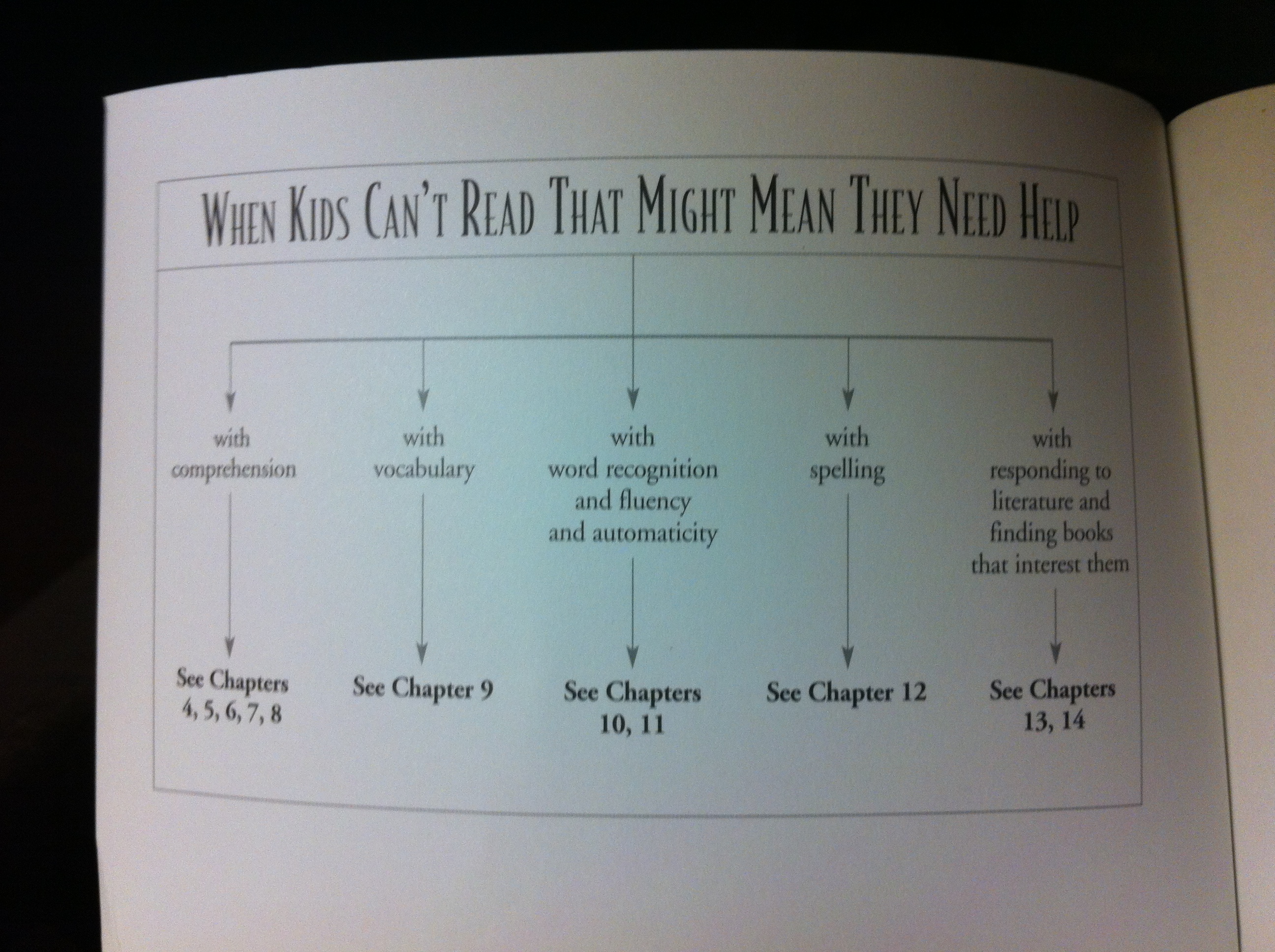
  1. It has a cheat-sheet inside the front cover so you don’t have to read it all: If you’re anything like me, sometimes you freak out because you teach 12th grade and one of your students appears to actually not be able to comprehend what he/she reads. Never fear! Simply use the handy little flowchart at the front of the book (see below) and turn to the chapter you need.
  2. There is an amazing, mind-blowing chapter called “Creating the Confidence to Respond” that changed the way I teach: This chapter speaks to how students perceptions and attitudes around reading often hold them back as much as (or more than) actual lack of literacy skills. The capter is filled with practical strategies like ensuring students know each others names and ways to celebrate diversity. These ideas built student confidence in my classroom both in terms of reading AND overall academic ability.
  3. Bookmark Templates: One of the golden ideas from the book is to have students read with an accordion folded bookmark (see below) and make notes on various topics as they read. There are different types of bookmarks – a great one is “Mark the Bold” where students write down the bold terms in a textbook thus assembling a vocabulary list all in one place.
  4. Amazing, student-friendly, diverse and gripping book lists: In the book’s appendix there is a collection of book lists under categories like “Humor and Laughter,” “Biographic, Autobiographic and Historical Fiction,” and “Realistic Fiction.” The author has assembled a really compelling list of books that I have found super helpful over the years.
  5. Get a crash corse in literacy: In a perfect word, all teachers would get masters degrees in literacy (or have a literacy specialist working alongside them in their classrooms – holla!!). However, if you find yourself lacking in literacy skills this book is great. There are clear definitions of literacy jargon like fluency, automaticity and comprehension as well as tools like basic reading level tests.

Anyone else love this book?


The Tome (Interactive Notebooks)

I could not teach without The Tome. If you have had me as your teacher in the past 8 years you have been subjected to making one of these monsters and are a better person for it (right?!). I certainly did not invent this idea (could it have been TCI, the History Alive! people? that is where I learned about it . . .). Here is the gist: every student has a three subject, college ruled 5 Star (or other high quality) notebook. Within the first week of school we number all of the notebook’s pages and then take notes, record individual reflections, and keep track of papers in a prescribed, highly organized way as a class. Most often, notebooks are set out like so:

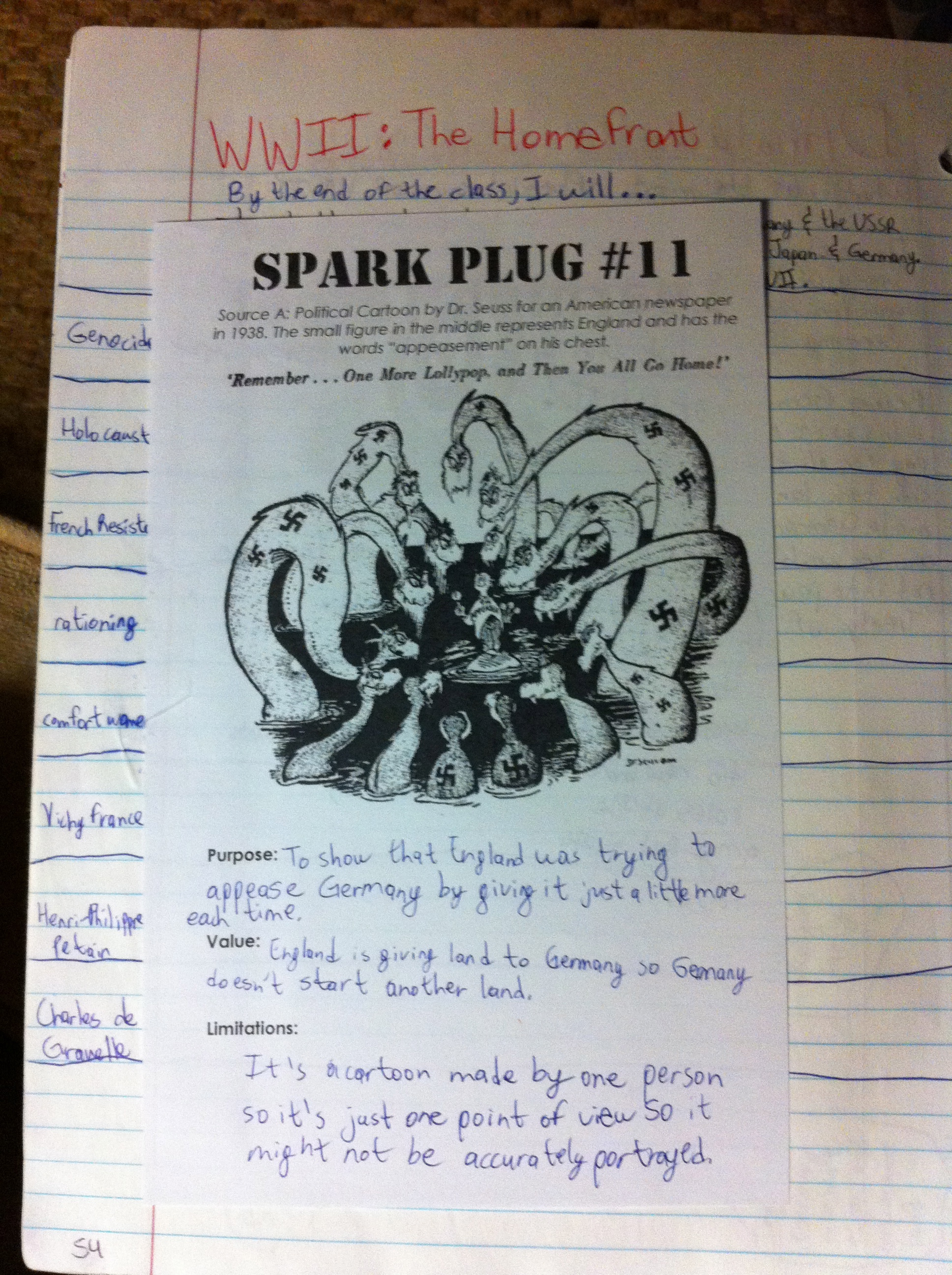
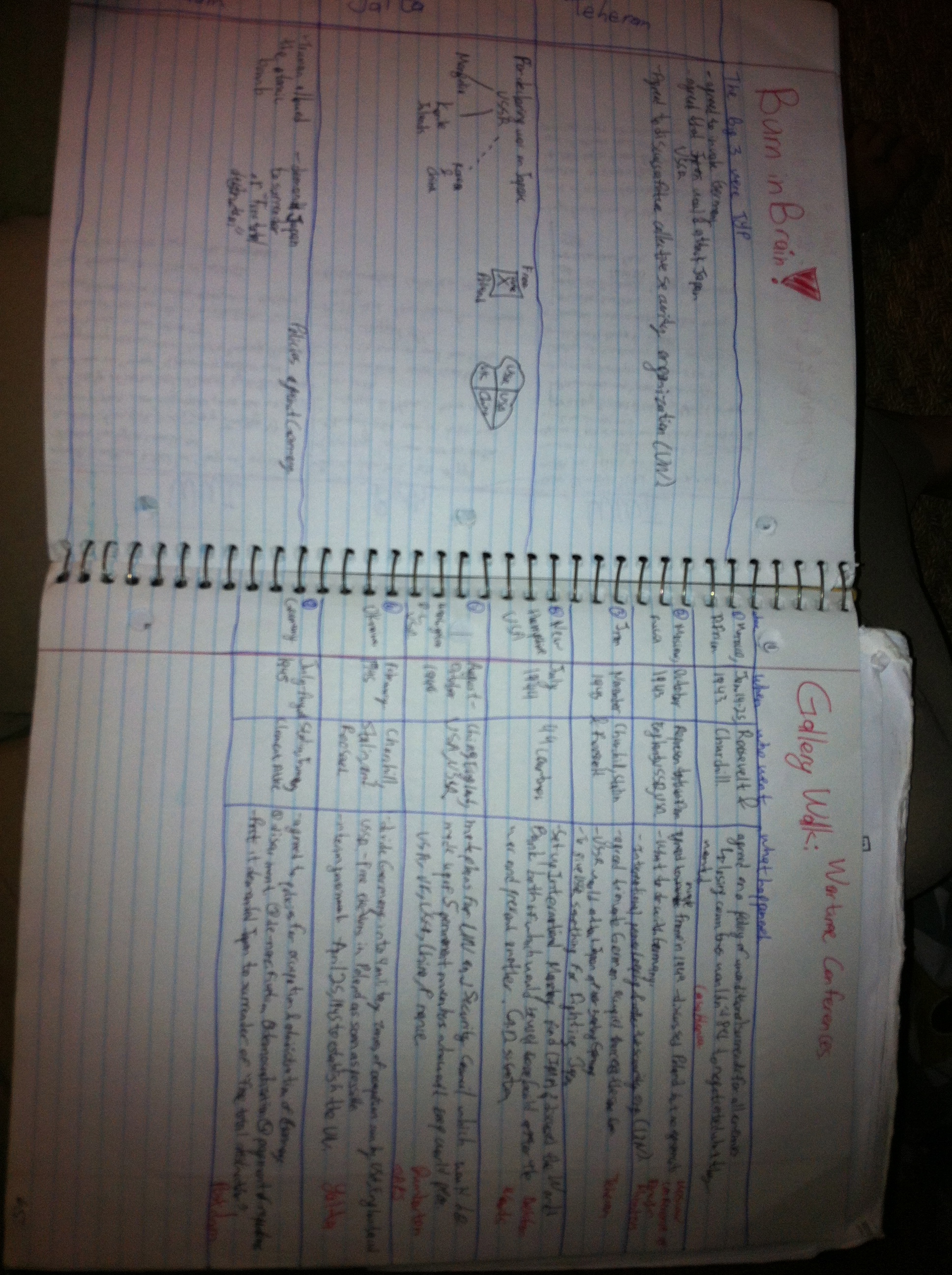
I actually tape in a 1/2 sheet of paper with the Do Now (which I call a Spark Plug) on the front and the Exit Ticket on the back (Spark Plug). Notes can look like this with a Gallery Walk on the Right and a Burn in Brain reflection on the left:

There are many excellent instructions for using interactive notebooks in your classroom out there (here is the History Alive! video promo, a nice book I’ve seen with a middle school science angle, and a book on interactive notebooks and ELLs). I’ve also put together some instructions that explain how I have used it before in my World History class (Instructions for The Tome). If you want to give interactive notebooks a shot in your classroom, here are some tips/ideas that have come from learning it the hard way:

  1. Give it a cool name: Students don’t love the term “interactive notebook” – so go with “The Tome” or “My Best Friend” all of which I have used at one point or another. Not only is it more fun, I love to hear students say “Do we need our Best Friends in class today?” Always, dear student, always.
  2. Use it daily and build really tight classroom procedures around it: This should not be a time waster. I have made students practice gluing images into their Tomes (in what Melissa Barkin calls “the X maneuver” which involves an X of glue, no more). They may only use a thumb’s length of tape. Each group has a labeled basket with supplies that take 10 seconds to go an get, another 60 to use and then another 10 to put back; done and done. While it is nice for students to take their time and make the notebooks as creative and beautiful as possible, extra decoration (i.e. drawing, coloring, gluing scrapbooking materials in, adding glitter, drawing intricate museum-worthy work, spraying on perfume so “it smells nice,” etc.) should happen outside of class time.
  3. Notebooks are better than binders: Papers fall out of binders but stay in notebooks. I recommend having labeled binders in class with tests, papers, homework, tracking, etc. that never leave the room and then having your Tomes come in and out of class each day. If students do not want to keep up with them designate a “parking lot” shelf where they can leave them. However, do not take responsibility for what happens in the parking lot. If they are stolen or messed with – too bad.
  4. Grade those notebooks: Nothing says “This is important” like making it be a grade. I grade notebooks every 3 to 6 weeks depending on the age of the students. The first check should come within the first week (this is just a do you have it check) and then a check to make sure students are following procedures comes two weeks later. Here is the form I’ve over the years: Tome Evaluation Here also are some student instructions for setting things up: Cover instructions for TomeTome Into and Setup Note: I don’t grade notebooks for seniors and only grade juniors for 1/2 the year.
  5. Invest students in the notebooks: Have a cover decorating contest within the first week. Provide clear packing tape for students to cover over their designs (this is like laminating them). Give students extra credit if they add color or make their notebooks particularly creative. Also, make them super useful and integrated into your class. Take notes in them every day. Reference them in class (“If you look back on page 147 you’ll see we talked about __”) On the back cover tape critical information so students have quick reference in your class (see below).


Creating the Conditions for Authentic Learning

Much has been written about the connection between authentic learning and self-actualization. A great way to ensure you are an effective teacher is to think about your classroom through the lens of Maslow’s Hierarchy of Needs.

Here are some ideas for meeting your students’ needs at each level in order to ensure they are able to access self-actualization and, ultimately, long-lasting learning.

  • Physiological Needs: For those of us who teach in under-served schools, these needs can be pressing. Ideally teachers are working with Social Workers and/or school councilors to help students and their families access resources. Unfortunately, teachers often need to teach students who are operating at the basic survival level with some critical needs going unmet. Keeping food in the classroom, getting to know parents through home visits or phone calls, building relationships with students so you know when they have needs, and working with community partners (like clinics or food banks) can be ways to ensure these needs are met.
  • Safety: A critical component to safety is strong classroom management founded on a few principles (such as respect, responsibility and responsiveness). Hold students accountable to your rules and do not be afraid to give consequences with your expectations for behavior are breeched. It should be very clear what can and cannot happen in your classroom. When students know what to expect, they can relax and begin to access the more developed parts of their brain (which, lord knows, they find difficult enough).
  • Social Needs: The two key aspects here are student-teacher relationships and student-student relationships within the class. As the teacher our job is to make sure both types of relationships are strong. Get to know your students via one-on-one conferences, student surveys, home visits, and quick conversations in the hallway (I like to stand at my door and shake hands with every student as they enter). Likewise, students should know their teachers – show pictures of your family, play music you like, casually and quickly mention aspects from your life without going down a rabbit trail (“So Hamlet is clearly embarrassed here – just like I was when, in 10th grade, the guy I had a crush on read my diary. Yes, that happened. No, we are not going to talk about it. Let’s keep reading at line 342 . . .”). Also, help students to get to know each other by regularly providing opportunities for them to meet new people in the classroom (switch up seats, partners, etc.) and talk briefly about non-academic topics. I like to give students 1 minute to discuss the worst movie ever or their favorite song or TV show before they dive into the academic task when working with partners. In one of the most difficult classes I ever taught, I spent 5 minutes after the Do Now activity playing some kind of ice-breaker game every single day. The goal is to make the class feel like a special club with inside jokes and traditions and funny stories that cement it together.
  • Esteem: Celebrate not only academic achievement (the A grades) but also academic improvement. Have students track their progress either by objective mastery or skills acquisition (ex. improved performance on a writing rubric) and celebrate when there is growth. This could look like putting stickers on a chart, one-on-one conferences where you go over student’s tracking tool, or a weekly ceremony where you play “We are the champions” turn on a strobe light and have students who have improved soul train down the center of the class to celebrate. Another way to do this is to celebrate collective achievement. Track the average grades of your class and post them publicly. Celebrate when there is real improvement and growth from one assessment to the next.
  • Self-Actualization: This is the tier where learning happens. However, if you read the descriptors on the pyramid – creativity, problem-solving, authenticity, spontaneity – it doesn’t exactly describe the high stakes tests our students must take or the traditional everyone-in-rows-now-listen-to-me-talk model of teaching. It is so important to provide learner centered lessons as well as authentic assessments for our students even if we also have to get them ready for an exam.
Tagged , ,

Hot Cheetos & Takis

An ode to the ubiquitous, absolutely all over my school and neighborhood (but not my classroom!) snacks. Also a really stinkin’ catchy song. What teacher can’t see their students in these ridiculously cute, if not nutritionally sound, children? “Got my hands stained red and I can not get it off . . .”

Keeping it Civil: Tips for In-Class Discussions


One of my favorite quotes about the importance of education is:

“If a nation expects to be ignorant & free, in a state of civilisation, it expects what never was & never will be.” – Thomas Jefferson

Jefferson envisioned that public schools would be the means of educating “common people” about issues and the mechanisms of our republic as the means of “safe-guarding democracy.” Despite his elitist tone, I think he was right. In addition to social studies and civics courses our students also need to learn the skill of civil discussion about any topic. Regardless of where you stand politically, I think we can agree our public discourse has taken a turn for the worse (Todd Akin or Joe Biden anyone?). Even if this is an election year slump in civility, most students would benefit from a little extra training on how to speak their opinions with grace as well as substance. Here are five tips for running discussion in your classroom:

  1. Show students an example of what you expect in a class conversation BEFORE your first conversation: Teach a mini-lesson classroom discussion that includes an actual example. A great way to do this is to call 4 – 6 students in after/before school or during lunch and prep them on the norms you’d like to see in class discussions. Then have them talk about a non-academic topic as they model the norms of discussion (ex. Team Jacob v. Team Edward, best movie of the summer, best olympic sport, etc.). It might even be helpful to script a few “breeches” where a student yells, or interrupts, or doesn’t use an I statement, or makes an unsubstantiated claim, etc. so you can point it out to the class. Keep their discussion under 4 minutes or so and then show the clip in class when you teach the procedure for in-class discussions.
  2. Post norms for discussion on your wall: These could include 3 – 5 statements like “Respectfully disagree” or “Use I-statements” or “Back up your opinions with evidence” or “Listen carefully to the speaker and do not interrupt.” Whatever norms you decide on make sure you explain what they mean to your students. Here are my Collegiate Discussion Guidelines
  3. Give students sentence stems to ease them into a discussion: I give my students a whole list of sentence stems like “I agree with __ and I’d like to add . . .” or “I disagree with _, I think . . .” or “If you look at the text on page _, it says __. This makes me think . . .” and have them either tape the sheet into their notebooks or directly on to the desk. This way students have a quick reference during a discussion.
  4. Have students prepare to speak before the discussion through writing: This seems obvious but I have found student participation soars if I have them come to a discussion with prepared statements. These could be questions they want to ask, quotes from our text they want to point out, or pre-written opinions they want to read. This gives students an automatic entry to the conversation.
  5. Hold students accountable for their contribution to the discussion: When I have a classroom discussion, I often use the Socratic Seminar format (where I do not speak at all) and have students grade each other (I use socratic seminar scoring guide). A great way to start this off is to do a “Fish Bowl” where 10 or so students who are more outspoken beginning the conversation. They sit in a circle of desks in the middle of the class while everyone else watches them. Let them talk for 10 minutes and then have them switch out with a new group. Letting the talkative crowd blaze the trail has the added advantage of removing them from the more reluctant speakers’ group later on. If there are no talkers in a smaller group eventually someone will speak up! Don’t be afraid to let silence hang in the air. Eventually, they will talk! Sometimes it takes a couple of attempts but it happens. My colleague Jenny Corroy has students who struggle with shyness work with a classmate. The classmate will ask the shy student a predetermined and practiced question in a way that allows them to naturally contribute to the discussion (what’s up college readiness?). You could also draw names to get students started or use a ball and have students throw from speaker to speaker (again, teach those norms!)

I have also incorporated silent signals into discussions (a hand-signal for questions, agreement and disagreement) which allows more participation from the class. What other ideas/resources do y’all have around class discussions?

Tagged

Great Books: The Skillful Teacher

I love The Skillful Teacher by  Jon Saphier et. al. so much it is difficult for me to be articulate. When asked why I love this book I sound like a 12 year-old talking about Justin Beber. This is my desert island teaching book (but then why would you read a book on teaching if you were stranded on a desert island without students, you ask . . . good question, I say, but I would STILL take The Skillful Teacher with me – it is THAT good). Aside from the thousands of teaching tips and tricks (which the book calls “moves and tools”) one of the most powerful aspects I learned from The Skillful Teacher is a framework for thinking about the discipline of teaching.

I have worked with a number of organizations that have attempted to spell out exactly what makes up good teaching through various rubrics. I am not a rubric hater, however the structure of a rubric places all of the various competencies (lesson planning and classroom management for example) on an equal level when the truth is a charismatic teacher who never, ever writes lesson plans can look pretty darn good on the surface. Management must be mastered to some degree before lesson planning can be effective. It was upon seeing the image below that I finally was able to visualize teaching.

I LOVE how this pyramid begins with a foundation of teacher beliefs. The Skillful Teacher describes 7 key beliefs teachers must have in order to be successful. Below are some of my favorites as quoted from The Skillful Teacher:

  • “You can get smart” Children’s learning is primarily determined by their effective effort and use of appropriate strategies. “Intelligence ” is not a fixed inborn limit on learning capacity. All children have the raw material to do rigorous academic material at high standards.
  • Learning varies with the degree to which learners’ needs for inclusion, influence, competence, and confidence are met.
  • The knowledge bases of a professional teacher are many, diverse and complex; and skillful teaching requires systematic and continual study of these knowledge bases.
  • The total environment of a school has a powerful effect on students’ learning.
  • Racism exerts a downward force on the achievement of students of color that must be met with active antiracist teaching.

In my experience, the more I deeply believe the above statements the more effective I am as a teacher. Without these essential beliefs I might be able to teach some kids sometimes on somedays but I will be far from reaching all of my students. Least I plummet further into pseudo-religious babble about the skillful teacher, I’m going to recommend to check out the The Skillful Teacher website and then check out a copy from your local library or have your school buy a copy for you.