Category Archives: Writing

Great Books: When Kids Can’t Read

If you haven’t read When Kids Can’t Read by Kylene Beers, here are five reasons not only to kiss a copy but to crack it open and have a look:

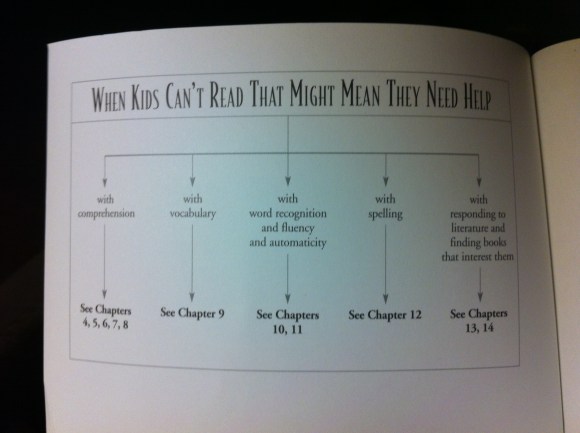
  1. It has a cheat-sheet inside the front cover so you don’t have to read it all: If you’re anything like me, sometimes you freak out because you teach 12th grade and one of your students appears to actually not be able to comprehend what he/she reads. Never fear! Simply use the handy little flowchart at the front of the book (see below) and turn to the chapter you need.
  2. There is an amazing, mind-blowing chapter called “Creating the Confidence to Respond” that changed the way I teach: This chapter speaks to how students perceptions and attitudes around reading often hold them back as much as (or more than) actual lack of literacy skills. The capter is filled with practical strategies like ensuring students know each others names and ways to celebrate diversity. These ideas built student confidence in my classroom both in terms of reading AND overall academic ability.
  3. Bookmark Templates: One of the golden ideas from the book is to have students read with an accordion folded bookmark (see below) and make notes on various topics as they read. There are different types of bookmarks – a great one is “Mark the Bold” where students write down the bold terms in a textbook thus assembling a vocabulary list all in one place.
  4. Amazing, student-friendly, diverse and gripping book lists: In the book’s appendix there is a collection of book lists under categories like “Humor and Laughter,” “Biographic, Autobiographic and Historical Fiction,” and “Realistic Fiction.” The author has assembled a really compelling list of books that I have found super helpful over the years.
  5. Get a crash corse in literacy: In a perfect word, all teachers would get masters degrees in literacy (or have a literacy specialist working alongside them in their classrooms – holla!!). However, if you find yourself lacking in literacy skills this book is great. There are clear definitions of literacy jargon like fluency, automaticity and comprehension as well as tools like basic reading level tests.
Anyone else love this book?


Keeping it Civil: Tips for In-Class Discussions


One of my favorite quotes about the importance of education is:

“If a nation expects to be ignorant & free, in a state of civilisation, it expects what never was & never will be.” – Thomas Jefferson

Jefferson envisioned that public schools would be the means of educating “common people” about issues and the mechanisms of our republic as the means of “safe-guarding democracy.” Despite his elitist tone, I think he was right. In addition to social studies and civics courses our students also need to learn the skill of civil discussion about any topic. Regardless of where you stand politically, I think we can agree our public discourse has taken a turn for the worse (Todd Akin or Joe Biden anyone?). Even if this is an election year slump in civility, most students would benefit from a little extra training on how to speak their opinions with grace as well as substance. Here are five tips for running discussion in your classroom:

  1. Show students an example of what you expect in a class conversation BEFORE your first conversation: Teach a mini-lesson classroom discussion that includes an actual example. A great way to do this is to call 4 – 6 students in after/before school or during lunch and prep them on the norms you’d like to see in class discussions. Then have them talk about a non-academic topic as they model the norms of discussion (ex. Team Jacob v. Team Edward, best movie of the summer, best olympic sport, etc.). It might even be helpful to script a few “breeches” where a student yells, or interrupts, or doesn’t use an I statement, or makes an unsubstantiated claim, etc. so you can point it out to the class. Keep their discussion under 4 minutes or so and then show the clip in class when you teach the procedure for in-class discussions.
  2. Post norms for discussion on your wall: These could include 3 – 5 statements like “Respectfully disagree” or “Use I-statements” or “Back up your opinions with evidence” or “Listen carefully to the speaker and do not interrupt.” Whatever norms you decide on make sure you explain what they mean to your students. Here are my Collegiate Discussion Guidelines
  3. Give students sentence stems to ease them into a discussion: I give my students a whole list of sentence stems like “I agree with __ and I’d like to add . . .” or “I disagree with _, I think . . .” or “If you look at the text on page _, it says __. This makes me think . . .” and have them either tape the sheet into their notebooks or directly on to the desk. This way students have a quick reference during a discussion.
  4. Have students prepare to speak before the discussion through writing: This seems obvious but I have found student participation soars if I have them come to a discussion with prepared statements. These could be questions they want to ask, quotes from our text they want to point out, or pre-written opinions they want to read. This gives students an automatic entry to the conversation.
  5. Hold students accountable for their contribution to the discussion: When I have a classroom discussion, I often use the Socratic Seminar format (where I do not speak at all) and have students grade each other (I use socratic seminar scoring guide). A great way to start this off is to do a “Fish Bowl” where 10 or so students who are more outspoken beginning the conversation. They sit in a circle of desks in the middle of the class while everyone else watches them. Let them talk for 10 minutes and then have them switch out with a new group. Letting the talkative crowd blaze the trail has the added advantage of removing them from the more reluctant speakers’ group later on. If there are no talkers in a smaller group eventually someone will speak up! Don’t be afraid to let silence hang in the air. Eventually, they will talk! Sometimes it takes a couple of attempts but it happens. My colleague Jenny Corroy has students who struggle with shyness work with a classmate. The classmate will ask the shy student a predetermined and practiced question in a way that allows them to naturally contribute to the discussion (what’s up college readiness?). You could also draw names to get students started or use a ball and have students throw from speaker to speaker (again, teach those norms!)

I have also incorporated silent signals into discussions (a hand-signal for questions, agreement and disagreement) which allows more participation from the class. What other ideas/resources do y’all have around class discussions?

Tagged

Current Events

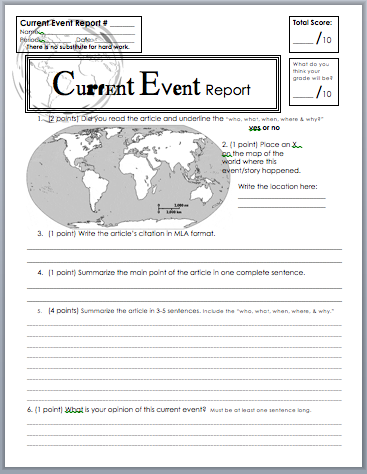
This is a Presidential election year and regardless of what you teach the press will be filled with articles, cartoons and analysis waiting for your students to read and think about critically. One great way to do this is to have you students do a current event every week. You certainly do not have to teach Social Studies to encourage your students to read the news – what about articles on science? Engineering? Climate change?

Many local newspapers have free or near-free subscription offers for schools. I often get a class set of 30 subscriptions and have students cut out (or print out) articles and attach them to the back of this form (Current Event Report form) in order to show that they annotated the article. Having a stack of newspapers is also a great enrichment tool for students who finish early.

Feeding Two Birds With One Hand: DBQ on Me


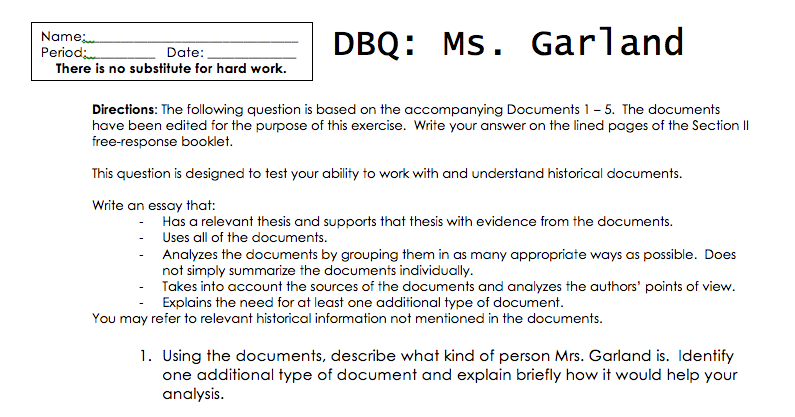
One of the tricky objectives to cover at the beginning of the year is to teach your students how to write content specific essays (ex. Document Based Questions (DBQs), Source Based Questions, Lab Reports, Personal Narratives, etc.) using texts from your content (primary sources, evidence gathered from a lab, fictional texts, etc.). My favorite way of introducing the format I want students to use is through a non-content related topic. For example, in my World History class students had to write essays (DBQs) using primary sources and so the first essay we tried was a DBQ on me that used primary sources not from history but from my own life. This serves the dual purpose of 1) teaching my students how to write using the correct format and 2) introducing more of myself to the class via an important academic skill – feeding two birds with one hand. I can uses the text to teach my students annotation and careful reading as well as the format I want them to use to write their essays. When we are finished, I show them an exemplar response I wrote and have them compare their essays to both the exemplar and to the official rubric we will use throughout the year.

I think this could easily be adapted for a science lab, poetry unit (write a biographical poem), or math paper. I know other teachers do similar lessons at the beginning of the year and I would love for people to share them out here . . . borrow and steal.

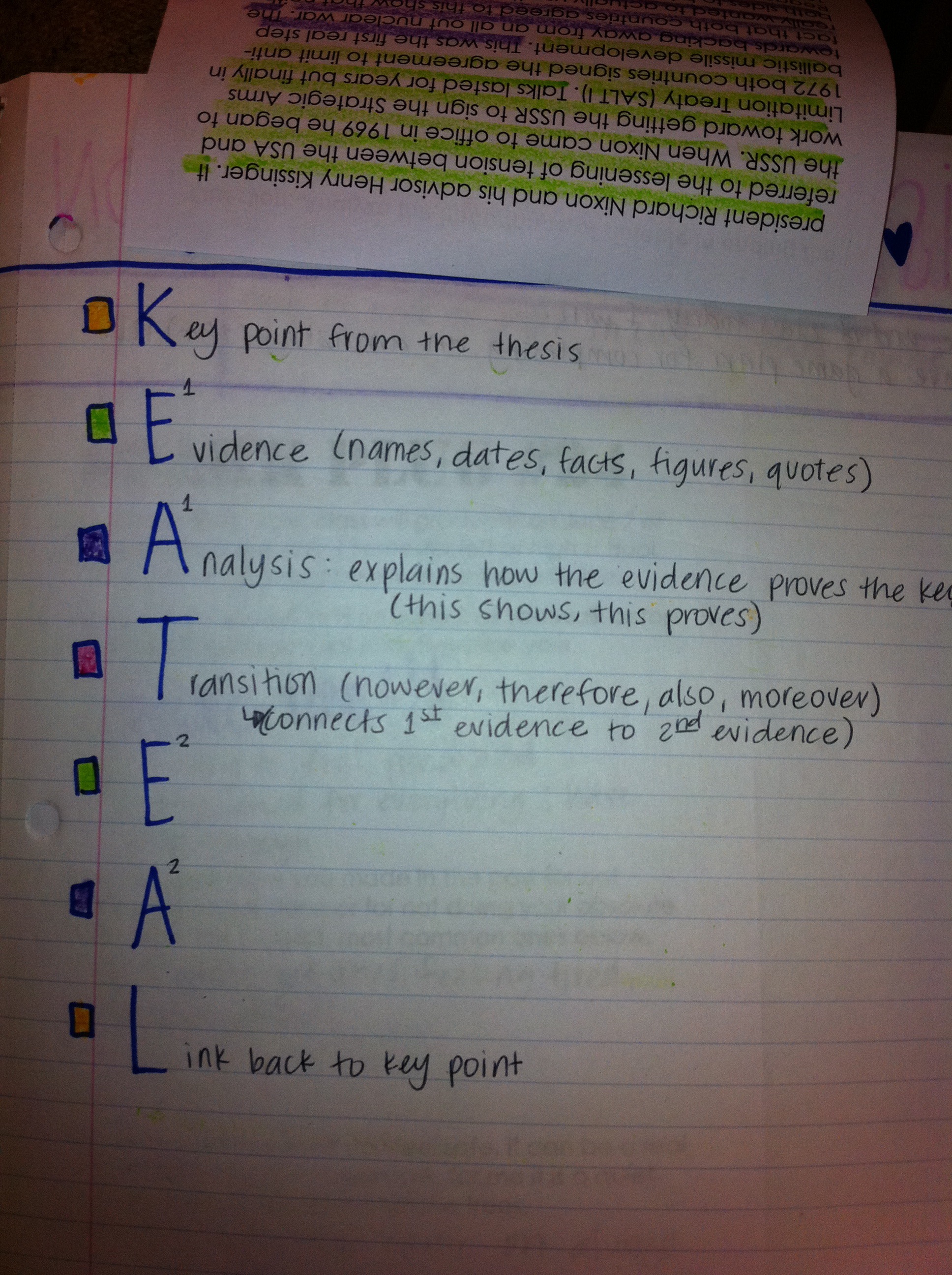
KEATEAL

The KEATEAL lesson from one of my student’s interactive notebooks.

One of the most difficult but important skills we teach our students is how to write non-narrative prose. Crafting and defending an argument is an essential skill in many professions but for my first five years of teaching I put it aside in favor of teaching facts and multiple choice test taking tricks.

KEATEAL is one of the most helpful tools I’ve found for helping students write expository essays (shout out to Megan Lowe for introducing it to me – good teachers borrow, great teachers steal).

K – Key point from the thesis statement

E – Evidence (piece of evidence #1)

A – Analysis of the Evidence

T – Transition to piece of evidence #2

E – Evidence (piece of evidence #2)

A – Analysis of the Evidence

L – Link back to the thesis statement

I teach KEATEAL by introducing what the acronym means and then having my students read an essay I wrote about Lady Gaga answering the question: Was Lady Gaga “born that way?” (Born This Way is the title of one of her albums). Here is an example of a paragraph:

Thesis: Lady Gaga was not “born that way” instead she has purposefully spent years creating a “weird” image, her record company employs highly paid professionals who help work to create her image, and she earns millions for being a different, sensational performer.

K: Although she claims to have been “born that way” the strange fashion and behavior of Lady Gaga is actually something she has worked long and hard to create.

E: Stefani Germanotta grew up in a very strict Catholic School (where Ms. Garland’s brother-in-law went to school!) and so she felt the need to “break free” when she graduated. She became a dancer in the underground club scene in New York she adopted the name “Lady Gaga” from the Queen song Radio Ga Ga.

A: This shows that instead of being “born that way,” Lady Gaga took purposeful steps to escape her roots and make herself into something she was not.

T: In addition to changing her name, Lady Gaga has also create a narrative about her high school experience different from the story those who went to school with her tell.

E: High school friends report that she was “a good student” and had a “core group of friends” whereas Lady Gaga claims that although she was “very dedicated . . . studious” she “didn’t fit in” (Wikipedia).

A: This shows that Lady Gaga made up a story about her high school life that seemingly justifies her current image and provocative behavior.

L: Despite Lady Gaga’s claims that she was “born that way” she actually has re-written the story of her high school career as well as changed her name to literally become someone different.

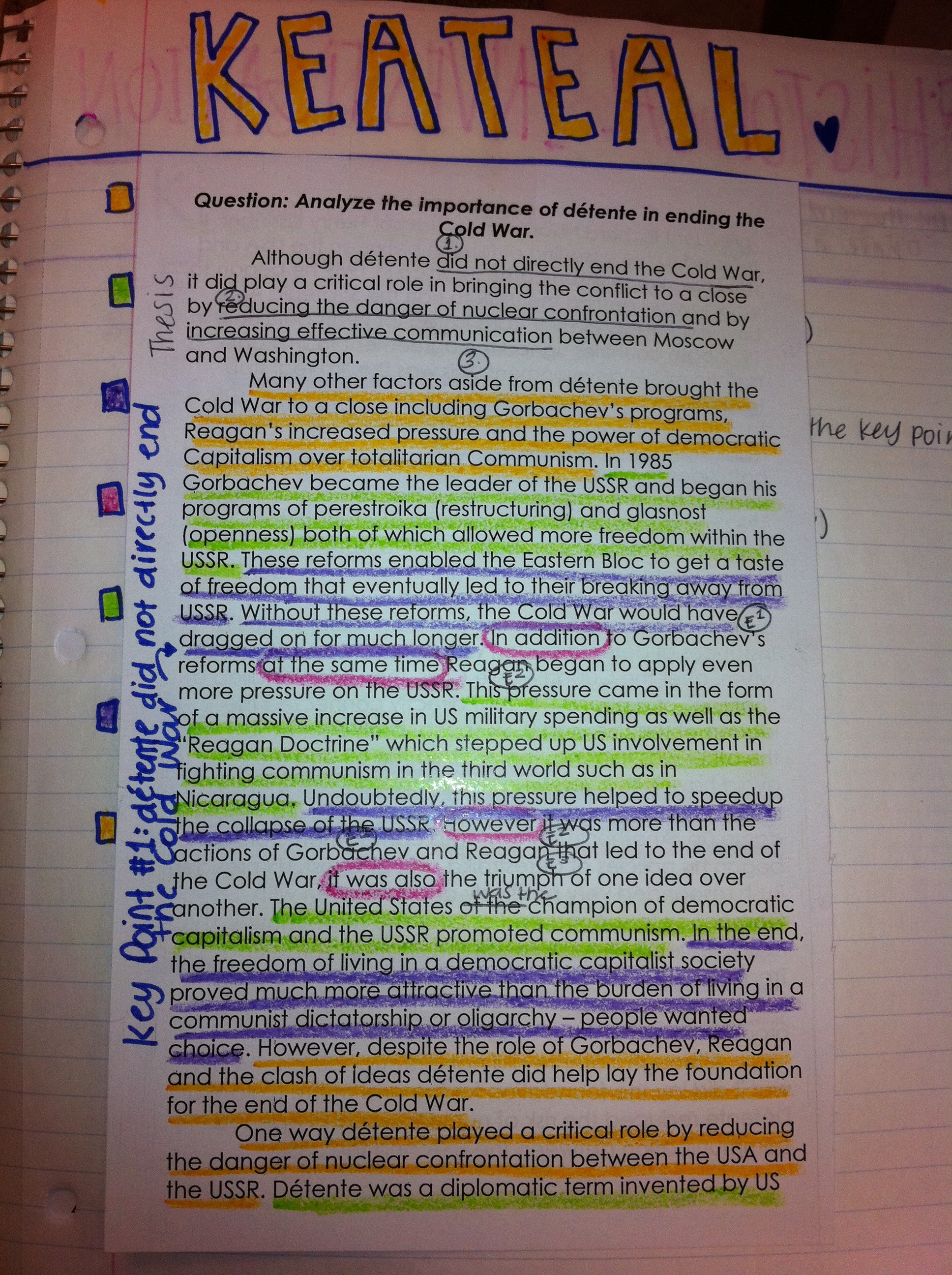
Then I’ll have students color code an academic example of a KEATEAL essay such as the one below:

I have used this strategy successfully in both middle school and high school classrooms. What strategies do you use in your classroom to get your students doing non-fiction writing?