Category Archives: Student Motivation

Hot Cheetos & Takis

An ode to the ubiquitous, absolutely all over my school and neighborhood (but not my classroom!) snacks. Also a really stinkin’ catchy song. What teacher can’t see their students in these ridiculously cute, if not nutritionally sound, children? “Got my hands stained red and I can not get it off . . .”

Keeping it Civil: Tips for In-Class Discussions


One of my favorite quotes about the importance of education is:

“If a nation expects to be ignorant & free, in a state of civilisation, it expects what never was & never will be.” – Thomas Jefferson

Jefferson envisioned that public schools would be the means of educating “common people” about issues and the mechanisms of our republic as the means of “safe-guarding democracy.” Despite his elitist tone, I think he was right. In addition to social studies and civics courses our students also need to learn the skill of civil discussion about any topic. Regardless of where you stand politically, I think we can agree our public discourse has taken a turn for the worse (Todd Akin or Joe Biden anyone?). Even if this is an election year slump in civility, most students would benefit from a little extra training on how to speak their opinions with grace as well as substance. Here are five tips for running discussion in your classroom:

  1. Show students an example of what you expect in a class conversation BEFORE your first conversation: Teach a mini-lesson classroom discussion that includes an actual example. A great way to do this is to call 4 – 6 students in after/before school or during lunch and prep them on the norms you’d like to see in class discussions. Then have them talk about a non-academic topic as they model the norms of discussion (ex. Team Jacob v. Team Edward, best movie of the summer, best olympic sport, etc.). It might even be helpful to script a few “breeches” where a student yells, or interrupts, or doesn’t use an I statement, or makes an unsubstantiated claim, etc. so you can point it out to the class. Keep their discussion under 4 minutes or so and then show the clip in class when you teach the procedure for in-class discussions.
  2. Post norms for discussion on your wall: These could include 3 – 5 statements like “Respectfully disagree” or “Use I-statements” or “Back up your opinions with evidence” or “Listen carefully to the speaker and do not interrupt.” Whatever norms you decide on make sure you explain what they mean to your students. Here are my Collegiate Discussion Guidelines
  3. Give students sentence stems to ease them into a discussion: I give my students a whole list of sentence stems like “I agree with __ and I’d like to add . . .” or “I disagree with _, I think . . .” or “If you look at the text on page _, it says __. This makes me think . . .” and have them either tape the sheet into their notebooks or directly on to the desk. This way students have a quick reference during a discussion.
  4. Have students prepare to speak before the discussion through writing: This seems obvious but I have found student participation soars if I have them come to a discussion with prepared statements. These could be questions they want to ask, quotes from our text they want to point out, or pre-written opinions they want to read. This gives students an automatic entry to the conversation.
  5. Hold students accountable for their contribution to the discussion: When I have a classroom discussion, I often use the Socratic Seminar format (where I do not speak at all) and have students grade each other (I use socratic seminar scoring guide). A great way to start this off is to do a “Fish Bowl” where 10 or so students who are more outspoken beginning the conversation. They sit in a circle of desks in the middle of the class while everyone else watches them. Let them talk for 10 minutes and then have them switch out with a new group. Letting the talkative crowd blaze the trail has the added advantage of removing them from the more reluctant speakers’ group later on. If there are no talkers in a smaller group eventually someone will speak up! Don’t be afraid to let silence hang in the air. Eventually, they will talk! Sometimes it takes a couple of attempts but it happens. My colleague Jenny Corroy has students who struggle with shyness work with a classmate. The classmate will ask the shy student a predetermined and practiced question in a way that allows them to naturally contribute to the discussion (what’s up college readiness?). You could also draw names to get students started or use a ball and have students throw from speaker to speaker (again, teach those norms!)

I have also incorporated silent signals into discussions (a hand-signal for questions, agreement and disagreement) which allows more participation from the class. What other ideas/resources do y’all have around class discussions?

Tagged

Great Books: The Skillful Teacher

I love The Skillful Teacher by  Jon Saphier et. al. so much it is difficult for me to be articulate. When asked why I love this book I sound like a 12 year-old talking about Justin Beber. This is my desert island teaching book (but then why would you read a book on teaching if you were stranded on a desert island without students, you ask . . . good question, I say, but I would STILL take The Skillful Teacher with me – it is THAT good). Aside from the thousands of teaching tips and tricks (which the book calls “moves and tools”) one of the most powerful aspects I learned from The Skillful Teacher is a framework for thinking about the discipline of teaching.

I have worked with a number of organizations that have attempted to spell out exactly what makes up good teaching through various rubrics. I am not a rubric hater, however the structure of a rubric places all of the various competencies (lesson planning and classroom management for example) on an equal level when the truth is a charismatic teacher who never, ever writes lesson plans can look pretty darn good on the surface. Management must be mastered to some degree before lesson planning can be effective. It was upon seeing the image below that I finally was able to visualize teaching.

I LOVE how this pyramid begins with a foundation of teacher beliefs. The Skillful Teacher describes 7 key beliefs teachers must have in order to be successful. Below are some of my favorites as quoted from The Skillful Teacher:

  • “You can get smart” Children’s learning is primarily determined by their effective effort and use of appropriate strategies. “Intelligence ” is not a fixed inborn limit on learning capacity. All children have the raw material to do rigorous academic material at high standards.
  • Learning varies with the degree to which learners’ needs for inclusion, influence, competence, and confidence are met.
  • The knowledge bases of a professional teacher are many, diverse and complex; and skillful teaching requires systematic and continual study of these knowledge bases.
  • The total environment of a school has a powerful effect on students’ learning.
  • Racism exerts a downward force on the achievement of students of color that must be met with active antiracist teaching.

In my experience, the more I deeply believe the above statements the more effective I am as a teacher. Without these essential beliefs I might be able to teach some kids sometimes on somedays but I will be far from reaching all of my students. Least I plummet further into pseudo-religious babble about the skillful teacher, I’m going to recommend to check out the The Skillful Teacher website and then check out a copy from your local library or have your school buy a copy for you.

Looking for a Do-It-All Seating Chart?

I want to start by acknowledging this post firmly labels me as a hopeless teaching nerd and establishes the fact this blog, while practical, is just not cool. This Seating Chart Template is one of those teacher files I stole years ago (from Brent Maddon if you know him!) and have adapted. The grid to the left is roughly set up like the rows or groups in my classroom but it allows me to take attendance by looking at empty desks. I just draw a little line through the student names who are absent, if they show up I add another line (like an X but with out the top-left line) to show they were tardy.

I have a special little clipboard upon which I have one of these templates per period cliped. In addition to attendance, I will also use the template to track other items such as behavior (positive/negative), participation during class discussions, etc. I use the right-hand side to keep an alphabetical list of last, first names (which I’ve deleted) so I can also see grades for the week at a glance.  I really love this template because I can see attendance, behavior, and grades for the whole week at a glance. At the end of the week, I punch holes in them and pop them into a binder because it is super-smart to cover your bases with a physical paper trail (anyone else been traumatized by an electronic grade book that ate your grades?).

When students walk into my classroom I hand them a card with a number on it that corresponds to a desk. This way I can break up obvious friend pairs (in order for everyone to get to know each other better) as well as strategically position students who look like they might need a little more physical proximity to me. Then I pass a list around and they write their name next to the number they picked up so I can build a seating chart for the first couple of weeks from the list. I typically rotate seats every 3 weeks to keep it fresh as well as make strategic seating assignments given academic performance and/or behavior.

Additionally, a seating chart like this can be really helpful for when a colleague or coach is observing you. Have them watch an entire lesson and put a ? on the student’s name when they ask a question, a + when they provide an answer or contribute positively and a – when they are audibly disruptive or off-task. Put a check mark every time you (the teacher) specifically address a student. It is incredibly enlightening to see a record of your classroom in this manner.

Any one else have a seating chart they love?

Classroom “Branding”

It might seem like a waste of time to “sell” yourself, your content and your class to your students but in the brand and advertisement saturated world our students live in it just doesn’t hurt to throw in your own set of messages.

1. Pick a motto and put it on everything: I have used the Cesar Chavez quote “There is no substitute for hard work” for many years now. I have it in huge letters in the back of my classroom and I include it on top of all my handouts, exams, quizzes, etc. At the beginning of the year I introduce it by doing a mini-lesson on Chavez and talking about how earning a passing score on the International Baccalaureate history exam is just hard work and there is no easy way around it.

2. Use the same font for all printed materials: Consistancy with font allows students to find a piece of paper in their locker or at the bottom of their backpack and know that it is for your class. I think it’s probably best to go with something easy to read (I love Century Gothic) as opposed to something cutesy like Comic Sans.

3. Establish procedures for everything: Routine really does make students feel safe. When a child can predict what will happen next he or she will be more relaxed and ready to access higher levels of thinking. Many teachers more qualified than I have complied lists of all of the times in class where there should be a procedure but I wanted to highlight a few procedures I leverage for classroom investment as well:

  • Homework is only due once a week (I like Wednesday or Thursday). This forces me to be thoughtful about what I assign, it respects my students time after school and it lets gives me time to enforce consequences if nothing gets turned in. I always break up the work into a suggested pacing guide so it isn’t done all on one night which teaches the skill of breaking up a big project over time.
  • Have rhythm for the week. Always give quizzes/tests on Fridays (or whenever), read a current event article on Tuesdays, always show a cute dog picture on Monday, whatever.
  • “Memorize me while you pee” was the brain child of my colleague Jackie Kroll. The idea is you have a clipboard with a sheet protector on it with a couple of facts or formulas or whatever you want students to memorize on it as a restroom pass. Students take it with them and in the hallway or bathroom they memorize it. They recite it back to you upon returning to the classroom and failure to do so means they lose restroom privileges for X amount of time.

4. Have a class song. Although I usually try to pick something close to the mainstream, I always pick something inspiration with central messages about overcoming or pushing forward or beating the odds. I make a big deal about introducing the song: I print the lyrics, have students reflect on them (either in writing or in groups or both) and then have some sort of visual connection to the song like a line from the song on the wall or an illustration of imagery from the song. In the past I’ve used Hannah Montana’s The Climb, the Flobots’ Rise, Matisyahu’s One Day, and Michael Franti’s Hey, Hey, Hey. This year I’m digging Nicki Minaj’s Fly.

5. Know your students and help them get to know each other. Use seating charts, student surveys and one-on-one conferences to get to know your students personally. Build in time to your day to help your students learn each others names, to affirm each other in a structured way and to laugh and have fun with each other. Use group projects, in-class presentations and jigsaw structures to help marry academic learning with interpersonal learning as well.

How do you create a sense of place and build culture in your classroom?

What should teachers wear?

In addition to buying office supplies, August is always the time of year when I “update my wardrobe” for the year. As a teacher, I am faced with two key realities that inform my wardrobe purchasing: 1) I have to stand up in front of 120+ people who will stare at me for hours everyday and so I should not be painful to look at and 2) I have a pretty limited budget.

Inspiration from Glee – skinny tie and cardigan

Teachers need to dress both professionally but yet comfortably enough to engage in the physical work of teaching (bending over, standing all day, monitoring recess/halls, etc.). So what to wear?

Non-example: Cameron Diaz in the movie “Bad Teacher”

And above we see another consideration as well as the reason why I have always worn my hair pulled back, my neckline high and my skirts below the knees. It is tempting to go the way of the iconic “apple jumper” but that feels like surrender. As does wearing school-branded polos or, even worse, the “spirit t-shirt” on Fridays – lord save us!  These sentiments are what led my friend and fellow teacher Heather Thompson and her colleague to start the blog Regular People Wear Their Clothes.

Heather setting the bar for teacher style

If you are needing wardrobe inspiration I highly recommend checking out Heather’s blog which is updated daily with new outfits and also includes source information. As for me I pretty much get everything from either Target, Too Good to be Threw (a nice re-sale shop in San Antonio) or, occasionally, Ann Taylor’s Loft.

So what should a teacher wear? Any tips for combining both style and functionality?

“Don’t Smile Until Christmas”

“Mean Teacher” by Jennifer Cruté

When I started teaching, I was definitely given this advice by many well-intentioned teachers. This seems like good advice but the problem is this: students are actually really stinkin’ funny. Seriously, even on my WORST days some kid will say/do something hilarious and I will laugh – maybe not audibly but certainly in my head.

Do you want kids to really listen to you and respect you? In my experience the quick way to get there is to be all smiles, super funny, self-deprecating and generally enthusiastic all of the time – except when you need to “mean business” (in the words of Fred Jones who’s book Tools for Teaching is a goldmine if you are struggling with behavior issues in your classroom). In those moments I become straight-faced, still and silent; then, when I have everyone’s attention, I essentially whisper what I want to have happen. My credibility as the leader of the classroom goes up when all I have to do is be still and speak softly to command attention and give directions. Add to this some behavior narration and a solid consequences/rewards system and you’re in business.

My rewards system is based around Opportunities (click on the link for a ready-to-print document). I give these out for any type of behavior I want to encourage in my classroom: participation, excellent academic performance, improved academic performance, strong peer collaboration, etc. Students write their names on the Opportunities and then put them in a basket. At the end of every week, and sometimes randomly in the middle of a lesson when I want to reward the whole class, I do an Opportunity drawing. The student whose name gets randomly drawn wins either a prize (pen, highlighter, mini-notebook, glitter pen, post-it pad, whatever the dollar store has that’s cool) or a privilege (I pick this before I draw a winner and its usually the privilege of selecting his/her own seat, extra bathroom pass, 5 points extra credit on something, etc.)

I have found this system to work from 8th to 12th grade. Even though it’s effective I still feel a little angst because I read Alfie Kohn’s Punished by Rewards (read it or save yourself 3 – 5 hours and laugh as you watch this NBC’s Office-themed video). What are y’alls thoughts on smiling and teaching? What about rewards?

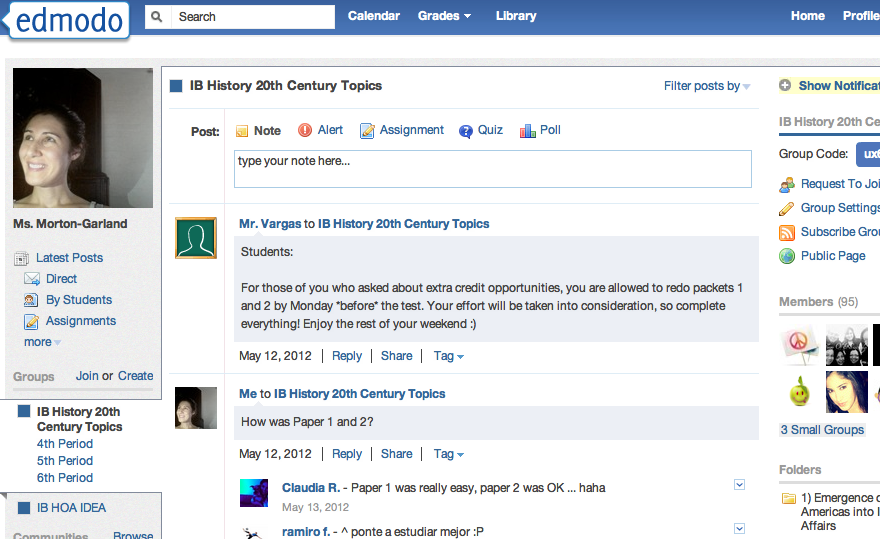
Your Classroom Online: Edmodo


Until last year, I regarded the idea of virtual communication with students as something to be avoided and also vaguely (or actually, in some states) illegal. Then my colleague and friend Crischelle Navalta turned me on to Edomodo, a free and safe social networking cite designed specifically for teachers. Here are some reasons why Edomodo is worth a shot in your classroom this year:

  • there is a HUGE amount of online storage space which I used to post all of our class handouts. This eliminated a lot of “can I get another copy of X?” because students could just go online (at home or at school) and print off another copy.
  • Edomodo helped me do some “front-loading” or “flipped classroom” instruction where students learned for homework (watched a history video online, explored a website, did their own research) and then came to class ready to discuss/write/practice in some way the material they learned for homework.
  • there is a mobile app for Edmodo that made responding to student posts really easy to do with my smart phone. Likewise students with smart phones had quick access to online class-related content.
  • Edmodo was helpful when I had to be absent from class in terms of communication with students and posting assignments. When I took my maternity leave this was particularly helpful.
  • the school where I worked has a 80%+ free or reduced-lunch student population and despite limited access to technology at home, given enough time, students found ways to access content either at school, on smart phones or at the local library.

Although I graduated from college well before the advent of Facebook and do not consider myself a techy-teacher at all I found Edmodo to be pretty intuitive and user friendly. Has anyone else used Edomodo? Are there other helpful teacher/student social (educational?) networking websites?

Ode to Office Supplies: The Moleskine

There is one truth I have found to be universal about teachers: we love office supplies. Tape, post-its, highlighters, and notebooks are the tools of our trade. Want to dive into a never ending rabbit hole of a conversation with a teacher? Ask us about our pen preference (Pilot’s Precise V7 (NOT V5) Fine in blue ink) or our planner. Yes, I know iCal and Google’s calendar tools are amazing and I don’t care. You will have to pry my paper planner out of my cold, dead hands. And for my money, there is no better planner than a Moleskine.

Isn’t that sexy? One of the best parts about the back to school ritual is going and buying a beautiful, cellophane-wrapped Moleskine 18 month academic planner. I draw a line down the middle of the calendar side (on the right-hand page) and write down appointments on one column and the do lesson planning on the other for each day. I then use the lined side of the notebook to make to-do list, put together groups of students, and write down important information I need to remember.

About five years ago I learned about keeping a professional journal from a kindergarten teacher. The basic idea is that everyday at the end of the day, sit at your desk for 5 or 10 minutes and capture what you learned. Some days I have written several pages (mostly about keeping my mouth shut, not making snap judgements, not being an idiot, etc.) and sometimes it’s just one line (ex. “Don’t come to work when you feel this sick ever again.”). I also keep the notes from workshops I’ve attended or books I’m reading so that at the end of the year I have a record of my growth as a teacher.

Anyone else have planner or professional journaling tips? Are there other Moleskine lovers?

Top 10 Classroom Decor Tips

The ID (name, event, place from history) wall in my classroom spilling out of its butcher paper frame. Each color represents one unit.

1. Turn off the overhead florescent lights: I am a big fan of natural light (what IS it with schools being designed with minimal windows?! Energy efficiency? Re-use of prison blue-prints?) so I actually make it a point to go outside (weather permitting) and open my shades even if it means I have to close them back up when I want to use the projector. I also have several thrift store lamps I spray painted black so they all match and I use these in the corners on top of shelves. I also do a string of fairy-lights around a bulletin board and have one of those paper lanterns with the lightbulb kit. I have one student assigned to turn these on in the morning and another assigned to turn them off – because I would forget and leave them on all weekend/night.

2. Wallpaper the room with butcher paper: Depending on the type of wall material I use either a hot-glue gun on cinderblock or a stapler on drywall and literally go around the room and wallpaper it. This usually takes about 2 – 3 hours depending on the size of the room but it is SO SO worth it! I usually use light blue paper and creates an immediate effect on students when they walk in the room. It shows you care about the space, it makes the room more welcoming, it makes the room less like a cell and more like a place you (and students) might actually choose to be in.

3. Hang up actual art (not cheesy teacher kitch): Resist the urge to hang that motivational poster with the pedestrian nature scene and quote from dead president and instead pick up a giant poster calendar of your favorite artist’s work. I laminated a Frieda Kahlo calendar set seven years ago and have used it ever since – I never get sick of looking at her work (and I suspect my students don’t either).

4. Hang up paper lanterns: I buy a bunch of paper lanterns in different shades of green and blue (to match the butcher paper) and hang them using fishing wire. This so cheap, both in time and money, to do but it is the thing students notice first. It draws the eye vertical (not to get all decorator-y on you).

5. Buy a can of air refreshener OR a reed diffuser OR a bunch of dried eucalyptus branches: Teachers should engage all of their students’ senses. And let’s be honest – sometimes children stink.

6. Ditch your desk: I have found the traditional behemoth-ish teacher desk to just take of valuable space in an already cramped room. Plus, how often do you actually sit down at it? Get rid of it altogether or push it flush against a wall and use it as a table with handy storage space below. I use a smallish round table as a desk where I can both conference with students and parents as well as work during my planning period.

7. Cut out huge letters to spell your classroom motto across the top of your room: The top three feet of space around the room beneath the ceiling are underused – why not use it to display your motto? I do not trace these letters out before hand. I put on You’ve Got Mail and I get my scissors and I cut. They are not perfect and it is OK. Better yet, get a kid to do it for you. When you’ve got your motto, use spray adhesive to glue it to the wall.

8. Use the space above the board in the front of the class to put information you want students to know by heart: I call this the “study while you space-out” area. All students zone out at some point and why not have information they need to know glued/taped to the space they will stare absently at? I have a row of presidents we’re memorizing, important dates, techniques to remember when writing essays . . . sure it sometimes has to be covered during a quiz or test but it works! Every year I have students comment on how there came a point on a test and they just remembered where the fact was on the wall in their mind and immediately wrote down the right answer.

9. Have a word/fact/etc. wall that builds over time: Word walls have the same effect as the tip above and they also allow students to see how their knowledge has build over time. I use a different color sentence strip for each unit and then by the end of the year we have visual record of what we have learned – one whole wall’s worth!

10. When you put up student work, put up everyone’s paper: This sends two messages 1) ooohh! she put up MY paper as well as 2) ahhh!!!! she put up MY paper. The teacher is not playing favorites and if a student produces crap it will be displayed publicly. Also, I only do this with work that does not include a grade directly on the paper itself (so no 100% or 55% in glaring red staring off the wall).

Do you have some excellent classroom decor advice? Share the goods – leave it in a comment.