Category Archives: Student Motivation

Ode to Office Supplies: Post-It Notes

It’s been a few weeks since I last sang the praises of a particular office supply (the Moleskine, read the post here) so today I thought I’d tackle the ubiquitous and versatile post-it note. Here are my top 5 ways to use that cute little slip of sticky paper:

  1. Student of the Week Shout-Outs: Every week, I pick a student from my homeroom to feature as the “Student of the Week.” I write the student’s name on a 3×5 card and then have him list five things he wants people to know about himself. His classmates and I then write affirmations about him on post-its and we put them on our classroom door around the student’s name and fact sheet. I have post-its available for others to add affirmations throughout the week. My husband does the same thing but takes a picture of the student and puts it in the middle with the affirmation post-its all around – he call is “The Homeroomer of the Week.” As in, when it’s your week you are “homerooming.” Teacher jokes, teacher jokes . . .
  2. Daily Assessment: If my daily assessment involves students writing a 1 – 3 sentence answer I will often have them write the answer and their name on post-it notes and then put them on the white board as they exit the classroom. I can read the entire classes responses quickly and get a clear idea of mastery.
  3. Opinion spectrums or corners: On of my favorite ways to use post-its is to draw an opinion spectrum (strongly disagree to neutral to strongly agree) and have students respond to questions on post-its and then place their responses along the spectrum. I do this for content questions (i.e. Should the US have become involved in Vietnam?) as well as classroom culture questions (i.e. How prepared were you for the exam we took today? Explain your answer.) Opinion corners provides another dimension to the spectrum. Draw a square and divide it into fourths. Each quadrant represents an opinion position. For example, the question “Whose fault was the Kent State Massacre?” could have quadrants named: the protesting college students, the national guard, the Kent state professors, the United States government. Students would write their answers on the post-it and then place them where they belong. This is nice because it allows for multiple answers – you could place a post-it in between the college students and national guard boxes to indicate you blame both or in the middle to indicate you blame all four groups equally.
  4. To make tab dividers in notebooks: You can buy the swoon worthy babies below or just use mini-post-its for the same effect.
  5. To annotate textbooks or other school-owned books: It is so important for students to learn how to annotate properly and to save their annotations for expository essays or research papers. However, it often isn’t possible for all students to buy a copy of the book you are using in class. I have students make notes on post-its and just keep these in the books for the duration of the time we are using a particular text. Then at the end of the unit or year we just take them out. I like the large, lined post-it notes for this task and encourage students to write page numbers on the post-it next to teach of the comments they are writing down or quotes they want to copy/remember.

How do you use post-its in your classroom?

The 10 Commandments of Getting a Life Beyond Your Classroom

After my rant against “heroic teaching” I thought it might be helpful to give some tips on what has worked for me. Let me be clear that I am still trying to get my balancing act together as well . . . do as I say not as I do. This is a tongue-n-cheek list I made a couple of years ago for a professional development session I did on balance:

  1. Thou shall backwards plan. This is how you get your life back. Ideally, you calendar objectives for each day for the whole year in the summer; this way you never have to ask “What am I teaching today?
  2. Thou shall backwards plan thy next unit or at least week this very Saturday and get ahead of the game.
  3. Thou shall plan thy planning periods – and not just do whatever has to be done.  A weekly routine is a good way to handle planning periods. Monday – plan make a to do list, catch up, grade; Tuesday – grade; Wednesday – write lesson plans for the next week; Thursday – create materials for the next week (handouts, gather equipment, put together readings, etc.); Friday – make copies
  4. Thou shall only use class time and planning time in service of thine assessments. Teach to the test – but make sure it is a good test.
  5. Hate thine enemy e-mail and only check it twice a day; once in the morning and once immediately after school ends. Never during your planning period.
  6. Verily I say unto you the copier is also thine enemy therefore do not make copies in the morning – inevitably this will lead to disaster.
  7. Thou shall work at school because that is what you are paid to do – you are not paid to work at home. Also working at home makes you loath our sacred profession if you do it too much. Therefore I say unto you, come early and/or stay late but seriously avoid working at home.
  8. Remember the Sabbath and keep it holy. (and this one I didn’t make up!) Pick one of the two weekend days and do not do any work on that day. Whatever you do, make sure you’ve stopped working by 6:00pm on Sunday.  Working Sunday night makes you loath our sacred profession.
  9. Thou shall be friends with thy colleagues. These people will get you through the worst days – don’t try to do this alone. Friends don’t let friends work themselves to death. Sometimes, bring your coworkers food/treats/coffee/etc..
  10. Remember if thou hast worked thyself to death this week, thou can try for balance again tomorrow or next week. There is always another chance to change your classroom and take control of your life.

“The Limits of Heroic Teaching”

My first year as a teacher I lived and taught with a wonderful roommate and teacher. For the first several months I would stay up late every single night trying to perfect my lesson plans and by November I was miserable because I wasn’t doing anything else but working. My roommate gave me some great advice: “You can always do more with a lesson, at some point just stop. It will never be perfect.”

This was the beginning of trying to balance a compelling and demanding profession with a personal life. Over the years I have known many teachers who have sacrificed so much for their students including their physical health, relationships, bank accounts, and mental well-being. I do not believe in a burn-out model of teaching and I do not believe this is what is required to be an excellent teacher. Unfortunately, many of the charter school systems I have worked with as well as TFA have spot-lighted teachers who put in 70+ hour weeks and inadvertently encouraged, or at times outright advocated with purposeful messaging (“Work Hard. Be Nice.” and “Whatever it takes” and “Relentless Pursuit”), personal life martyrdom for the achievement gap. Although this kind of all consuming teaching, which Wendy Kopp calls “heroic teaching,” may result in student academic growth within a single school year and/or subject – what happens the next year? Will the students sustain their growth with a new teacher? Will the teacher be able to sustain a career in the classroom? Kopp writes . . .

heroic teaching like theirs does not offer a likely path to educational opportunity for all. It is impossible to imagine a force of hundreds of thousands of teachers as rare in their abilities and commitment as [these teachers] are, and it is impossible to imagine hundreds of thousands of them sustaining the requisite level of energy and devoting the requisite amount of time not just for two years but for many years, and on a teacher’s salary to boot. We can’t expect all of our teachers to shoulder the responsibility of creating transformational classrooms within schools that often don’t have the mission or capacity to change students’ trajectories, let alone provide teachers with the training and professional development necessary to teach this way.

Although Kopp admits self-sacrificial teaching is unsustainable she certainly admires it – it is “heroic” – but I would argue the opposite. This kind of teaching is both unsustainable and ultimately destructive for teachers, students and schools.

One teacher does not close the achievement gap in one year in one class. Research shows students need at least three years of excellent teaching in order to make up performance differences (although some argue even three years with a great teacher isn’t enough). If a good teacher burns herself out after 2 or 3 years although her students might have had one great year the cost is high: her school looses a veteran teacher and potential leader, hundreds of other children will have to settle for a weakened school experience and that promising young teacher will never reach her full potential as an educator. Additionally, what kind of example for her students is a teacher who is not eating well or exercising or maintaining healthy relationships or improving her mind and soul through reading and non-education related activities like spirituality or hiking outdoors?

Rigorous and challenging professions with sustainable career paths exist (ex. doctors, lawyers, etc.) however making this possible for teachers requires systemic changes. In the meantime, fellow teachers, let us commit to balance and help lessen the burden by sharing resources and supporting each other. Set a timer when you write lesson plans and when the timer goes off put it aside and call it done. Use or modify resources from other teachers – don’t “reinvent the wheel.” Spend time on what is important (giving useful feedback to students, backwards planning to strong assessments, getting to know your students as people and learners) and less time on the small stuff (formatting documents, finding the perfect picture for that power point, obsessively tracking small knowledge bits instead of larger skills or themes). Breakdown the walls of isolation in your building and collaborate with your colleagues.

And if your colleague next door is burning herself out please stage an intervention like my roommate did with me 10 years ago. Let’s not call what is tragic heroic.

Superschools: Creating an Environment of Achievement

There is a quick, interesting article at the Time Ideas website on how some schools are able to produce an exceptional number of highly skilled math students – particularly female math students. The article by Annie Murphy Paul (who has an engrossing blog, here) explains how more than good curriculum or technology are needed for excellence. Paul points to two factors: expectations and environment. She argues these two factors are essential for leading students to achievement – even when they come to school with all sorts of advantages already in place. Read the whole article here.

What about the girls?

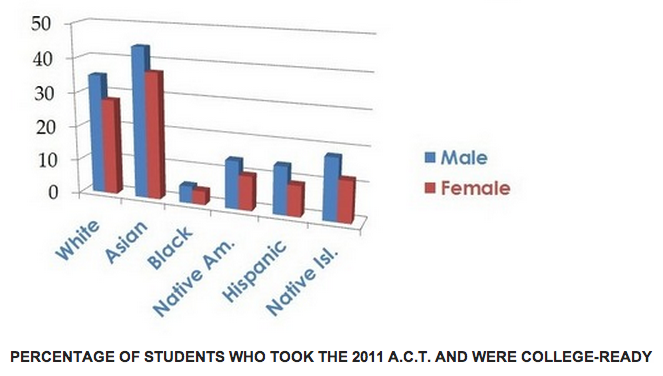
I came across this super-upsetting graph in an newsletter from the Department of Education (called Teaching Matters, you can sign up for it here). This data comes from a new report from the National Center for Education Statistics (NCES) on gaps in access and persistance in higher education (for full report, click here) I’ve found the ACT to be such a line in the sand in terms of college readiness and the chart above clearly illustrates the race and gender discrepancies in scores.

There are several really gripping findings in the study but another chart that jumped out at me was the one below which shows passing percentages on Advanced Placement exams by subject, race and gender.


This chart is even more troubling because more often than not AP classes are not open-enrollment and so these scores represent the top performing students and not the population at large. Although performance by race differed dramatically in many subjects I was stunned to see how wide the gap is for young women of color.

One of the central moments of my development as a teacher was in my second year when my principal sat in on my lesson and kept a record of student-teacher interactions (questions asked, hands raised, cold-calls, reprimands, etc.). At the end of class he wrote on a post-it “Interesting lesson! What about the girls?” As I looked at the chart, I was stunned to see that for every interaction with a female student I had almost three more with a male student. I was giving almost three times the attention to boys in my class. I was mortified. I had read Reviving Ophelia! I took TONS of women’s studies classes in college! I was only two years out from writing my undergraduate thesis titled Can We Milk This Tiger: A Study of Feminist Theory and Revolutionary Praxis in Central America and I there I was actually favoring my male students.

Unfortunately, the data above shows I am not alone. What about the girls?

The Sexy Six

In a perfect world, students would not be subjected to multiple choice exams as a measure of what they know – much less locked up quarterly in classrooms for entire days to take said exams. Don’t get me wrong, I believe strongly in teaching to rigorous tests as part of smart backwards planning; however, your average state exam is far from inspirational, much less rigorous. But we do what we got to do . . . so bring on the tricks and gimmicks! Each test has its own bag of tricks but one trick I come back to year after year is what I call “The Sexy Six.”

  1. Read & Underline the question
  2. Don’t look at the answer yet (wrong answer choices poison your brain!)
  3. Guess what you think the answer will be – write it to the side
  4. Cross out wrong answer choices, maybe dots beside possible choices
  5. Circle your answer and write it to the side
  6. Star & Skip questions you can’t get down to 2 answer, come back to them when you’ve finished the rest

The Sexy Six are a tried and true strategy for any multiple choice exam. I teach them at the beginning of the year and have a big poster with them on it at the front of the classroom. I even give exams where each question is worth 5 points – 1 point for the right answer, 1 point for underlining, 1 point for writing a guess to the side, 1 point for crossed out answers and maybe dots, and 1 point for writing the answer choice to the side. I model The Sexy Six in think-alouds when we review multiple choice Do Nows and I show how students can use them to answer seemingly impossible questions. By spring, The Sexy Six are second nature and colleagues, I’m pretty sure test taking skills are at least 51% of the battle on these standardized-monstrosities.

Why “Sexy?” Ok, ok, I’ll admit it . . . it’s a cheap trick. Nature has wired adolescents to flag information related to and around sex as “highest priority.” As skillful teachers, we can use this to our advantage and attach horrifically dry and mundane tasks (like multiple choice exam strategies) to the forefront of their brains. Appeal to that reptillian stem! I’ll admit for middle school “Super” might be more appropriate.

The Best Review Game of All Time

Although there are many elaborate review games out there I only use one – I call it The Game. I did not invent it however I have modified it over the years to be something that works for many grade levels, many contents and many situations. Students always, always love it. The only downside is that it can get so loud your colleagues will wonder what the heck is going on in your room.

Equipment Needed:

  • a small whiteboard for each row in your classroom (like the kind commonly used in math classes)
  • dry erase markers
  • a roll of paper towels to use as cheap-o erasers

The Game:

Teams sit in the same rows (from front of the room to back of the room) and come up with a name for themselves. I give them 90 seconds to think of a name and if they fail to do so or if the name is inappropriate I give them a name (the “electric pink chipmunk eaters” or the “puking pigeons” etc.). Write each team name on the front board and keep a running tally of points under each name. The whiteboards, markers and paper towels are then passed to the very back of the room and held by the last person in each team’s row.

You ask a question and the teams race to write a legible answer on their whiteboards and then pass them to the front of the room. The students in the first row hold up their team’s answer. Anyone on the team can write the answer, not just the last person. So if the last person doesn’t know they just pass the whiteboard up to the teammate that remembers the answer. Two points for the first team with the correct answer at the front and one point for each correct answer that isn’t first to the front. After each questions students move up a desk so that students are constantly on the move both by having to pass the whiteboard and switch desks after each question. This is the beauty of The Game – forced engagement and physical activity.

A few tips: Have students practice with a couple of questions before you start keeping score. This allows them to get the swing of things in a low pressure context. Take off points for trash-talking classmates as well as arguing with you about who was first or legibility issues, etc.

Any other review games folks like to use?

Classroom Management & Kohlberg’s Stages of Moral Development

I read Rafe Esquith’s There Are No Shortcuts and, after getting over my feelings of crushing inadequacy, came away compelled with the need to teach character in my classroom. Rafe uses Kohlberg’s Theory of Moral Development to help children self-identify their current behavioral standards and then seek to grow from that point.

This blew my mind. We differentiate for things like reading levels, learning differences, and the ability to speak English – why not differentiate for students’ level of moral development? I began teaching these stages to my students through content lessons (ex. read historical sources and identify the level of Kohlbergs for each author) and posting them in my class along with the question “Are you moving up?”

This was so helpful for having discipline discussions with students: “So what level were you operating on when you foraged your parents signature on this grade report?” Below are the more student-friendly stage names I used in my classroom (in descending, rather than ascending order like the chart above):

I found it helpful to actually go through my lists of students after about the third or fourth week of school and identify where I though each student was operating. This was really helpful in knowing how to respond to students in terms of motivating them not only to behave but to do their homework, participate and achieve all-around in my classroom. A student who is operating at the Premoral Level (punishments and rewards) is simply not going to be compelled by my Don’t-You-Just-LOVE-History-And-Isn’t-It-Fascinating-And-Great tactics. I need to provide them with various, tangible incentives and, when those don’t work, consequences because that is what they need. It is what is appropriate for them at that moment.

The chart below describes a persons view of others as well as perspective on society at each level:

A word of caution: it is not enough to simply diagnose students’ moral development levels but we also need to help them grow. Key ways to do this are to help students self-identify, to frequently provide them with examples (historical, living and fictional) of people operating at various levels, and to show them the benefits of operating at higher levels (both personally and to our communities). Try bringing the language of Kohlberg in to your classroom and see how your students begin to conceptualize and think holistically about their behavior.

Anyone else use Kohlberg’s Level and have tips for helping students grow?

Tagged

The Tome (Interactive Notebooks)

I could not teach without The Tome. If you have had me as your teacher in the past 8 years you have been subjected to making one of these monsters and are a better person for it (right?!). I certainly did not invent this idea (could it have been TCI, the History Alive! people? that is where I learned about it . . .). Here is the gist: every student has a three subject, college ruled 5 Star (or other high quality) notebook. Within the first week of school we number all of the notebook’s pages and then take notes, record individual reflections, and keep track of papers in a prescribed, highly organized way as a class. Most often, notebooks are set out like so:

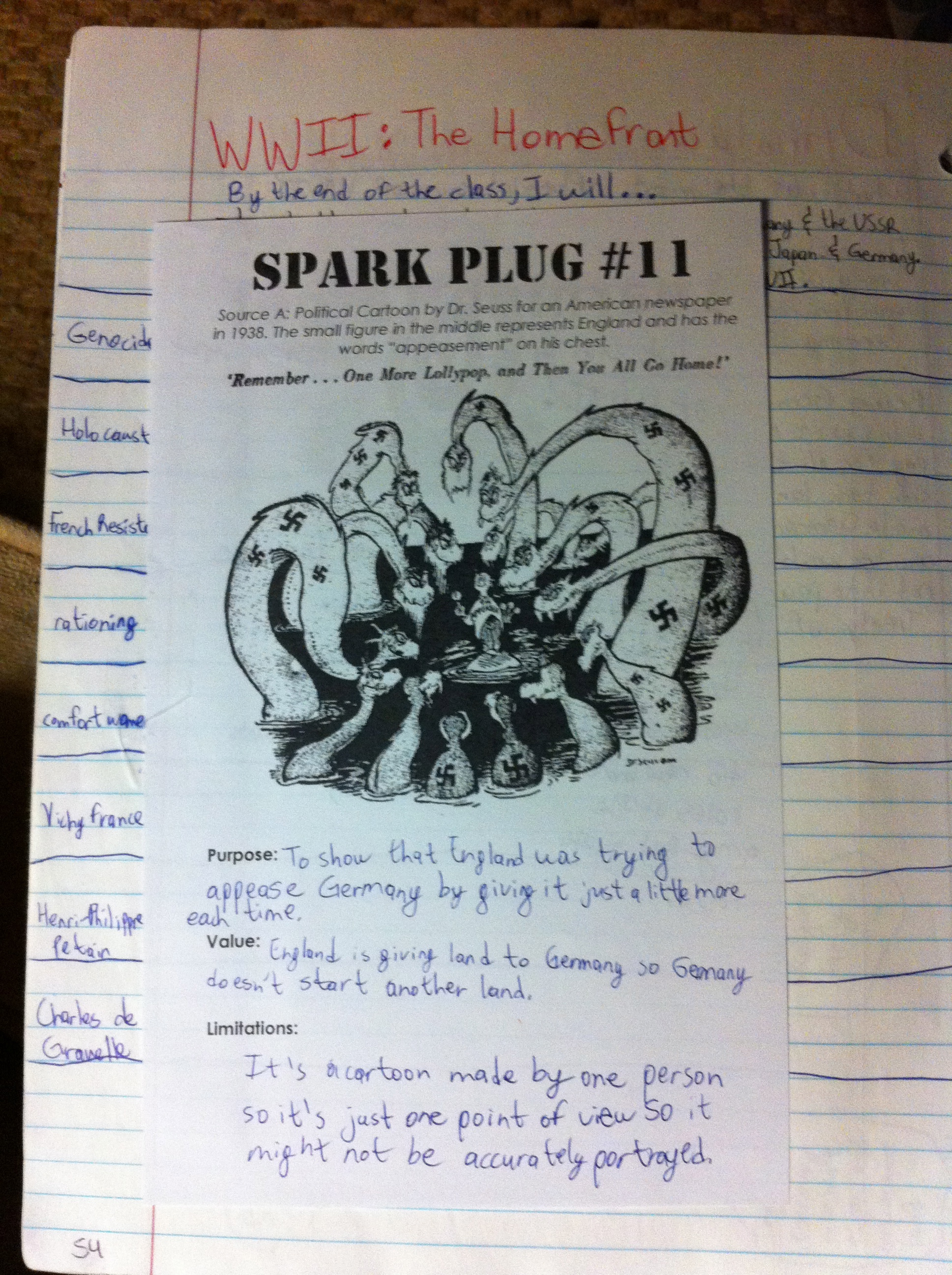
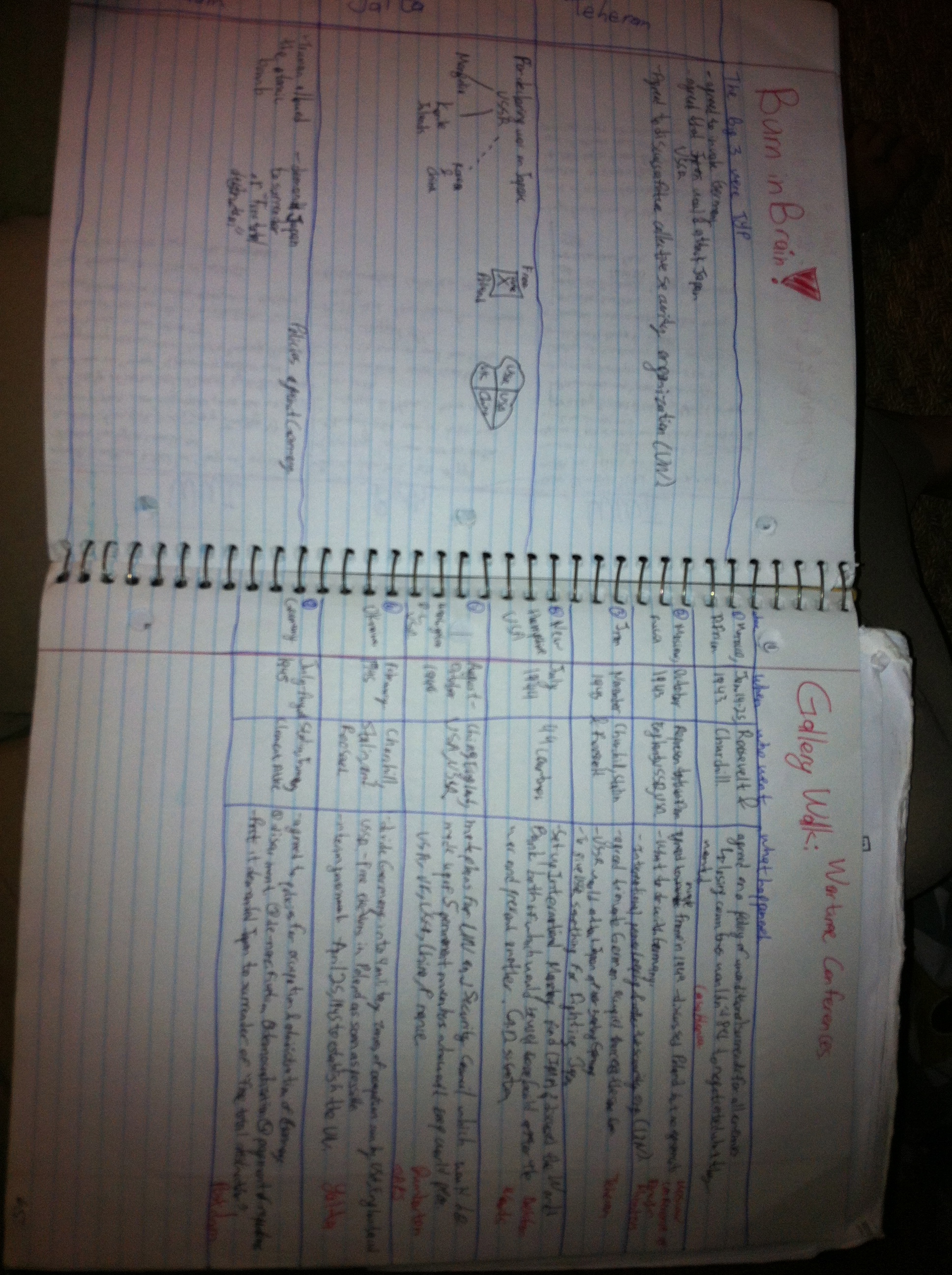
I actually tape in a 1/2 sheet of paper with the Do Now (which I call a Spark Plug) on the front and the Exit Ticket on the back (Spark Plug). Notes can look like this with a Gallery Walk on the Right and a Burn in Brain reflection on the left:

There are many excellent instructions for using interactive notebooks in your classroom out there (here is the History Alive! video promo, a nice book I’ve seen with a middle school science angle, and a book on interactive notebooks and ELLs). I’ve also put together some instructions that explain how I have used it before in my World History class (Instructions for The Tome). If you want to give interactive notebooks a shot in your classroom, here are some tips/ideas that have come from learning it the hard way:

  1. Give it a cool name: Students don’t love the term “interactive notebook” – so go with “The Tome” or “My Best Friend” all of which I have used at one point or another. Not only is it more fun, I love to hear students say “Do we need our Best Friends in class today?” Always, dear student, always.
  2. Use it daily and build really tight classroom procedures around it: This should not be a time waster. I have made students practice gluing images into their Tomes (in what Melissa Barkin calls “the X maneuver” which involves an X of glue, no more). They may only use a thumb’s length of tape. Each group has a labeled basket with supplies that take 10 seconds to go an get, another 60 to use and then another 10 to put back; done and done. While it is nice for students to take their time and make the notebooks as creative and beautiful as possible, extra decoration (i.e. drawing, coloring, gluing scrapbooking materials in, adding glitter, drawing intricate museum-worthy work, spraying on perfume so “it smells nice,” etc.) should happen outside of class time.
  3. Notebooks are better than binders: Papers fall out of binders but stay in notebooks. I recommend having labeled binders in class with tests, papers, homework, tracking, etc. that never leave the room and then having your Tomes come in and out of class each day. If students do not want to keep up with them designate a “parking lot” shelf where they can leave them. However, do not take responsibility for what happens in the parking lot. If they are stolen or messed with – too bad.
  4. Grade those notebooks: Nothing says “This is important” like making it be a grade. I grade notebooks every 3 to 6 weeks depending on the age of the students. The first check should come within the first week (this is just a do you have it check) and then a check to make sure students are following procedures comes two weeks later. Here is the form I’ve over the years: Tome Evaluation Here also are some student instructions for setting things up: Cover instructions for TomeTome Into and Setup Note: I don’t grade notebooks for seniors and only grade juniors for 1/2 the year.
  5. Invest students in the notebooks: Have a cover decorating contest within the first week. Provide clear packing tape for students to cover over their designs (this is like laminating them). Give students extra credit if they add color or make their notebooks particularly creative. Also, make them super useful and integrated into your class. Take notes in them every day. Reference them in class (“If you look back on page 147 you’ll see we talked about __”) On the back cover tape critical information so students have quick reference in your class (see below).


Creating the Conditions for Authentic Learning

Much has been written about the connection between authentic learning and self-actualization. A great way to ensure you are an effective teacher is to think about your classroom through the lens of Maslow’s Hierarchy of Needs.

Here are some ideas for meeting your students’ needs at each level in order to ensure they are able to access self-actualization and, ultimately, long-lasting learning.

  • Physiological Needs: For those of us who teach in under-served schools, these needs can be pressing. Ideally teachers are working with Social Workers and/or school councilors to help students and their families access resources. Unfortunately, teachers often need to teach students who are operating at the basic survival level with some critical needs going unmet. Keeping food in the classroom, getting to know parents through home visits or phone calls, building relationships with students so you know when they have needs, and working with community partners (like clinics or food banks) can be ways to ensure these needs are met.
  • Safety: A critical component to safety is strong classroom management founded on a few principles (such as respect, responsibility and responsiveness). Hold students accountable to your rules and do not be afraid to give consequences with your expectations for behavior are breeched. It should be very clear what can and cannot happen in your classroom. When students know what to expect, they can relax and begin to access the more developed parts of their brain (which, lord knows, they find difficult enough).
  • Social Needs: The two key aspects here are student-teacher relationships and student-student relationships within the class. As the teacher our job is to make sure both types of relationships are strong. Get to know your students via one-on-one conferences, student surveys, home visits, and quick conversations in the hallway (I like to stand at my door and shake hands with every student as they enter). Likewise, students should know their teachers – show pictures of your family, play music you like, casually and quickly mention aspects from your life without going down a rabbit trail (“So Hamlet is clearly embarrassed here – just like I was when, in 10th grade, the guy I had a crush on read my diary. Yes, that happened. No, we are not going to talk about it. Let’s keep reading at line 342 . . .”). Also, help students to get to know each other by regularly providing opportunities for them to meet new people in the classroom (switch up seats, partners, etc.) and talk briefly about non-academic topics. I like to give students 1 minute to discuss the worst movie ever or their favorite song or TV show before they dive into the academic task when working with partners. In one of the most difficult classes I ever taught, I spent 5 minutes after the Do Now activity playing some kind of ice-breaker game every single day. The goal is to make the class feel like a special club with inside jokes and traditions and funny stories that cement it together.
  • Esteem: Celebrate not only academic achievement (the A grades) but also academic improvement. Have students track their progress either by objective mastery or skills acquisition (ex. improved performance on a writing rubric) and celebrate when there is growth. This could look like putting stickers on a chart, one-on-one conferences where you go over student’s tracking tool, or a weekly ceremony where you play “We are the champions” turn on a strobe light and have students who have improved soul train down the center of the class to celebrate. Another way to do this is to celebrate collective achievement. Track the average grades of your class and post them publicly. Celebrate when there is real improvement and growth from one assessment to the next.
  • Self-Actualization: This is the tier where learning happens. However, if you read the descriptors on the pyramid – creativity, problem-solving, authenticity, spontaneity – it doesn’t exactly describe the high stakes tests our students must take or the traditional everyone-in-rows-now-listen-to-me-talk model of teaching. It is so important to provide learner centered lessons as well as authentic assessments for our students even if we also have to get them ready for an exam.
Tagged , ,