Category Archives: Student Motivation

Character Report Cards

KIPP Report Card sample

In Paul Tough’s new book How Children Succeed he provides compelling evidence for how so-called character strengths, such as self-control, optimism, and grit, are what make people successful or not. A large chunk of these attributes are instilled within us as babies and toddlers (for more on that click here) however Tough provides evidence that these traits can be taught to teenagers. His prime example is the KIPP charter school’s character report card (pictured above).

KIPP’s approach to teaching character involves a multi-faceted approach which includes everything from banners and t-shirts to bulletin boards where students “shout-out” each other for various traits to the character report card. One of the driving reasons behind creating the report card is KIPP wanted to show students and parents that character (like intelligence) is malleable and can be learned. Teaches use descriptors such as “Comes to class prepared” and then evaluate students on a scale and average scores to reach an index for each of the 8 traits KIPP assesses: grit, self-control, zest, social intelligence (both academic and interpersonal), gratitude, optimism, and curiosity.

At one of the first report card nights where the new character report was rolled out Tough describes a conversation between an African-American woman, her eight-grade son Juaquin, and his English teacher Mr. Witter. The teachers tells the mother that the report card represents traits that are “indicators of success.” “They mean you’re more likely to go to college. More likely to find a good job. Even surprising things like more likely to get married, or more likely to have a family,” says the teacher. After discussing the parts of the character report card where the student scored well the teacher turns to the low numbers:

“The first thing that jumps out at me is this.” Witter pulled out a green felt-tip marker and circled one indicator on Juaquin’s report card. “Pays attention and resists distraction,” Witter read aloud: this was an indicator for academic self-control. “That’s a little lower than some of the other numbers. Why do you think that is?” “I talk too much in class,” Juaquin said a little sheepishly, looking down at his black sneakers. “I sometimes stare off into space and don’t pay attention.” The three of them talked over a few strategies to help Juaquin focus more in class . . . “The strong points are not a surprise,” [said the mother] “That’s just the type of person Juaquin is. But it’s good how you pinpoint what he can do to make things easier on himself. Then maybe his grades will pick up.”

Wait. That’s it? And just like that, Juaquin is told, essentially, that if he does not pay attention in class then he will not go to college, find a job or even get married and have a family. Where in this conversation, on this report card, is there space for Juaquin to give his two cents? What if his teachers are boring? What if they can not manage their classrooms and Juaquin is unable to focus amid all the distractions? What if Juaquin is completely uninvested in learning subjects like Algebra 1 and early U.S. History? What if no one has explained to Juaquin why he should be interested in school? Undoubtedly, implementing these report cards is much more complicated and more involved than what Tough has described in his book however I find the lack of student ownership of this process troubling. Another way to describe the acquisition of traits like gratitude, zest, and self-control is self-actualization. Without explicit student ownership over the process of character building, there is no self-actualization.  To twist-quote Yeats, education, and certainly character education, is not the filling of a pail but the lighting of a fire.

Character report cards seems to be a wishful shortcut. One of the basic tennets of modern, research-based education pedagogy is students must practice what they learn. Teaching is a cycle of direct instruction, authentic and assessment aligned student practice, and teacher feedback. Practice and feedback. Practice and feedback. More practice and more feedback. The classic novice’s mistake is to lecture about writing an essay and then miraculously expect students to write a perfect essay. This is like lecturing about swimming and then throwing kids into a pool. Or lecturing about playing the violin and then handing a child an instrument. Students must practice what they are expected to learn. This is true regardless of the learning objective: math, history, English, French, science, or underwater basket weaving . . . and character.

Juaquin may yet learn to sit still in his classes, but he may also learn to hate math (or English, or history). He may also come to believe he “just isn’t good” at math (or science, or Spanish) because he is disengaged by the instruction. He may also learn to dislike school and authority figures in general because they have wasted both his time and focus. To what extent are Juaquin’s character short comings the result (or lack of) teacher actions like boring methods and teacher-centered instruction. What is the role of culture and race in defining character traits like zest and gratitude?

I have a huge amount of admiration for the attention KIPP is paying to character and I think it is a step in the right direction. However, I worry about how effective a school with ridged culture expectations (in uniform, SLANT, rules, etc.) will be in promoting traits like self-control. When will students have authentic opportunities to practice character? Most character lessons are learned outside a classroom. I personally learned about character via sports, waiting tables, and traveling to South America with my parents on medical exchanges. What would it look like for schools to release students to internships for part of the school day? What about sponsoring two week hiking trips? What about allowing students to choose what interests them and learn character along the way?


Let the students teach themselves! (Seriously)

This TED talk from Sugata Mitra on slum children in India learning how to use a public computer by simply playing with it and working together makes for a nice finish to my listen-to-the-students themed week. Enjoy!

Pathbrite: Student Portfolios

https://www.youtube.com/watch?v=iZKl0MsRuOU

Pathbrite is an easy to use, highly functional and free online portfolio system. I had the chance to meet the founders of this organization at Education Nation this year and I was really impressed with their commitment to designing a helpful tool for both students and teachers. I could see using Pathbrite over the course of a class as a place for students to collect their knowledge and respond to material. It could also be used as a means for students to build a 360 view of themselves in preparation for summer program or college applications. Looking for a way to help your students build a dynamic online portfolio either for your class or for college admissions, check out Pathbrite here!

Student Run Schools: Nightmare or Human Right?

Last March, Esquire revealed what it called the current “War on Youth.” In July, Newsweek dubbed millennials “Generation Screwed.” In the middle of this mayhem, young people have been left on the sidelines, given the cold shoulder, and ignored. In my life, I’ve been told to shut up, sit down, and listen. I witness this every single day at school. Top-down, rigid policies dictate word-for-word what students and teachers must do and learn. As a young person, very few seem to be on our side and even fewer attempt to strengthen our voice. Education thought leader Paulo Freire once quipped, “If the structure does not permit dialogue, the structure must be changed.”

In keeping with the “listening to students” theme this week, Nikhil Goyal over on Good has a short piece on Democratic Schools where students are empowered to choose their learning environment. The pro-reformer/charter school warrior in me reads the article’s subtitle “Adults need to get out of the way” and envisions a Lord of the Flies situation. Who among us teachers doesn’t have a little bit of the Hobbesian “nasty, brutish, and short” view of human nature? Have you seen what happens in PE when there is a substitute? Seriously.

The state of nature aside, I also know listening to children and allowing them to make meaningful choices are cornerstones of becoming self actualized people. What troubles me is which children are afforded the opportunity to attend these Democratic Schools; they are largely privileged and white (for a visual illustration of what I’m talking about, check out the contrast in uniforms between minority/low-income charters and white/wealthy private schools). At the same time all children need clear boundaries and students from underserved communities in particular need to be explicitly taught the rules and norms of what Lisa Delpit calls “the culture of power.”

As it often does, the answer here must lay somewhere in the middle. Could we potentially diagnose  scaffold and assess our student autonomy in the same way we do their academic skills? What new school-wide structures could be built around this data set? I believe, along with Paulo Freire, that “to alienate humans from their own decision making is to change them into objects.” As educators we have an obligation to afford our students the opportunity to make choices that go beyond choosing between making a diorama or writing a poem for their book report on “The Giver.” Lord knows I have failed in this area but here are some thoughts I have:

  • Allow students to choose topics that interest them: As much as possible, give students choice about what they learn and how they learn it.
  • Let students create classroom charters and social contracts: Check out Ms. Thompson’s example here.
  • We must change the way our school days are organized: When we want the same outcomes for all students (objective mastery or “college readiness”) we cannot expect all students to reach those goals in the same amount of time. Students who are behind or who have special needs will require more time to learn as well as more one-on-one feedback and coaching. At my former school we experimented with “Working Wednesdays” during which each 12th grade students were given an individualized schedule depending on their 1) needs and 2) ability to manage their time. I’d love to see a school where daily schedules were differentiated and lock-step progression was thrown out the window. Anyone know of examples?
  • Our instruction should be authentic: Students absolutely crave the chance to be treated like an adult and to learn in relevant ways. Why not mix internships at local law offices, police departments, and city halls with a few lectures, papers and exams and call it a government credit? Why not teach World War II via a research project on your city’s involvement complete with field trips to the local museum or archive and guest lectures from local veterans?

Does anyone have experience teaching at a Democratic School? I am particularly interested in learning about people who have used these ideas in underserved communities – anyone? What other thoughts do you have about the role of student choice in our schools?

Listening to Our Students

A visual representation of what a group of teenagers at a Imagining Learning event wanted their education to look like.

I have noticed a theme in this week’s posts: Listening to students. First in the children’s book Iggy Peck and then in an op-ed by a well-informed (if not a little snarky) high school student. I found this super interesting organization called Imagining Learning that goes around the country holding “listening sessions” with teenagers centered around the question:

“How do we educate young people to thrive in a world of possibility?”

Students talk through their answers to the question and then collectively create a visual representation of their ideas. Interesting if not a little “hippe-dippy” as some of my math colleagues might say. However the exercise reminded me of how valuable this structure can be in an academic context. I often have students explore a topic via reading and discussion and then task them with creating visual representations in groups. I find this strategy to be more effective for non-factual, higher order questions like: “Who should be blamed for the Arab-Israeli conflict?” or “Was Hamlet actually crazy?” or “Is cloning ethical?” A great way to ensure this exercise is rigorous is to wrap up the class by having students write an evidence based response to the question that was studied, debated and illustrated. Alternately, the writing could occur the next day after students have had time to look at each other’s illustrations and form their own opinion.

How do you show your students you are listening to them?

Our Students’ Interests & “Iggy Peck, Architect”

I read a lot of children’s books and many, many of them just stink; however, Iggy Peck, Architect by Andrea Beaty is an absolute gem. It has everything that makes a children’s book awesome: dazzling illustrations, a life-affirming polt line, and clever, rhyming text.

In the image above Iggy shows his early interest in architecture by building a tower out of dirty diapers (a beautiful idea that inspired disaster in my potty-training two year-old, don’t ask). The plot twist comes when the young savant’s second grade teacher, who has a fear of buildings, forbids the study of architecture in her classroom.

Shortly after Ms. Greer declares “We will not talk of buildings in here!” Iggy becomes disinterested in school. He slouches at his desk and mopes at the back of the line. It was at this point while reading to my daughter that my teacher brain clicked on – what was happening here? Check out the picture above. Notice the rows of compliant students sitting with folded hands, the towering Ms. Greer with her dagger-like feet, and then Iggy in the back of the room building a castle out of chalk sticks. I don’t know anything about illustrator David Roberts’ experience in school but looking at this picture makes it pretty easy to guess.

“Ha!” I thought, “Ms. Greer is such an idiot! What teacher would squelch such obvious talent?” And then I thought about the number of times I have asked students to stop doodling or humming to themselves in class. More subtly, I thought about all of the assignments and learning experiences I’ve assigned that simply do not allow any room for students to bring their own interests into my classroom. The problem is our students’ talents are rarely as obvious or conventionally valuable as Iggy’s architectural prowess. Below are my ideas for bringing student interests into our classrooms:

  • Student Choice: As much as possible, allow students to choose both how they will learn material as well as how they will show you their learning. Standardized testing makes some forms of assessment inevitable, but try as much as possible to provide parallel assessments – I have never known a student with a particular passion for multiple choice exams (regardless of talent).
  • Get to know your students: Student interest surveys (and more than just one in August!), parent conferences, home visits, one-on-one conferences, and sharing information with other teachers are all great ways to deepen your knowledge of students. If I had a dollar for every time I’ve learned something about a student and said “Wow! I had no idea!” I would have a well-stocked classroom library.
  • Take ownership over students’ interest in your class: Kids sleeping in class? Lots of minor misbehavior? I found my classroom totally changed when I stopped blaming children for their lack of interest in my class and began to take responsibility. How could I convince them to like what we were studying? What did I need to do to really get them into learning? This mind shift seems subtile but it really is critical for successful instruction.
  • Take a tip from Ms. Greer: At the end of Iggy Peck, Ms. Greer allows Iggy to give weekly presentations about architecture – he is ecstatic and re-invested in learning other content.
  • Leverage their interests for your subject: A great gateway to their attention is through their interests. Look for ways to reference pop culture like using analogies from popular movies. Allow them to bring images of people and things they care about into your classroom via creating displays, decorating notebooks, illustrating word walls, etc. For example, I use Lady Gaga to teach a paragraph writing strategy called KEATEAL (check it out here).

Are you, like me, inadvertently acting like Ms. Greer? What do you do in your classroom to engage your own little Iggy Pecks?

“Better Science Teaching”


My childhood BFF and now geologist and science teacher extraordinare Dr. Chrissy O’Malley has started a great blog called Better Science Teaching and it is fabulous! Recently, she has been writing about common misconceptions students have about science and what teachers can do to address these misconceptions. Thanks Chrissy and check it out here.

Schools and Sandy

Interested in how schools are dealing with Sandy? There is a great article at Time  (written by my sister-in-law, Sarah Garland!) about a school on Coney Island and the principal’s battle to save it.

Trying to Keep Organized? WorkFlowy is Working for Me

I know I have sworn eternal love and devotion to my Moleskine planner (I’m not giving it up!) but I recently started using a really amazing list making organizational app called WorkFlowy. I think I’m in love . . . the creators of WorkFlowy use the description “Your brain on one page” and I actually think that’s pretty accurate. The program allows you to make lists and then file sub-items under each item. The design is sleek and simple and there are mobile apps for your smart phone that automatically sink with the website list. What I’m really loving is the ability to have all of my lists in stacks (or digital files? it’s a hard metaphor, you sort of have to see it) in one place.

This kind of one-stop-shop list making is particularly helpful for teachers who are constantly trying to keep several ideas, questions, tasks, meetings, etc. organized at the same time. I was thinking I could potentially create a list of class periods, input the names of my students and then keep quick notes or brief records about students all in one location. Check out the video and then give it a try!

If you already use WorkFlowy how do you like it? If you try it out, let me know what you think!

Have a great weekend y’all!

The Teaching Test: Feedback, Reflection, & Movin’ On

I recognize the critical role standards and high-stakes testing have played in bringing educational accountability to schools that failed communities year after year. However state assessments do not provide useful feedback for students or teachers; the goal is to “pass” not to improve or grow or reflect critically. While we certainly must equip students to pass these exams we must also provide them with substantive feedback, opportunities to reflect, and the chance to construct a path forward towards additional growth.

Providing Feedback: I find the key component here is to assess based around a clear, pre-established criteria such as a rubric, set of objectives, or benchmark paper. When grading students’ performance provide them with a highlighted or annotated rubric showing where they could improve and where they have already succeeded. Strong feedback can never be a simple grade because a mere number or letter does not enable a student to improve her performance in the future. One way to do this with a multiple choice style exam is to collect the answer document (scantron) from the student but let them keep the test. Then immediately give them a copy of the key with explanations for each correct answer choice as well as links to the objectives (see below).

Students should grade themselves, track their objective mastery progress, and then reflect on how they could score higher in the future. This instant feedback will create a learning via testing experience as well as eliminate the “Have you graded it yet?” phenomenon.

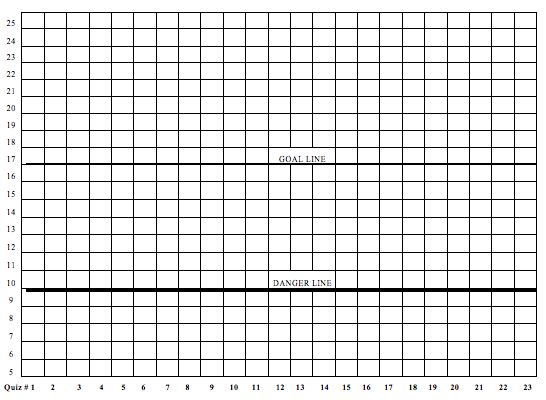
Opportunities to Reflect: It is tempting to never talk about a test or paper once it is passed back and in the grade book; however, a graded exam can be a powerful teaching tool. One quick way to do this is to grade a sample essay or exam in front of the class while students attempt to grade their own or follow along on a sample. Have them predict what they think they will earn on their exam and then pass out graded exams. Students should then reflect on the differences in grading between their self-assessment and the grade you assigned. I keep all exams in a binder with the students name on it on a big book shelf in my classroom. When we pass back exams or papers students grab their binder, inset the exam and then fill out tracking and reflection sheets. They track the fluctuations in score, the mastery of skill objectives and the accumulation of knowledge. The graph below is my quiz tracker that allows students to see their progress over time as well as whether or not they have met the passing mark (Goal Line) for each quiz. I also have a Danger Line to let students know when they are at an unacceptable performance level that will require after school tutorial and quiz re-takes.

Constructing a Path Forward: I have learned that students must believe they can and are getting better at the subject you teach because if they believe they “just aren’t good at X” or that they will inevitably fail your class then it is only a matter of time before they become noncompliant or even a huge behavior problem. Each assessment should show students exactly where they need to improve their performance. It is worth it to take some time to elaborate on specific steps students can take to do better on each particular objective or skill you are trying to teach. See below for an example reflection sheet for my Historical Investigations:


Although it can take some extra time and effort to make tests, even life-sucking standardized tests, become teaching tools it is ultimately well worth the effort. What do you do in your classroom to ensure students learn from summative assessments?