Category Archives: Reading

Ditch the lecture (or 8 tips to do it better)

You have likely heard that people only remember 20% of what they hear (which may be a rubbish statistic) and we all, theoretically, understand lecturing is a generally ineffective way to teach pretty much everything from science to math to bowling to potty training. I have a hard time letting it go mainly because I feel like I’m good at it AND I like to do it. Seriously, y’all. I’m funny, charming, I walk around the room a lot, I have a loud, clear speaking voice, I wear costumes, and my power points have cool pictures, large fonts and non-annoying transitions. It’s like I DID get to have that career in acting . . . captive audience! Colleagues, you know what I’m talking about.

The truth is kids do not learn if we just lecture, that is unless we are ineffectively executing alternative approaches. In fact, a recent Harvard study found:

. . . while problem-solving activities may be very effective if implemented in the correct way, simply inducing the average teacher employed today to shift time in class from lecture style presentations to problem solving, without concern for how this is implemented, contains little potential to increase student achievement.  On the contrary, the study’s results indicate that there might even be adverse effects on student learning.

This makes a ton of sense to me. I think we can all think of a time when we went to PD, heard about some amazing, alternative approach, did it in our classroom the next day and it was a total, epic fail. Regardless of how you approach direct instruction in your classroom, the key to learning anything is what is called the practice and feedback cycle wherein the student practices the skill or knowledge and then relieves feedback on their performance. Then they cycle begins again with more practice, this time better than the last, and more feedback.


Although teacher-centered instruction such as lecture can be effective, the main problem is it sucks up all of our class time and does not leave room for our students to practice. Rather than take an extreme position of “NEVER LECTURE EVER” I have settled on a few rules of thumb I personally follow to make sure my classroom is student centered:

  • Never talk for more minutes than the students’ grade level (i.e. 6 minute for 6th grade) without pausing for students to actively participate: We all have those moments where we look out over our classrooms, see the glazed look on our students spaced-out faces and realize we have become the teacher in Charlie Brown. We think we are teaching, our students just hear “Whamp, whamp, whamp, wahm, wahm.” My go-to ways to break up a lecture are: 1) stop and jot pause while students write the answer to a question and 2) turn and talk pause while students turn to a pre-ordained partner and talk about a question.
  • Setting up effective student-centered instruction is harder than just lecturing: The Harvard study hits the nail on the head. There is a reason why novice (or seasoned but less prepared teachers!) struggle to execute effective student-centered instruction. It requires buttoned-down classroom management as well as careful preparation. Here are two hybrid suggestions if you are just easing into shifting away from lecture: 1) “The Miss Messes Up” – purposefully make a mistake on a problem or example and post it up. Have your class read it and then write down where you went wrong. Then call up a student to talk through where you made the mistake and what they would do to correct it. Spice this up by acting indignant “What?! No I’m 100% right! What are you guys talking about?!?!” and then praising them for being eagle-eyed. 2) Modeling – write the essay as they watch and copy down what you do, solve the problem as they copy what you do. Just make sure you take time to pause and have them work on particular problems on their own. Also make sure you narrate the process going on in your head as you read, write or solve. Another strong idea is for students to record the process, instead of the example, as you model.
  • The more one-on-one instances of feedback the better: Find ways to bring the ratio down either through peer feedback or by individual conferences.
  • Use the yo-yo method: Instruct and then release to practice, clarify and release, clarify again and release again. Math teachers traditionally do this better than the rest of us. They model a few problems, answer questions and then allow students to work a set of problems. While students work the teacher circulates and clears up misunderstandings often bringing the class back to a whole group setting in order to emphasize points many students seem to misunderstand. In my history classroom, this process looks like me teaching a short 7 minute lesson of background on the Vietnam War. Then I would talk through the meaning of 3 political cartoons about Vietnam while students followed along. Then I’d have them work out the meanings of 10 additional cartoons in partners using their textbooks (or computers or, honestly, smart phones) to look up references they don’t get. I’d circulate as they worked and pull the class back together to clarify what “Kent State” is if everyone gets stuck.

How do you incorporate effective student-centered instruction and practice into your classroom?

Listening to Our Students

A visual representation of what a group of teenagers at a Imagining Learning event wanted their education to look like.

I have noticed a theme in this week’s posts: Listening to students. First in the children’s book Iggy Peck and then in an op-ed by a well-informed (if not a little snarky) high school student. I found this super interesting organization called Imagining Learning that goes around the country holding “listening sessions” with teenagers centered around the question:

“How do we educate young people to thrive in a world of possibility?”

Students talk through their answers to the question and then collectively create a visual representation of their ideas. Interesting if not a little “hippe-dippy” as some of my math colleagues might say. However the exercise reminded me of how valuable this structure can be in an academic context. I often have students explore a topic via reading and discussion and then task them with creating visual representations in groups. I find this strategy to be more effective for non-factual, higher order questions like: “Who should be blamed for the Arab-Israeli conflict?” or “Was Hamlet actually crazy?” or “Is cloning ethical?” A great way to ensure this exercise is rigorous is to wrap up the class by having students write an evidence based response to the question that was studied, debated and illustrated. Alternately, the writing could occur the next day after students have had time to look at each other’s illustrations and form their own opinion.

How do you show your students you are listening to them?

How much time should students get?

There is a short but interesting post over at Education Week that considers the question of how much time students should have on exams and assignments. The teacher essentially argues students should have as much time as they need and sees timed assessments as an artificial construction that doesn’t mirror real life tasks. True. However, as those of us in Texas can attest, there is a dark side to allowing students to take “as much time as they need.”

The state exam for Texas, known as the TAKS, permitted students to spend the entire school day on 40 – 50 multiple choice question exams. Some schools went a step further and forbid students to even turn in a completed exam until 2 in the afternoon on testing days in order to ensure they took their time and checked over their work. As a teacher, these were some of the most physically grueling (teachers couldn’t sit down, I was even given a pedometer once and encouraged to compete for the “most steps taken throughout the testing day”) and mentally lobotomizing days of my teaching career. Most students did take their time and usually finished just before lunch for a total of 4 hours testing. Once I had a student stay at school till 10:00pm finishing an exam because, she later said, she wanted to see how late we would let her stay. Students as young as 3rd grade were kept in the same room all day (lunch was eaten in the room) and only allowed out for monitored restroom breaks.

In addition to these ridiculous extremes the “as much time as necessary” approach led to measurable reductions in Texan students’ ability to perform on timed tests like AP exams and the SAT. I wonder though if the issue here isn’t with the time allotment but rather with the value and emphasis placed on these high-stakes exams? What if the same effort was dedicated to more rigorious academic tasks like conducting an authentic scientific experiment, writing a historical paper using a local museum archive, or learning how to file a tax return for a cupcake shop?  Or what if, God forbid, the same energy was spent on creative tasks like playing an instrument, painting a mural or choreographing a modernist take on the Nutcracker?

My thinking here really crystalized when I became a mother. I thought, “There is no way I will ever allow my daughter to sit for 8 hours in the same classroom with the single task of completing 50 multiple choice questions. It is simply inhumane.” So what can we do? Here some thoughts I’ve had:

  • Advocate for appropriate time limits for your students: Often the problem is not enough time as opposed to the TAKS situation. Teachers play a critical role in ARD meetings by advocating students with IEPs receive the time they need to be successful. Additionally, adapting a flexible or at least scaffolded approach to timed assessments can also help students who struggle with timing be more successful.
  • Make sure students are aware of time during an exam: Project a time on the front of your room or give students time updates by calling out minutes remaining or writing the time on the board. Encourage students to wear watches on exam days.
  • Lead your class in stretches before, during and after the exam: Sitting for such a long time is simply unhealthy. Help students – regardless if an exam is timed or untimed – by leading a class-wide stretching session. Roll the head, shoulders, do a few back twists and finish with some jumping jacks to get the blood flowing.
  • If time is inflexible (as with a state exam or the ACT) practice, practice, practice: The more realistic and authentic you can make practice exams the better. Time should play a central role in practicing for any timed high stakes exam. Students should get the feel of what the time limit for a particular exam is and should know, for example, how many questions to have answered by 1 hour in to the exam and what to do if they are running behind or if they have extra time.
  • If this all sounds crazy, have your child, or a child you love, opt-out: There is a time and place for standardized testing but many believe the pendulum has swung too far. It used to be considered fringe and radical but more and more parents are refusing to allow their children to participate in low-rigor, high-emphasis state tests. As with all civil disobedience there is a right and a wrong way to do this but I think there is potentially a lot of power in parents and students taking a stand through respectful non-compliance. Check out this website for more resources.

How do you handle timed assessments in your classroom?

What to do with a half day? Symposium!


Does your school have those quirky days where students come for just the morning? Do half days pop-up just before a holiday break or for extended professional development in the afternoons?  At my former school we struggled with how to use this day effectively. Cutting classes down to 25 – 30 minute whirlwinds was crazy but at the same time we wanted to make sure we maximized learning time. A couple of my colleagues and I came up with the idea of conducting mixed grade level reading, discussion and writing seminars called symposiums.

Because our school is an International Baccalaureate (IB) school we centered each symposium around one of the IB Learner Profile traits:

We selected Risk-takers as our first trait and then crafted a central question to frame the readings and discussion within the symposium: What is a good risk? We wanted to build a session that started with an ice-breaker, included both collaborative and independent reading time, whole and small group discussion, as well as independent writing time. We choose the following texts for our Risk-takers symposium:

Text Genre Synopsis
“The Road Not Taken” Robert Frost Poetry The famous poem about taking “the road less traveled by”
“Woman Hollering Creek” Sandra Cisneros Short Story A young woman leaves her family in Mexico to get married to a man in Texas; he treats her terribly and she is faced with another decision
“Letter from Birmingham Jail” Martin Luther King, Jr. Letter King defends his decision to come to Birmingham – even though it landed him in prison
“Reviving Ophelia” Mary Pipher Nonfiction Pipher explains her research that shows how girls become less and less confident in school when they enter middle school
“After Long Decline, Teenage Pregnancy Rate Rises” Tamar Lewin Newspaper This article looks at the trend of increased teenage pregnancy and interviews experts on the subject(see link below)
Frieda Kahlo Artwork  Self-Portrait with Cropped Hair, 1940 and Self Portrait with Thorn Necklace and Hummingbird, 1940

If you would like the full teacher and student guide for the Risk-takers symposium it can be downloaded here. The discussion with my group of 20 9th – 12th grade students was lively, fun and informed by the texts. It was a great way to incorporate both fiction and non-fiction texts into a source-based discussion and writing experience for students. It also allowed students to get to know kids from other grade levels which helped get at some cross-grade tension we were experiencing. I enjoyed watching my 12th grade students take the lead on answer and posing questions during our discussion time as well as help clarify misunderstandings during group work.

The downside was us teachers spent from 8 – 12 without so much as a bathroom break; however, I have had years where my planning period isn’t until the last period and I run that schedule anyways. The upside was one collective planning effort served as lesson plans for the entire high school. At any rate, it was a whole lot better than movies and class parties!

Anyone else have an innovate approach to half days?


Popular Pedagogy: Project-Based Learning

Recently there has been a buzz around both flipped instruction (where students are exposed to material at home via online content before practicing in class) as well as project based learning (PBL). I experimented with flipped instruction last year using Edmodo as a launch point for online content I linked to my class. I felt so-so about the experience but chalked it up to being 8 months pregnant and a fist time flipper. However, I’ve never really given PBL a fair shake. But I’ve recently seen more articles and resources out there on project based learning. I wanted to share them here and see if anyone else has advice for teachers who might be considering making the switch to PBL.

  1. “The Flip: The End of a Love Affair” by Shelly Wright – This teacher describes why and how she shifted her instruction from the flipped model to project based learning. It is a quick read but also a well thought out argument in favor of using projects to engage students in authentic learning.
  2. “For Authentic Learning, Start With Real Problems” by Suzie Boss – This is a condensed explanation of what project based learning is as well as some resources for making it work in various types of classrooms.
  3. Project Based Learning at Edutopia – A clearinghouse of examples and tips for teachers looking to try out project based learning.

What is your experience with PBL? Please share links, stories or potential help for others (OK, so help for me) if you have a moment.

The Most Important 10 Minutes of Your Class Time

In my first years of teaching, I often felt unsure at the end of each lesson. Did the students learn? Was my lesson good? But I remember one lesson where I thought I had totally and completely dominated. I mean I just taught the heck out of apartheid in South Africa. We looked at maps, I gave a engaging (even moving!) 10 minute lecture, we did an awesome role play I stole from History Alive!, the kids were digging it, I played mood music during group work – I was basically Robin Williams in Dead Poets Society. I’d planned to have students write a brief essay at the end of class as a daily assessment but we ran out of time. “Oh well,” I thought, “it’s OK because we got through the lesson.” Imagine my total shock when well-over half my class failed to clearly describe the impact of apartheid on our unit exam. “This is not my fault,” I said, “I taught a beautiful lesson – these kids never study!”

The exact situation above played out so many times in my classroom that it became a patter I could not ignore. WTF??! Upon reflection I realized the only thing I wasn’t doing was closing out the lesson. Here is what I now know: how I close my lesson will likely have the greatest impact on whether or not my students learn the objective.

Effectively closing a lesson is critical for two big reasons: 1) it allows students to synthesis or summarize their learning and 2) it allows teachers to know if the lesson was successful and identify misunderstandings and trends in individual as well as overall learning. Below are my top five end-of-lesson strategies:

  1. Written Reflection: This is super easy but such an important skill to develop. I simply take the objective and re-phrase it as a question (ex. SWBAT describe the impact of apartheid. What was the impact of apartheid on South Africa?) and have students spend 5 minutes writing a response. I usually have them attempt to do it from memory and then use their notes or handouts if they need to. I check each of these at the door as they leave and jot down on my all-in-one seating chart (click here to see it) who I need to come back to or what trends I notice.
  2. Draw a picture: Students take the information we studied and draw either one picture or a series of picture illustrating the concept.
  3. Interpret the source given what you now know: I put up a source of some kind – map, political cartoon, graph, written source, etc. – and have students explain it given what we just learned. Why is this cartoon funny? Why is the author of this source angry? What event is this passage referencing?
  4. Three-Two-One: Write down 3 things that really interested you, 2 questions you still have, and 1 idea you are going to write a page on tonight for homework
  5. Give one, get one, move on: Students divide a sheet of paper into nine boxes (three rows and three columns). Have them fill three of the boxes up with three ideas or pieces of information they remember from the lesson. Then have all students stand up and exchange what they wrote with their classmates. For every person they talk to they have to give that individual a new idea or fact, get a new idea or fact in exchange and then find another partner. If they find a classmate that has the exact same facts or ideas as they do then they should move on and find someone else.

Fine, but how the heck do you fit this in when class time is already so stinking short!?! I know, I know. Here’s what worked for me: I had a kid tell me when it was the last 10 minutes of class. I’ve also set a timer to go off at 12 minutes before the end. I also made a big sign that I posted at the back of my room that said “Close Out!” And when the time came, I stopped what we were doing if we weren’t finished and closed the lesson.

Colleagues, this single action was what brought me from interesting teacher to effective teacher. What closing activities do you all use?

Ode to Office Supplies: Post-It Notes

It’s been a few weeks since I last sang the praises of a particular office supply (the Moleskine, read the post here) so today I thought I’d tackle the ubiquitous and versatile post-it note. Here are my top 5 ways to use that cute little slip of sticky paper:

  1. Student of the Week Shout-Outs: Every week, I pick a student from my homeroom to feature as the “Student of the Week.” I write the student’s name on a 3×5 card and then have him list five things he wants people to know about himself. His classmates and I then write affirmations about him on post-its and we put them on our classroom door around the student’s name and fact sheet. I have post-its available for others to add affirmations throughout the week. My husband does the same thing but takes a picture of the student and puts it in the middle with the affirmation post-its all around – he call is “The Homeroomer of the Week.” As in, when it’s your week you are “homerooming.” Teacher jokes, teacher jokes . . .
  2. Daily Assessment: If my daily assessment involves students writing a 1 – 3 sentence answer I will often have them write the answer and their name on post-it notes and then put them on the white board as they exit the classroom. I can read the entire classes responses quickly and get a clear idea of mastery.
  3. Opinion spectrums or corners: On of my favorite ways to use post-its is to draw an opinion spectrum (strongly disagree to neutral to strongly agree) and have students respond to questions on post-its and then place their responses along the spectrum. I do this for content questions (i.e. Should the US have become involved in Vietnam?) as well as classroom culture questions (i.e. How prepared were you for the exam we took today? Explain your answer.) Opinion corners provides another dimension to the spectrum. Draw a square and divide it into fourths. Each quadrant represents an opinion position. For example, the question “Whose fault was the Kent State Massacre?” could have quadrants named: the protesting college students, the national guard, the Kent state professors, the United States government. Students would write their answers on the post-it and then place them where they belong. This is nice because it allows for multiple answers – you could place a post-it in between the college students and national guard boxes to indicate you blame both or in the middle to indicate you blame all four groups equally.
  4. To make tab dividers in notebooks: You can buy the swoon worthy babies below or just use mini-post-its for the same effect.
  5. To annotate textbooks or other school-owned books: It is so important for students to learn how to annotate properly and to save their annotations for expository essays or research papers. However, it often isn’t possible for all students to buy a copy of the book you are using in class. I have students make notes on post-its and just keep these in the books for the duration of the time we are using a particular text. Then at the end of the unit or year we just take them out. I like the large, lined post-it notes for this task and encourage students to write page numbers on the post-it next to teach of the comments they are writing down or quotes they want to copy/remember.

How do you use post-its in your classroom?

Great Books: When Kids Can’t Read

If you haven’t read When Kids Can’t Read by Kylene Beers, here are five reasons not only to kiss a copy but to crack it open and have a look:

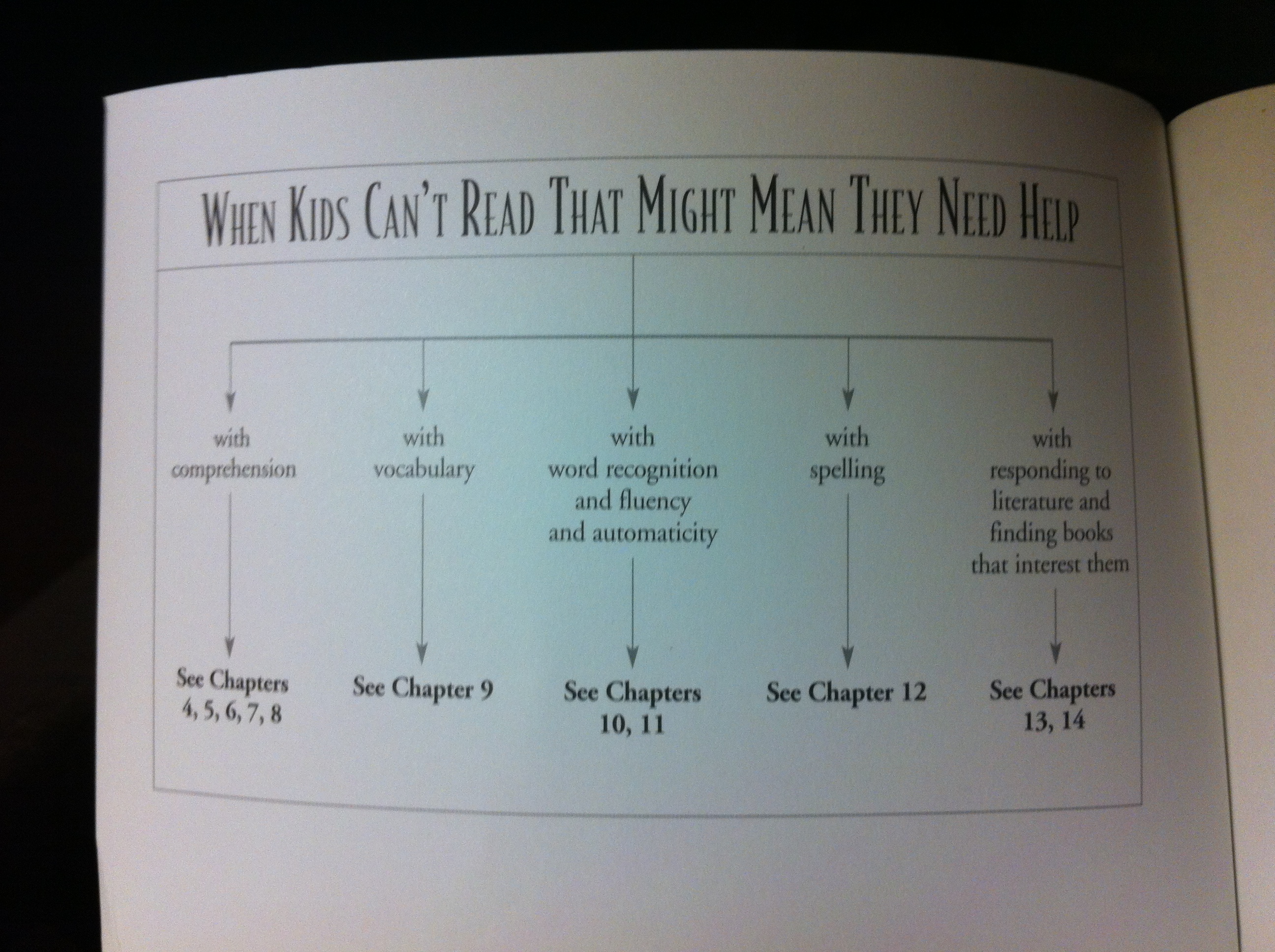
  1. It has a cheat-sheet inside the front cover so you don’t have to read it all: If you’re anything like me, sometimes you freak out because you teach 12th grade and one of your students appears to actually not be able to comprehend what he/she reads. Never fear! Simply use the handy little flowchart at the front of the book (see below) and turn to the chapter you need.
  2. There is an amazing, mind-blowing chapter called “Creating the Confidence to Respond” that changed the way I teach: This chapter speaks to how students perceptions and attitudes around reading often hold them back as much as (or more than) actual lack of literacy skills. The capter is filled with practical strategies like ensuring students know each others names and ways to celebrate diversity. These ideas built student confidence in my classroom both in terms of reading AND overall academic ability.
  3. Bookmark Templates: One of the golden ideas from the book is to have students read with an accordion folded bookmark (see below) and make notes on various topics as they read. There are different types of bookmarks – a great one is “Mark the Bold” where students write down the bold terms in a textbook thus assembling a vocabulary list all in one place.
  4. Amazing, student-friendly, diverse and gripping book lists: In the book’s appendix there is a collection of book lists under categories like “Humor and Laughter,” “Biographic, Autobiographic and Historical Fiction,” and “Realistic Fiction.” The author has assembled a really compelling list of books that I have found super helpful over the years.
  5. Get a crash corse in literacy: In a perfect word, all teachers would get masters degrees in literacy (or have a literacy specialist working alongside them in their classrooms – holla!!). However, if you find yourself lacking in literacy skills this book is great. There are clear definitions of literacy jargon like fluency, automaticity and comprehension as well as tools like basic reading level tests.

Anyone else love this book?


Feeding Two Birds With One Hand: DBQ on Me


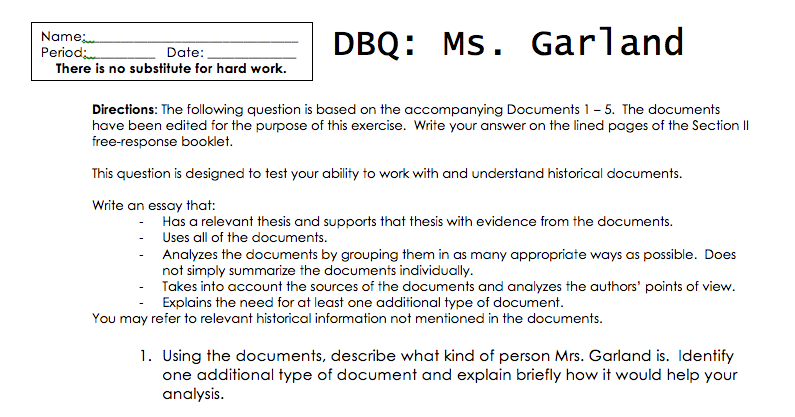
One of the tricky objectives to cover at the beginning of the year is to teach your students how to write content specific essays (ex. Document Based Questions (DBQs), Source Based Questions, Lab Reports, Personal Narratives, etc.) using texts from your content (primary sources, evidence gathered from a lab, fictional texts, etc.). My favorite way of introducing the format I want students to use is through a non-content related topic. For example, in my World History class students had to write essays (DBQs) using primary sources and so the first essay we tried was a DBQ on me that used primary sources not from history but from my own life. This serves the dual purpose of 1) teaching my students how to write using the correct format and 2) introducing more of myself to the class via an important academic skill – feeding two birds with one hand. I can uses the text to teach my students annotation and careful reading as well as the format I want them to use to write their essays. When we are finished, I show them an exemplar response I wrote and have them compare their essays to both the exemplar and to the official rubric we will use throughout the year.

I think this could easily be adapted for a science lab, poetry unit (write a biographical poem), or math paper. I know other teachers do similar lessons at the beginning of the year and I would love for people to share them out here . . . borrow and steal.