Category Archives: Education Policy

Keeping Up with Education News

In my first five years as a teacher I essentially did not read about education news, follow education policy issues or, let’s be honest, think beyond the four walls in my own classroom. Here are my personal go-to sources for the latest scoop on education issues:

  • Accomplished Teacher: This is a virtual news brief that gets delivered everyday via email. It is basically a compilation of articles from various websites, publications and blogs all dealing with education. I like Accomplished Teacher because I can skim this email and get the headlines and summaries of major/current education news.
  • The Huffington Post’s education page: A grab bag but easy and quick to read. I like the posts from actual teachers about education issues.
  • The New York Times education page: There are often interesting stories about education research and studies here – plus it’s the New York Times.
  • Education Week: I remember being told by a 20+ year veteran teacher that I had “a professional obligation” to read Education Week. I particularly like the Teacher page which highlights news for teachers. They also put out a nice newsletter that has article briefs for quick reading.

So I realize that is only 4 sources . . . but teachers are busy! Add to this NPR (on the ride to/from work), the McAllen Monitor, the New Yorker and Texas Monthly and you have pretty complete picture of my information sources.

Where do you get your ed news from?

What should we do with excellent teachers?

This is my buddy and former colleague Jenny Corroy (the woman in the hip shades, not the fabulously feathered chicken). Jenny began teaching in 2004 and now, eight years later, is one of the finest educators/people I know. Point in case: this past spring 80% of her predominately Hispanic and low-income students at her open-enrollment public school passed the International Baccalaureate Language A (English literature) exam – she basically closed the achievement gap for her content. Every time I talk to Jenny or visit her classroom or look at her materials I become a better teacher (and person!). At the school where she works, her ideas and ways of teaching influence her colleagues and administrators.

Despite her extraordinary achievements Jenny makes the same as everyone else (even teachers who potentially received negative performance reviews) and her salary increases at a lock-step with an occasional small bonus (which, again, almost everyone automatically receives). Additionally, beyond being a content or grade team leader Jenny has no opportunity to move forward professionally without leaving what she loves most – teaching.

So what should we do with Jenny? Study after study has shown us that exceptional teachers are the silver bullet when it comes to the achievement gap (check out a fascinating report by TNTP on the “irreplaceables” – teachers like Jenny). How could we expand Jenny’s influence to reach more students? In my perfect world, Jenny would continue to teach but have more conference time during which she would coach other teachers and lead a school as a lead or master teacher. She would also make six figures. There is a great article over at Education Week called Expanding the Impact of Excellent Teachers which has more ideas for how great teachers could potentially make an even bigger impact. I’m not sure how I feel about one of their ideas – putting kids infront of computers to save money on teachers (actually, I am sure how I feel about that) – but I think there could be other more meaningful ways to use student’s time like internships at local business or law firms or volunteer options at hospitals and nursing homes.

Moving Beyond Advanced Placement

I taught Advanced Placement History and Geography for four years during which time I participated in the annual Reading (where the essay portions of the exams are graded) twice and attended a number of official week-long AP trainings. I was in love with the AP World History course – but the relationship soon became rocky. Despite our collective best efforts, the students at my open-enrollment high-poverty school struggled to be successful on the exam. We tried Saturday school, tutorial, vertical alignment, longer school days, meticulous tracking of knowledge and skills and still we struggled to see passing scores beyond 15% of all students. The percentage passing was even less in subjects like AP Literature and AP Biology.

What is worse is that my students went on to college unprepared to write expository essays simply because there was no time in the AP curriculum to accommodate teaching students to write a research paper. It was so hard to hear how my students struggled in basic classes because they were unsure how to use MLA citations or find reliable sources. At my school, we began to wonder just how college preparatory courses a mile wide but an inch deep really were . . . how many history courses did you take in college that 1) covered 10,000 years of history in one exam and 2) involved 70+ multiple choice questions?

For IDEA College Prep the solution was moving to the International Baccalaureate (IB) curriculum which all but eliminates multiple choice, narrows content matter to specific objectives, and includes out-of-class research papers and labs. Because IB places emphasis on analysis and skills over content knowledge, students who might struggle to read a college-level text or engage in route memorization are actually more successful. This past year, IDEA’s second year of producing IB graduates, 45% of students passed their history exam. Today I was fascinated to read about how some of the most elite schools in the country are getting rid of AP altogether. Check out this short but pithy article over at Mindshift for the more background about schools making this shift.

A little RESPECT

Image

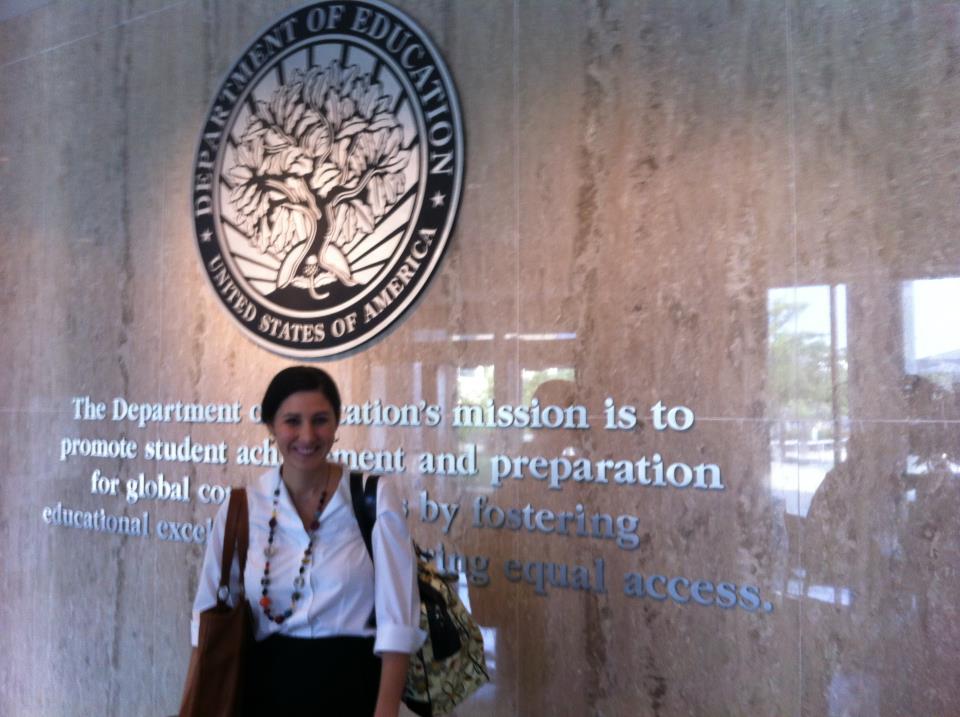
Super grainy photo of me at the Department of Ed (Photo Credit: a really nice security guard who said “Do you want to take another next to the Secretary’s picture?”)

Yesterday I spent the day with teacher leaders from around the country discussing the Department of Education’s initiative called the RESPECT project. The goal is to elevate the teaching profession by completely re-envisioning what it would look like to become, be and remain a teacher in the US. The project is still in its formative stages and today was about getting various groups (including the AFT, NEA, TFA, E4E, and the organization I represented the America Achieves fellowship) together to give feedback on the project’s draft vision statement. The draft is still under wraps  can be read here and the Department of Ed is planning more feedback sessions in the future. If you just want a quick overview, here are a few highlights:

  • reorganized classrooms that move away from a closed door and rows of desks to include open classrooms, integrated technology and schools defined by teacher collaboration
  • an extended school year and day that allows teachers greater flexibility for working with students, planning lessons and collaborating with peers (this also included ideas like moving away from age-based grade levels, hybrid teaching positions with lots of release time, and off-school-site learning)
  • distributed leadership (shared administrative responsibility between principals and lead teachers)
  • teaching career pathways that start out with a Residency (like doctor’s do) and end up with Master Teacher positions where teachers make up to $150,000

Sounds good right? But if you’re any thing like me distributed leadership, hybrid positions and $150,000 salaries seem like pie-in-the-sky. That being said I left the meeting feeling really hopeful that before I retire I might seem some of these changes become reality. There is no question teachers have a public perception problem in this country and unfortunately the effects of that are evident in the achievement gap and under-achieving classrooms. However, one of the biggest messages of the day was that if the teaching profession is going to be overhauled it is going to be done by teachers. As Secretary Duncan said, “The Federal government did not start the Civil Rights movement.”

Economic Integration in Our Schools

I have spent most of my career at IDEA Public Schools where I have had some really amazing colleagues, students and friends. At IDEA College Prep in Donna, Texas over 80% of students receive free or reduced-price lunch. I am committed to a career of serving low-income communities in South Texas but I always wondered what it might look like if there were more economic diversity among my students. At IDEA, 100% of our students have gone on to matriculate to a four-year university and I know many of them have struggled with the class differences between themselves and their peers – perhaps even more so than the racial differences.

My incredible sister-in-law, Sarah Garland, has written a really provocative and interesting article for The Atlantic  about the significance of increased economic integration in schools. It is well-worth the read!