Category Archives: Education Policy

The Civil Rights Movement of Our Time

Me on the set of NBC’s Education Nation; I’d probably have a similar expression if I had my picture taken in Buckingham Palace.

To say “education is the civil rights issue of our time” is to say what many, many others have said before and it’s stating the painfully obvious. Thirty years ago the US was rife with major racial inequities but led the world in terms of education; specifically, in the percentage of secondary and post-secondary degrees. Today the US is 14th in post-secondary degrees and 22nd in percentage of high school degrees. In the 1970s, 1 out of every 4 jobs required a college degree and today 2 out of every 3 jobs require some college. As Jon Shnur, the founder of America Achieves, said “Today the minimal ticket to a middle class life is some kind of post-secondary degree.” Our education situation is disconcerting for all Americans; however, for minorities and those from low socio-economic backgrounds the achievement gap is formidable.

At Education Nation this week I heard from some of the most powerful figures in education like Secretary Arnie Duncan, Mayor Michael Bloomberg, and the founder of the Harlem Children’s Zone Geoffrey Canada. Everyone agrees we in a special moment of American history now – we are standing at a crossroads. This is the third time I’ve been to NBC’s education conference but what was different this year, is how everyone kept talking about the significance of teachers – not new curriculum, buildings, supplies or even social services – in solving our eduction crisis. Within the spectrum of “union bashing” to “let’s give teachers more Best-Teacher-Ever mugs!!” I experienced a real shift in my thinking about the achievement gap: when we elevate the teaching profession, we will see student achievement soar.

I’m not the only one who thinks the key is increased respect for teachers. The Gates Foundation has also identified this shift as the main mover in education reform as well. I attended a fascinating presentation by the Gates Foundation on a McKinsey & Co. report they just funded (and is not yet released!) about how to potentially elevate the teaching profession. They studied high-performing countries like Singapore and Finland who recently made big changes in their education systems and looked at how teaching moved from a less to highly respected profession. Additionally, Gates looked at other professions in the US – like engineering and, interestingly, nursing – and studied how these professions rose to prominence. They found that in some cases, like Singapore, changes were implemented from the top down. Officials increased the salary of teachers as well as raised the requirements for becoming a teacher (Singapore only accepts 8% of those who apply to become teachers) and low and behold, a decade later their country is a world leader on almost all measures of student achievement. However most examples of successful professionalization begin within the profession: nurses form an association, lawyers create the LSAT as a gateway to law school, doctors outraged with snake-oil sellers write a code of ethics for their profession. Then, often over the course of 100 years, the professions move from a collection of underpaid, under-educated, and under-respected workers to widely admired experts. Along with this advance comes major leaps in quality as well; higher respect for nurses results in better healthcare.

One exciting development aimed at increasing the respect afforded to teachers is the Department of Education’s RESPECT Project which will (depending on what goes down in November) be tied to a Race To The Top style competitive grant. This money would be used by districts and states to fund new career tracks, master teacher programs, reorganized school days, and other initiatives centered around increasing respect for teachers. All of this interest in teacher effectiveness is really exciting (and potentially damaging, as it was in Chicago) but I believe change will come not from the Department of Ed or the Gates Foundation but from teachers. If education is the civil rights issue of our time then the agents of change will likely look like the Civil Rights movement – a grass roots endeavor comprised of ordinary people who were fed up with an unjust system. For every Martin Luther King, Jr. there were thousands of maids who walked to work everyday for two years in Birmingham, students who sat with quiet dignity at lunch counters, and voter registration workers who set up tables in small towns all across the south.

So colleagues, I ask you: what does it look like for us to remain in our seat at the front of the bus? What does it look like for us to boycott an unjust system? What does it look like for us to carefully prepare to be non-violent when we are attacked by police and dogs so that the rest of the country will be appalled at the resulting images they see on the nightly news?

I suspect a large part of this shift will look like dramatic restructuring of our school day/calendar as well as the power structures within our schools. Principals are a historical hold-over from a time when teachers where groups of women and minorities who needed a white man in an office to keep them in check. Why couldn’t teachers run schools in the same way senior lawyers run law firms? Certainly more people would become teachers and stay in the classroom if there were pathways to authentic power within their schools.

So what do you think? I am deeply interested in other teacher’s thoughts on elevating this profession . . . please leave comment. A great first step in our movement is to begin talking among ourselves.

“Should teachers be allowed to sell their lesson plans?”

A kindergarten teacher in George has made a million bucks selling her lesson plans online. Holy. Cow. Read about it in Andrew Rotherham’s article here.

How does your school district’s performance stack up?

The George W. Bush presidential library has an interesting (although, really over simplified) tool that enables you to compare average math and reading exam results for any public school district (both charter and traditional) with state, national and international figures (see above for an example of my hometown compared internationally). This tool is called “The Global Report Card” and is fun to play around with; but keep in mind that in addition to being a cool little application, the site is definitely promoting a pro-reform agenda.

US Education Spending vs. Performance

The graphic below, from the University of Southern California,  provides a nice comparison of US spending and academic performance as compared to other countries.

A quick social studies teacher note: this figure shows total annual spending and not percentage of GDP or spending in relation to population, etc. Although the US spends way more than Finland I would be interested to see what this looks like in comparison to GDP or spending per pupil.

“Throwing Money”

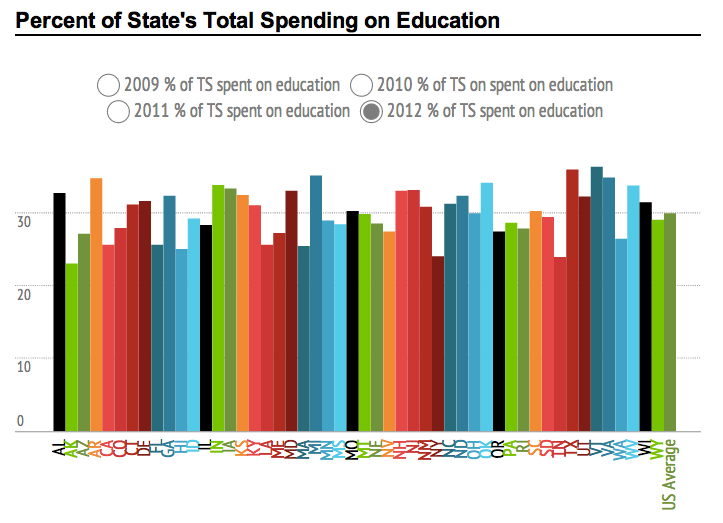
In any education debate, there are always two positions on education spending: 1) throwing money at the problem isn’t making things any better and 2) money is essential for underperforming schools – especially those in poor areas – to succeed. Last week the non-profit group State Budget Solutions released a report with title that left no doubt as to where they stand on the issue:  “Throwing Money at Education Isn’t Working.” Below is a graph of state expenditures as percentage of total budget.

The report shows education budgets have doubled since 1970 and yet the achievement gap by race and social class is still wide while US test scores have failed keep up with those in others countries. It then recommends control over education spending should happen on a local level rather than at a state or national level. This is an interesting argument at a time of Common Core implementation around the country.

As a teacher who has taught in schools where money is tight I have to really scratch my head at this report. I have had class rosters over 40 and not a single textbook in my room because of budget difficulties at public schools – and all of this in the state of Texas which spends near the top in terms of percentage of budget dedicated to education. Here is a look at how the spending per pupil has increased in Texas just since 1998:


To read the full report from State Budget Solutions click here or if you want a snappy little summary check out this article from Education Week.

What do you think about the role of money in education?


Why one Chicago teacher supports the strike

Want to hear why teachers in Chicago are striking from a veteran Chicago teacher? Read Lindsey Rohwer’s moving argument in support of the strike here.

Are US teachers paid as well as those in other countries?

Teachers say “I don’t do this for the money” so often it has become almost a descriptor of a good teacher. Teachers don’t actually need our salaries to survive, we live on the sheer beauty of our jobs. As if we could cash in the “I love you” cards from our students or, through osmosis, eat their high grades and test scores.

But money does matter. As much as I love teaching I also have financial obligations and responsibilities – like my two daughters – that require a salary. There is an interesting opinion piece at The New York Times about a new report released by Organization for Economic Cooperation and Development that compares salaries and hours worked by teachers in developed countries. The statistics are fascinating and provide insight into yet another aspect of why Chicago teachers are on strike. Click here to read more.

Does money matter to teachers?

The Strike in Chicago: What’s the big deal?

As a teacher in the very non-union state of Texas I have had to stay on top of the Chicago developments (via the news as well as some friends who teach in that city) in order to understand what everyone is so worked up about. Here is an over simplification: the strike isn’t about salary, it’s about not having 50% teacher evaluations linked to student performance on standardized tests and getting laid off teachers re-hired (if you want a more information, checkout this article at the New York Times or the extensive coverage at the Chicago Tribune as well as the Washington Post’s summary here).

What is really interesting about this strike is it pits traditionally Democratic labor unions against a Democratic Chicago mayor with best-friend ties to the president. Opposition to the Chicago teacher’s union strike may be the one issue both Obama and Romney agree on! It is easy to look at this strike and quickly conclude these teachers are ridiculous. What on earth is wrong with firing bad teachers?!? And, if you’re doing your job, why worry about linking standardized tests scores to your performance evaluation? I’ve heard super-lefty education reformers AND Rush Limbaugh both make snide, dismissive remarks about Chicago teachers that make us picture our own worst teachers (you know, the one that played movies, joked around with the popular kids, and put you in detention when you called him out for being wrong?) holding a poster that says “Give me what I deserve!” and yelling populist chants as copious spit sprays from his wide-open mouth. Ok. Wipe the imaginary spittle off your face, surpress your high-school angst and let’s take a closer look.

Teachers are public sector employees who’s salaries are paid by tax payers and so they should be held accountable for what happens, or does not happen, in their classrooms. Period. That being said, figuring out how to measure teacher quality has proven to be exceptionally difficult. Currently, the popular means of doing this look like various rubrics that act as checklists which put teachers in a spectrum ranging from unacceptable to excellent. The Obama administration, through programs like Race to the Top and the NCLB wavers, has incentivized attaching standardized test scores to these rubrics. But why use a generic measure for what is a very specific, individualized performance?

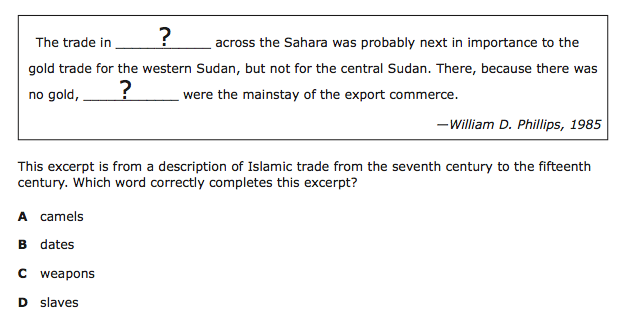
Teachers are not NFL quarterbacks whose performance can be measured anywhere and anytime with the same tool (i.e. yards thrown, run, touch downs, etc.). In fact, a truly excellent teacher is differentiating her instruction on a minute by minute basis for every single student depending on his or her needs. Standardized tests measure a students performance on on a single day on a small number of questions that are often sadly lacking. As a social studies teacher, these questions hardly get at the essential knowledge of my course and often don’t even touch on the skills foundational to understanding history (understanding bias in primary sources and defending a thesis). Check out the question below from the Texas 10th grade World History exam for an example of what I’m talking about:

And what if you teach art? Or PE or music . . . well you’ve most likely been fired given the current obsession with STEM and literacy to the exclusion of all other subjects so don’t sweat it. The truth is standardized testing results are not the products of teachers. Students who are more knowledgeable, skillful, and better equipped for citizenship are the products of teachers.

In a democracy, the role of public education is to provide a citizenry that will sustain the republic via informed voting, tax-paying, and activism. While the ability to take multiple choice test is necessary at times (SAT, GRE, LSAT, various professional accrediting exams, etc.) when was the last time you saw a job description that included the line “Must be a strong multiple choice test taker?” Additionally, teachers help children learn to cooperate with others as well as problem solve when interpersonal conflicts arise. Teachers also foster creativity and critical thinking – the cornerstones of what makes the US so innovative. Add to that character and value development (like a strong work ethic and empathy) and teachers are literally holding up our civil society. The impossibility of measuring these products through a standardized test is at the heart of what is bringing teachers to the streets in Chicago.

I would argue the people best suited to evaluating a teachers performance are the parents of our students. They are the tax payers and it is their children’s future on the line. This could look like a situation where parent evaluations where 50% of teacher evaluations but parents might lose the right to evaluate their child’s teacher if they did not attend a set number of parent-teacher conferences or volunteer for various classroom support roles. Every teacher I know would gladly put their job on the line if it meant guaranteed increased parent involvement. Studies show over 80% of parents are satisfied with their children’s teachers  so I doubt such a move would result in massive teacher lay-offs (the link is about satisfaction with local schools but I’ve seen the same numbers for individual teachers, anyone out there know the study I’m thinking about?). Standardized tests could make up 20 – 30% of a teacher’s evaluation but the majority should rest with those who have the most to lose or gain from a teacher’s performance.

I worry the fight in Chicago is a nice way for Republicans to brush aside unions that play an important role in protecting labor rights while Democrats delude themselves into thinking they’ve found a solution for the achievement gap (teacher quality evaluation) that rest in the hands of the government rather than the people. In the United States our country’s physical size and extensive diversity makes individual participation in our democracy complex but teacher evaluation seems like the ideal place for a tax payer and parent to have a direct say.

*the official answer to the history question above is “A. camels” . . . don’t ask me to explain it, I’m just a history teacher

What about the girls?

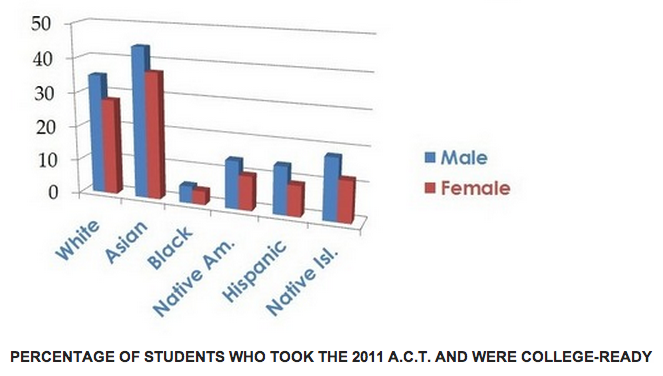
I came across this super-upsetting graph in an newsletter from the Department of Education (called Teaching Matters, you can sign up for it here). This data comes from a new report from the National Center for Education Statistics (NCES) on gaps in access and persistance in higher education (for full report, click here) I’ve found the ACT to be such a line in the sand in terms of college readiness and the chart above clearly illustrates the race and gender discrepancies in scores.

There are several really gripping findings in the study but another chart that jumped out at me was the one below which shows passing percentages on Advanced Placement exams by subject, race and gender.


This chart is even more troubling because more often than not AP classes are not open-enrollment and so these scores represent the top performing students and not the population at large. Although performance by race differed dramatically in many subjects I was stunned to see how wide the gap is for young women of color.

One of the central moments of my development as a teacher was in my second year when my principal sat in on my lesson and kept a record of student-teacher interactions (questions asked, hands raised, cold-calls, reprimands, etc.). At the end of class he wrote on a post-it “Interesting lesson! What about the girls?” As I looked at the chart, I was stunned to see that for every interaction with a female student I had almost three more with a male student. I was giving almost three times the attention to boys in my class. I was mortified. I had read Reviving Ophelia! I took TONS of women’s studies classes in college! I was only two years out from writing my undergraduate thesis titled Can We Milk This Tiger: A Study of Feminist Theory and Revolutionary Praxis in Central America and I there I was actually favoring my male students.

Unfortunately, the data above shows I am not alone. What about the girls?

Is Teach for America working?

This past weekend the New York Times’ “Room for Debate” series considered the question: Is Teach for America working? Responses ranged from “It changed my life” to “No” to “If anything, they work to hard.” But the opinion piece that caught my eye was “A Glorified Temp Agency” by University of Texas professor Julian Vazquez Heilig. Essentially, Heilig makes the argument that “more than 80 percent of [TFA] recruits leave for graduate school or another career before their fourth year.” He explains how these teachers “see a teaching stint with Teach for America as simply a résumé builder” and how TFA “is a revolving door of inexperienced teachers for the students who most need a highly qualified one.”

I have heard this criticism before (the prize for most hilarious goes to the Onion’s point/counterpoint article titled “My Year Volunteering As A Teacher Helped Educate a New Generation of Underprivileged Kids vs. Can We Please, Just Once, Have a Real Teacher?”) and it really rankles me. Here’s why:

The problem of educational inequity is caused by a multitude of factors: poverty, poor healthcare, lack of nutrition, underperforming schools, etc. It makes sense that the solution to this problem will be multifaceted as well – there is no silver bullet for the achievement gap. In my mind, we need as many people as possible working towards inventing and implementing various solutions. So when I hear education professors taking education non-profits to task for not doing enough it kind of feels like cannibalism.

I’m not sure if TFA is “working,” or even what that might look like, but I do know it worked for me. I fell in love with teaching the first time I stood in front of my own students on August 25, 2003. I knew, deep in my heart, I was doing at that moment what I would do for the rest of my life. That being said I had (have?) many, many doubts along the way. I did not want to be a teacher because it seemed like settling for 3rd place (not even 2nd!). Our society thinks teaching is really un-sexy and certainly a waste of time if you have any brains or motivation to speak of at all (“Those who can’t do, teach”). Even my own grandmother said, “It’s just that I had such high hopes for you!” and she WAS a teacher herself!

Within Teach for America I found a group of exceptional people who were not only interested in teaching, they loved teaching. People spoke about teaching in hushed tones of reverence and absolutely poured themselves out to be better teachers. As much as I “do my own thing” regardless of what others think, I believe having a community of smart, accomplished people who really value teaching has strengthened my own commitment to the profession. As Arne Duncan said, “Teach for America made teaching cool again.” Add to that the countless resources, examples, role-models, and friends I have encountered through Teach for America and there is no question about the role the organization has played in my life – I am a 10 year classroom teacher because of TFA. Without it, I would be doing something much, much less cool.

Thoughts about TFA?