Category Archives: Education Policy

Character Report Cards

KIPP Report Card sample

In Paul Tough’s new book How Children Succeed he provides compelling evidence for how so-called character strengths, such as self-control, optimism, and grit, are what make people successful or not. A large chunk of these attributes are instilled within us as babies and toddlers (for more on that click here) however Tough provides evidence that these traits can be taught to teenagers. His prime example is the KIPP charter school’s character report card (pictured above).

KIPP’s approach to teaching character involves a multi-faceted approach which includes everything from banners and t-shirts to bulletin boards where students “shout-out” each other for various traits to the character report card. One of the driving reasons behind creating the report card is KIPP wanted to show students and parents that character (like intelligence) is malleable and can be learned. Teaches use descriptors such as “Comes to class prepared” and then evaluate students on a scale and average scores to reach an index for each of the 8 traits KIPP assesses: grit, self-control, zest, social intelligence (both academic and interpersonal), gratitude, optimism, and curiosity.

At one of the first report card nights where the new character report was rolled out Tough describes a conversation between an African-American woman, her eight-grade son Juaquin, and his English teacher Mr. Witter. The teachers tells the mother that the report card represents traits that are “indicators of success.” “They mean you’re more likely to go to college. More likely to find a good job. Even surprising things like more likely to get married, or more likely to have a family,” says the teacher. After discussing the parts of the character report card where the student scored well the teacher turns to the low numbers:

“The first thing that jumps out at me is this.” Witter pulled out a green felt-tip marker and circled one indicator on Juaquin’s report card. “Pays attention and resists distraction,” Witter read aloud: this was an indicator for academic self-control. “That’s a little lower than some of the other numbers. Why do you think that is?” “I talk too much in class,” Juaquin said a little sheepishly, looking down at his black sneakers. “I sometimes stare off into space and don’t pay attention.” The three of them talked over a few strategies to help Juaquin focus more in class . . . “The strong points are not a surprise,” [said the mother] “That’s just the type of person Juaquin is. But it’s good how you pinpoint what he can do to make things easier on himself. Then maybe his grades will pick up.”

Wait. That’s it? And just like that, Juaquin is told, essentially, that if he does not pay attention in class then he will not go to college, find a job or even get married and have a family. Where in this conversation, on this report card, is there space for Juaquin to give his two cents? What if his teachers are boring? What if they can not manage their classrooms and Juaquin is unable to focus amid all the distractions? What if Juaquin is completely uninvested in learning subjects like Algebra 1 and early U.S. History? What if no one has explained to Juaquin why he should be interested in school? Undoubtedly, implementing these report cards is much more complicated and more involved than what Tough has described in his book however I find the lack of student ownership of this process troubling. Another way to describe the acquisition of traits like gratitude, zest, and self-control is self-actualization. Without explicit student ownership over the process of character building, there is no self-actualization.  To twist-quote Yeats, education, and certainly character education, is not the filling of a pail but the lighting of a fire.

Character report cards seems to be a wishful shortcut. One of the basic tennets of modern, research-based education pedagogy is students must practice what they learn. Teaching is a cycle of direct instruction, authentic and assessment aligned student practice, and teacher feedback. Practice and feedback. Practice and feedback. More practice and more feedback. The classic novice’s mistake is to lecture about writing an essay and then miraculously expect students to write a perfect essay. This is like lecturing about swimming and then throwing kids into a pool. Or lecturing about playing the violin and then handing a child an instrument. Students must practice what they are expected to learn. This is true regardless of the learning objective: math, history, English, French, science, or underwater basket weaving . . . and character.

Juaquin may yet learn to sit still in his classes, but he may also learn to hate math (or English, or history). He may also come to believe he “just isn’t good” at math (or science, or Spanish) because he is disengaged by the instruction. He may also learn to dislike school and authority figures in general because they have wasted both his time and focus. To what extent are Juaquin’s character short comings the result (or lack of) teacher actions like boring methods and teacher-centered instruction. What is the role of culture and race in defining character traits like zest and gratitude?

I have a huge amount of admiration for the attention KIPP is paying to character and I think it is a step in the right direction. However, I worry about how effective a school with ridged culture expectations (in uniform, SLANT, rules, etc.) will be in promoting traits like self-control. When will students have authentic opportunities to practice character? Most character lessons are learned outside a classroom. I personally learned about character via sports, waiting tables, and traveling to South America with my parents on medical exchanges. What would it look like for schools to release students to internships for part of the school day? What about sponsoring two week hiking trips? What about allowing students to choose what interests them and learn character along the way?


Wait, Arne Duncan isn’t perfect?

Me presenting to Arne Duncan at this year’s Education Nation – notice the bright red and extremely unprofessional Toms I’m wearing. Colleagues, this is what happens when Texas bumpkins think they can rock heels in NYC for more than 5 hours. You get horrific blisters, are  forced to wear Toms in front of the Secretary of Education, and then even your only suit can’t cover up your essential lameness. Lesson learned . . .

In our polarized political times it is really hard to find a government official with high approval ratings from all parts of the political spectrum. However, the Secretary of Education seems to be an exception; who doesn’t love Arne? He is both Obama’s basketball buddy AND was rumored to be on the short list for Mitt Romney’s potential Education Secretary. As a teacher, I have great admiration for Duncan’s deep respect for teachers as well as his commitment to educational equity for all of America’s children. So I was a bit taken aback when I came across an op-ed on NBC’s Ed Nation site titled “American Students Deserve Better Than Arne Duncan.” Even more interesting is the fact the piece is written by a 17 year-old high school student. While well-written, it is easy to recognize the classic adolescent tone I have come to love/have nightmares about:

Look, I wholeheartedly respect Secretary Duncan and I’ve met him a number of times, but the Department of Education deserves nothing more than a big fat F for its first term. Race to the Top has been an utter failure for brutalizing the teaching profession, adding irrational testing for preschoolers (I wish I was kidding), driving a national obsession over high-stakes testing, and pushing for charters to hijack public schools. It’s like a “Russian novel, because it’s long, it’s complicated, and in the end, everybody gets killed,” as one superintendent quipped.

Despite the youth of the author, this paragraph sounds par for the course in terms of what we get from most media outlets – this student has a bright future on talk radio, CNN, or FOX. While I might write “hyperbole”  and “combative tone” in the margins of this essay, I tried to look past the “big fat” rhetoric and tease out her argument. She believes too much attention has been devoted to what is wrong with our schools, teachers and students while proposed solutions are inadequate and uncreative. True story angry teenager, true story.

Unlike this student, I don’t believe Arne Duncan is to blame for the current crisis in American education. The Secretary seems to be doing everything he can (and then some . . . click here for the most amazing Onion article). Solutions will come from us. Teachers have the on-the-ground experience, the daily love of kids and the creativity necessary to fix what is wrong with our system. Here are some thoughts and suggestions about teachers taking the lead:

  • Don’t Wait for Superman, fix the problem yourself: Many of us get stuck in the trap of thinking “Oh I’m just a teacher, I can’t do anything about X . . . maybe if I were the principal or the superintendent or a millionaire.” Chances are you can make a difference; particularly if you get together with a couple of colleagues or parents and work together.
  • More of us need to be campus leaders yet remain classroom teachers: We talk about how great it would be if teachers had career ladders that kept us in the classroom but how many of us are putting ourselves out there? Lead that after school professional development, volunteer to run that committee on turning around school culture, or meet with your principal about the proposal you have put together. The key to making this work is to have a great relationship with your principal. See this post for my tips on working with principals.
  • Teachers have power in numbers: Maybe it is just my vantage point from the very non-union friendly state of Texas but I don’t hear many solutions coming from our national teachers unions. I think this is beginning to change however the change isn’t happening fast enough. How could we come together to elevate our profession? I love the Margret Mead quote that says “Never doubt that a small group of thoughtful, committed citizens can change the world. Indeed, it is the only thing that ever has.” Find some colleagues who want to work on the same problem you do and make it happen.
  • Lobby your elected officials or run for office yourself: School board members, state representatives, congressional representatives and the Secretary himself are all interested in hearing solutions from the people who are actually doing the day-in-day-out job of educating children. Write those emails and letters. Pick up the phone. Get your name on a ballot.

If Arne Duncan isn’t going to wave a magic wand and make it better, what else can teachers do to contribute to solutions? I would love to hear your ideas, please leave them in a comment!

Quitting On Principal

Imagine a law firm run by someone who is not a lawyer and has not argued a case in years. Imagine a medical practice run by someone who is not a doctor and has not treated a patient in years. Imagine a university run by someone who is not a professor and has not published scholarly work in years. Now imagine a school run by someone who is not a teacher and has not taught in years – oh wait.

Other professions – doctors, lawyers, and university professors – are typically organized into units run by the most accomplished and senior members. Lawyers become partners, doctors open their own practices, and esteemed professors become deans. High performing members of these respected careers continue to do the essential work at the heart of their profession even when they become leaders. Senior partners take the most important cases at law firms and well-practiced doctors perform the most demanding procedures on the sickest patients. Why is it that primary and secondary schools are not run by teachers but are often managed by people who have not been in the classroom for many years?

The answer to this question has roots in the history of inequality in our country. For years, some of the brightest people in the United States had no option but to become teachers. Women and minorities were welcome in the classroom but were not trusted to manage themselves; black and female teachers “required” a white man in an office to keep a school running. Granted the principal often took care of logistical issues as well as did the important work of hiring, mediating conflicts  and dismissing ineffective teachers (as well as those who became pregnant, a common practice as few as 50 years ago). However the principal is a uniquely American institution which might have run its course in terms of usefulness.

Many agree education is at a critical juncture in the United States and that the elevation of the teaching profession would serve as lever to improve our entire system. But how can we expect more respect for a profession with no career ladder? Most foreign systems do not have the same problem because schools clearly divide operations from instruction and place a head teacher or head master (think of Dumbledore) at the helm. Traditional public schools in the US tend to ascribe a largely operational role to the principal; however, the school reform movement cast the principal as the “instructional leader” of his school. In this role principals observe, evaluate and coach teachers as they develop their skills. I have seen this model work effectively but more commonly I see principals become overwhelmed with operations, discipline, parents, and a thousand other priorities which are so much more immediate than providing instructional leadership to teachers.

More troubling is a growing body research that points to ineffective principals as the number one reason why teachers leave the classroom. This comes as no surprise to those of us in the classroom. An excellent principal who is supportive, humane, and offers constructive criticism for improving is an absolute treasure – and just as rare. How much more effective would an excellent and senior colleague be at the head of a school? Such a leader would be more empathetic because they would still actually be in the classroom to some degree as well as more credible because they are not removed from the essential task of teaching. I often hear district leaders bemoaning the small number of effective principals and I wonder how many good teacher might make good head teachers, as opposed to principals?

While a teacher run school might seem like pie-in-the-sky they exist already (interested? Click here and here for the websites of two teacher run schools and here for an article on another). I have the personal goal of teaching at such a school before the end of the decade but until that time here are my tips for making it work with your awesome or not-so-amazing principal:

  • Walk a mile in her shoes: Principals deal with the worst, most thankless tasks schools offer like irate parents, surly children, and contrary teachers. Regardless of how frustrated you might be with your principal ultimately they deserve your pity not your anger.
  • Always assume your principal is in it for the kids: It is so damaging to make judgements about your principal’s motivation and, unless you can read minds, you actually don’t know why they do the thankless job they do. Assume the best. Give your principal the benefit of the doubt. No one gets into education to get rich or go on a power trip. Seriously.
  • Ask not what your principal can do for you but ask what you can do for your principal: Keep a mental record of how many requests you make of your principal and provide at least two solutions for every one favor asked. In other words, when you refer a child to the office for further discipline you now owe your principal one after school duty supervision and one mini-presentation during a staff meeting. Always be thinking of ways in which you could help your principal out by providing a solution to a problem. Think of what she needs and try to be the one who provides an answer or support.
  • Be positive, be positive, be positive: As tempting as it may be not to, try to speak positively about your principal at all times. And, as our mothers always said, if you can’t say anything nice, don’t say anything at all. If others are trash talking the boss, walk away.

What tips do you have for working with principals?

77 Years in the Classroom

“The Lord will tell me when to stop.”

– Olivia Neubauer, who died this week at the age of 100 after 77 years in the classroom

As I read this story about Olivia Neubauer I vacillated between mild horror and a silent prayer of “Please God let that be me!” I have so much respect for a life time dedicated not only to education but to classroom instruction but how is it possible when somedays it seems like I will seriously not be able to teach beyond 6th period?

Clearly longevity is not the result of working yourself to the bone – it’s a marathon not a sprint. I personally reject the burn-out model of teaching, regardless of how glorious or productive it might sometimes appear, and believe we should help each other “teach in balance” as one of my mentors and friends says. What stood out to me was how in 1964, after 20 some-odd years in public schools, Neubauer helped found a private Lutheran school where she taught for the next 49 years. On the one hand she did not go into administration but on the other hand she surly must have directly impacted the way that Lutheran school was set-up and run. Additionally, I wonder if the same kind of longevity would be possible in a public school? The private school must have been able to accommodate her particular needs as she aged in ways a more regulated, traditional school could not.

Here is one lesson I am walking away with: teachers need to found or run more schools and then stay in the classroom while they continue to be campus leaders. I often feel one of the most frustrating aspects of being a classroom teacher is how absolutely powerless I am. Sure, a good principal listens and consults with her teachers however teachers are at the mercy of a principal’s collegiality and willingness to be influenced. Acting as a founding teacher should look more like shared or distributive leadership rather than a hyper-burn-out model for teaching; unfortunately, most of the founding teachers of various schools (mostly charter) that I know never stay more than 2 or 3 years.

Olivia Neubauer also reminds me to see the long game and forgive myself when a lesson, day, unit or year doesn’t go how I planned. Imagine what a life time dedicated to education contributes?

What would it take for you to teach 77 years?

“The New Majority”

Last year I noticed that I, at the lofty age of 30-something, was one of the oldest teachers in my building. I chalked it up to teaching at a charter school which often have a young teaching force but the graph above shows young teachers are what Teach Plus calls the “new majority.”

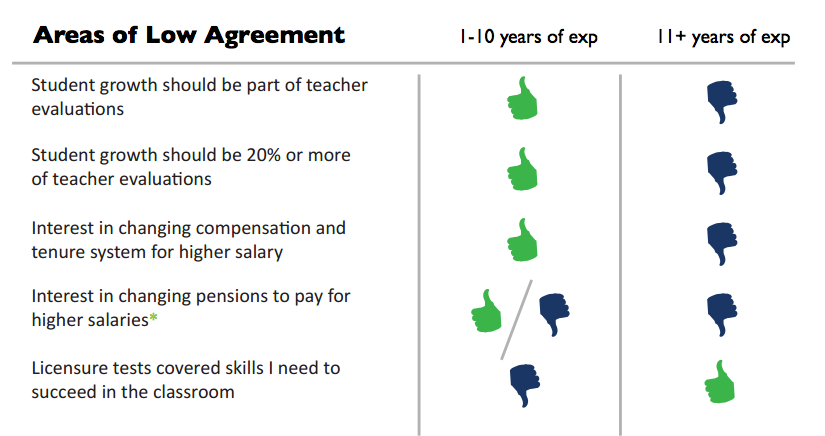
Teach Plus recently released a new report that compares the perspectives and opinions of the new majority to those of teachers with 11+ years of experience. The findings are both intuitive as well as surprising. Below is a table that highlights issues where both sets of teachers – the new majority as well as experienced teachers – strongly agreed with one another on survey questions.


What I found interesting here is that both groups of teachers believe there needs to be a clear and measurable standard for excellent teaching; however, they also both believe current evaluation systems are not getting the job done. Another critical agreement is class size. Although some research shows class size technically has no impact on student achievement (particularly at the secondary level) teachers clearly agree size does matter. Even more interesting are the areas where the new majority and experienced teachers disagree:


These shifts seem to line up with changing education policy and certainly are a nice validation for the Race to the Top stipulations.  Regardless of the merit or challenges associated with policies like linking student growth to teach evaluation, I think this study shows an eagerness on the part of new teachers – now the majority of teachers – to see our profession reinvented. Unfortunately, we also know the new majority exist in part because three out of every five new teachers quit within the first five years of teaching. Clearly we have a unique window of opportunity with this young, open-minded teaching force (this is not to say those of us with 11+ years are not open-minded!!) however we should be careful to advocate for policies that both raise the bar for our profession as well as keep teachers in the classroom.

New majority teachers what would keep you in the classroom for the next decade?

Survive Suctober

October is the month of crisp weather, turning leaves, and depressed teachers. A month with no national holidays and no end in sight; October is so far from June. It’s the point in the school year where the honeymoon period is over and students are earnestly pushing boundaries as far as possible. But this slump can be overcome! Here are my go-to survival tips for Suctober:

  • Take a Wednesday off: I recommend this coming Wednesday because the third week of October is the worst. Wednesdays are particularly decadent because you can’t go out of town or do anything three-day-weekend-spectacular worthy – you just read, watch TV, or (let’s be honest) sleep. Your students will be fine without you and in fact, they will have a better teacher because you will return to them rested and eager to do it again. RESIST the temptation to make this a “catch up day” and grade or plan. Do not do it. Rest.
  • Watch your favorite movie: If you have a particularly bad day you should watch your favorite movie. Maybe not all the way through but at least a nice little chunk of it. Subsequently, in our house, October is the month of Jason Bourne and You’ve Got Mail (no judging my husband for loving a Meg Ryan flick . . . ok so that’s me).
  • Stop paying close attention to the news: I am not advocating ignorance here but there is no question ignorance can bring a little bliss. My rule lately is I listen/read until I become angry or disgusted which, in an election year, is pretty darn fast.
  • Exercise: Go for a run or walk or whatever you do to get the endorphins flowing.
  • Avoid talking to negative people at work: Typically you can handle Ms. Negative in the teachers lounge however in October she is toxic. It may feel good to indulge in a little talk about how your school is the very source of evil but it will bring you down in the long run. In fact October might be a good time to just avoid hanging out with too many teachers. Even the best of us are feeling crappy.
  • Remind yourself why this work is sacred: Tap into the reasons why you became a teacher. Hang an inspirational quote about being a teacher in your classroom. Tell your students you have the best job in the world. Watch a cheesy, teacher glorifying movie. Take 10 minutes of class to have students write a thank you note to one of their teachers.
  • Really, really try hard to keep nights and weekends work free: This is tricky but it’s possible. One approach is to dedicate an entire Saturday or Sunday to catching up on grading and planning. Then follow a weekly schedule to keep ahead of yourself. Some of the darkest moments of my life have been October mornings battling the copy machine and the clock. For more advice about keeping a reasonable work-life balance click here.

How do you combat Suctober blues?


Uniforms: An easy way out of character education?

Recently I had a pass-out-it-is-so-good pupusa lunch made by one of my dearest friends. Over lunch we talked about how four of her children are doing in school this fall. It was good reports all around but my soft-spoken friend talked about how difficult it was for the family to purchase a specific, and expensive, brand of kaki pants mandated by the school’s newly updated uniform policy. Because they could not buy the pants some of her children had been assigned detention in which they were required to pick up trash around campus. My friend was told requiring a particular brand of pants was a means of preventing bullying. I have known this family for a decade and asking the school for either charity or an exception from the rule is not an option. I imagined her respectful, hard-working children walking around the campus after school picking up garbage instead of doing homework or practicing volleyball. I imagined the jeers of their classmates, the inevitable jokes that come with public shame. Bullying prevention indeed.

I understand why schools implement uniforms: it builds culture, it is an equalizer, it eliminates some of the distractions of  teenage preening, it makes for a respectful looking student body, and it provides visual order that often translates into on-task behavior. I am currently reading How Children Succeed by Paul Tough (book review to come!) and it is making me think deeply about the ways we teach character to our students. Does wearing a uniform build the traits necessary for success Tough writes about like grit, self-control, zest, social intelligence, and curiosity? I find the strictest uniform codes are at college preparatory campuses – both public charters and traditional private prep schools. However, prep schools often have uniforms like this:

Male students at Philips Exeter, the high school of Presidents . . . and don’t they look it!

Blazers and ties comprise the base of a uniform that actually prepares students for a real world job. Whereas in public charter schools, particularly those made up of predominately low-income minority students, uniforms often look more like this:

While certainly respectful and clean-cut, these students look more ready to take my order at Burger King than to be my future doctor or lawyer. Full discolosure: I have a good amount of cognitive dissonance around this issue. I have enforced and defended a dress code similar to the one depicted above. However, it was always unnerving when we would have “professional dress days” and girls would come to school looking ready for the club while boys would show up in the morning without a tie (there wasn’t a tie in their house) or unable to tie it if they had one. My colleagues and I would sigh in exasperation and cross our fingers they would figure it out before an important job interview. How authentically college-preparatory is a school that isn’t explicitly teaching and giving students the chance to practice dressing appropriately?

As for the cool-kids-wear-Abercrombie-and-Fitch-and-you-don’t-so-you-suck phenomenon it seems like uniforms are an inappropriately indirect way to teach tolerance and respect. It’s like the Kurt Vonnegut short story Harrison Bergeron about a distopian future where beautiful people are required to wear masks, athletic people to wear chains, and quick thinkers to wear earpieces filled with shrieking bells that interrupt their thoughts. Uniforms do not eliminate socioeconomic inequalities in our students. More importantly, students from low-income backgrounds who go to college will inevitably encounter peers who are expensively dressed and might even be dismissed for their own cheap clothing.

What can we do to address these touchy questions of income inequality, professional dress, and bullying in our own classrooms? Here are some ideas I use in my own classroom:

  • Model professional dress: My husband, the 8th grade science teacher, refuses to wear jeans and a t-shirt on Fridays (or if he must he wears a blazer over it). He wears a tie and slacks everyday and makes a point of telling his students he does so because he respects them. Lord knows I have certainly taught in jeans (and not just on Fridays . . . more like my entire last trimester both times I was pregnant) but I do try to put a little effort into dressing like the serious professional I hope to be (more tips on teacher dress here).
  • Provide opportunities to teach professional dress: Field trips, college visits, guest lectures, important class presentations all merit special attire. Teach students how to dress appropriately and then have them practice doing so. Make sure to give feedback when dress is both appropriate (“You look like a future president!”) and inappropriate (“The length of that skirt does not match the serious, intelligent woman you are and want to be perceived as.”) Even if you teach in a school with a strict non-preparatory dress code ask your principal if you can have an exception for professional dress a few times in a year (more if you teach seniors).
  • Speak openly about social inequality: Although we often tip-toe around the realities of poverty at school our students live with it in blunt, everyday ways. Find natural ways to talk about poverty and engineer situations (via readings or speakers or lessons) to teach students about the innate dignity of all people regardless of income.
  • Do not tolerate bullies: Immideiately assign consequences for any and all disrespectful behavior. Directly address clothing discrepancies. Make it known that you do not value your students for the price of their clothing but for the content of their minds and character. Tell stories about how what is fashionable will come and go. Compare a 2012 A&F hoodie to a 3 foot powdered wig from 1760.
  • Check out the gold mine that is Teaching Tolerance: This organization has so so many resources on exactly this topic and they are so power and so well-made. Check it out!

How do you teach tolerance in your classroom? What are your thoughts on uniforms?

“Over the partisanship and through the bickering”

We will never solve our education crisis if we meander around the extremes of our party platforms. Rather, we must reward methods that yield success and abandon those that continue to fail, regardless of politics.

– Gabriel Ozuna, college sophomore at Yale University writing for Pass the Chalk

I’m am feeling pretty proud today because one of my former students has a measured, thoughtful and hyperlink-filled posting over at Teach For America’s blog “Pass the Chalk!” After last night’s Presidential town hall/cage fight it was refreshing to hear a call for solutions over partisanship from the next generation.

What I find interesting about education and politics is how everyone agrees reform is urgent and necessary yet there seems to be a lack of creativity in implementing solutions. Certainly NCLB, Race to the Top, and the Common Core represent bold strides into new territory however I also believe the time has come to correct the agressive swing towards frequent high-stakes testing and return to a measured, yet accountable, approach that includes the arts and humanities.

At the same time I am unsurprised by the lack of federal solutions to what I believe is a local problem. If education is the Civil Rights movement of our time we can hardly expect legislatures and bureaucrats to do the work of what must be a grassroots movement. Though it is one small contribution it feels pretty great to have had the privilege of teaching a young man who is already taking part in demanding more from his elected officials. I was once told “our students are the messages we send to a future we will not see.” With former students like Gabriel and his classmates, I am more than hopeful about seeing an education revolution well within my lifetime. Indeed, it is already underway.

“AP Classes are a Scam”

Those of you who know me or who have been reading my blog will know I am an ardent and public enemy of Advanced Placement and so I was delighted to see the article “AP Classes Are A Scam” on The Atlantic website. The article’s author, John Tierney, claims AP classes are “one of the great frauds currently perpetrated on American high-school students.” I would only add that for minority students in under-served schools or areas of high poverty, AP classes become inadvertent tools used to perpetuate underachievement in the communities who need to succeed the most. Students with the highest academic performance are tracked out of mainstream classes and promised a college preparatory curriculum but instead receive a frustrating and ultimately ineffective education in random minutia. Add to this the additional problems brought on by a teacher who teaches her AP class by assigning lengthly readings from a college-level text and lecturing for 40 minutes or more every day and our struggling students are completely left behind and even less ready for the potential rigors of college. I know because this is how I rolled for 5 years – long enough for my students to graduate, spend a year or more in college, drop out and return to campus to ask me why I didn’t prepare them to be successful. Ummm . . . I was too busy teaching you to pass the AP exam?

AP classes are necessarily aligned to AP assessments which do not mirror college-level rigor, require broad and trivial fact memorization (a skill Wikipedia has made obsolete everywhere but on Jeopardy and 3G-less West Texas), and fail to build critical skills like expository writing based on research. Tierney does a nice job outlining the problems with AP courses in his article. Read the full article here and thanks to Jenny Corroy for bringing it to my attention.

What is your experience teaching or taking AP classes?

Considering the Un-Thinkable

I was a senior in high school the year of the Columbine massacre and I remember thinking it would be an isolated incident that would never occur again. By the time I became a teacher, I realized I should at least think about what I would do if I found myself in a similar situation. Most of us have been trained on some sort of “Code Black” protocol where we lock the door, turn off the lights and get away from windows but yesterday on NPR I heard a story about an alternate approach – fighting back. The report centered around what is called “ALICE” training which stands for Altert, Lockdown, Inform, Counter, and Evacuate.  ALICE trainers assert school shooters end up hitting more people because students and teachers hide and stay still. Instead, they recommend strategies like barricading the door, throwing a large number of items all at once at the attacker to distract from a rushing tackle, and running in zig-zags to avoid being shot.

It is hard to know what you would really do under in an actual situation but I believe it is worth some mental planning. Consider David Benke, the now famous math teacher in Colorado who tackled a gun man at his school in 2010. Benke thought about what he would do if a shooter ever entered his school and he said, “If something happens and there’s something that I can do about it, I want to try and do something about it.”

This is not a topic I have discussed at length with my fellow colleagues but I am interested to hear your thoughts. As teachers, what is our obligation here?