Category Archives: Classroom Visits

Ms. Duncan Evan’s Classroom

This week’s classroom tour comes from Hurricane Sandy survivor Cristina Duncan Evans in Baltimore, Maryland. Aside from a few power outages and three days off school (is it wrong to be jealous?) Cristina reports Baltimore is doing comparatively well. I recently attended a conference full of accomplished educators and Cristina stood out; she seldom spoke but every time she did I had a mini-revelation. Cristina is one of those people who when she speaks everyone in the room turns and listens. Thanks for sharing your classroom Cristina!

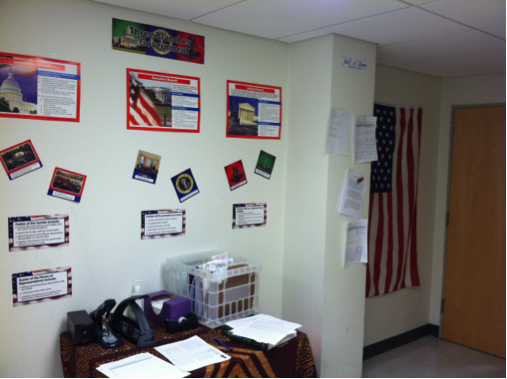
Welcome to my classroom! Please excuse my attire – I’m a little casual today because it’s a professional development day. I’m so glad to share my space with you! Right inside the door, you can see my folder system where extra copies go. There’s one folder each for Monday-Thursday and a folder labeled ‘Last Week.’ My students know that if they are absent they can pick up handouts and assignments from these folders. I also keep copies of frequently used sheets, like a current events analysis and weekly drill sheets available for students on that wall.

Where do you teach? In Baltimore City at the Baltimore School for the Arts

Who are your students? Most of my students are 9th, 11th and 12th graders.

What do you teach? I teach US History and American Government

This is my basic staging area where I place handouts and graded work that needs to be passed back. As a social studies teacher, I’m pretty much obligated to have up the three branches of government posters. The American flag is one of my favorite things in my classroom.

My ninth grade students maintain student work folders. At the end of each unit, they empty out their binder and put all of their old notes, readings, and graded work in a folder that I keep at the back of the class. It helps them stay organized. It also means that at the midterm and end of the year state test, I can give them back a year’s worth of notes, without worrying about them losing important pieces along the way. Finally, it helps me when I have parent meetings, IEP meetings, or meetings with a counselor, because I can always access examples of particular students’ work. It’s also be great in the past when I’m applying for peer-reviewed awards, to be able to easily add student work to my teaching portfolio.

Describe your teaching style in one word.  Evolving. For better or worse, I’m constantly trying new things and experimenting.

What is your go-to literacy strategy?  In American Government, one of my favorite strategies is current events analysis.  Each quarter, students must turn in six current events articles and an analysis sheet for each one.  The analysis sheet asks students for:

  • A summary of the article
  • What they found most interesting and why
  • Familiar terms and their definitions
  • Unfamiliar terms and their definitions
  • A positive possible outcome of the event described
  • A negative possible outcome of the event described that’s not just the opposite of the positive outcome
  • The connection to American Government

I love this assignment because it helps kids develop the background knowledge necessary to fully understand the class.  Often I’ll give the students themes.  For example, second quarter, three of the events have to be about civil liberties and three have to be about civil rights, since those are the unit’s we’ll be working on for most of the quarter.

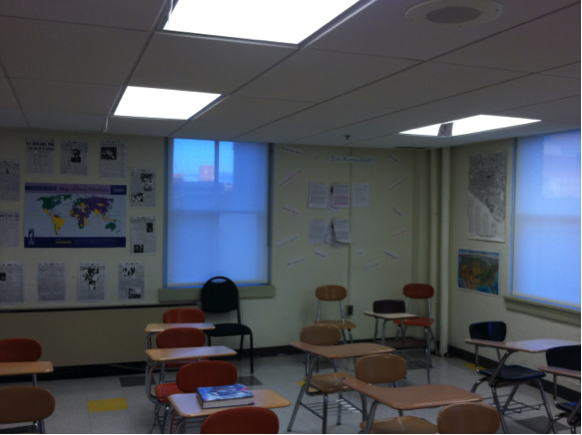
For the most part my desks are in rows, but about once every two weeks I make a circle for discussions or create small groups for kids to work together. In the back of the classroom you can see my freedom of the press wall, which has a map showing global press freedom and great student work. I love maps!

How do you motivate your students? I try to build student motivation by focusing on asking good questions and giving students the chance to listen to each other’s answers.

What is your favorite way to check for understanding? By cold-calling students using a random method, like popsicle sticks or a random number generator.

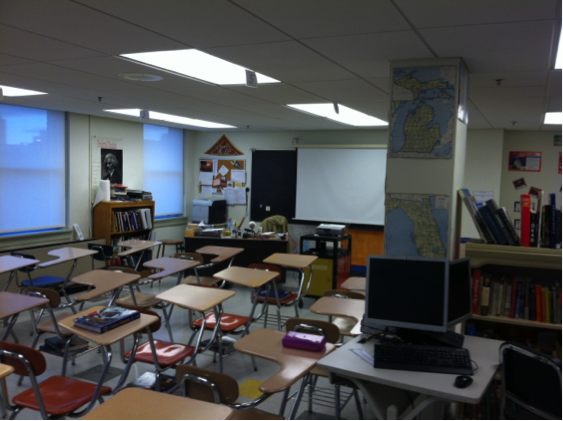
Here’s a view of my classroom from the back of the room. I have a few computers that I let students work on if they need to. I also have a growing classroom library that I’m not quite sure what to do with – there are a mix of all different types of books, but I haven’t yet done much independent reading in class. You can probably tell from looking at the front of the room that I’m a big LCD projector teacher – almost everyday I use powerpoint.

Ms. Casey’s Classroom

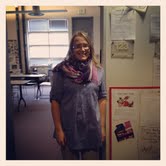
One of my first encounters with the amazing Nik Casey involved her standing on a table in a cowboy hat leading a group of teachers in rousing chants and cheers. Her energy was infectious then and it is clearly evident today in her classroom. After many years as a successful science teacher Nik switched to English. Her approach is innovative and compelling – thank you for sharing your classroom Nik!

Where do you teach? Denver School of Science and Technology in Colorado

Who are your students? 9th Graders

What do you teach? Humanities (essentially, English with a flare of history and a focus on social justice issues)

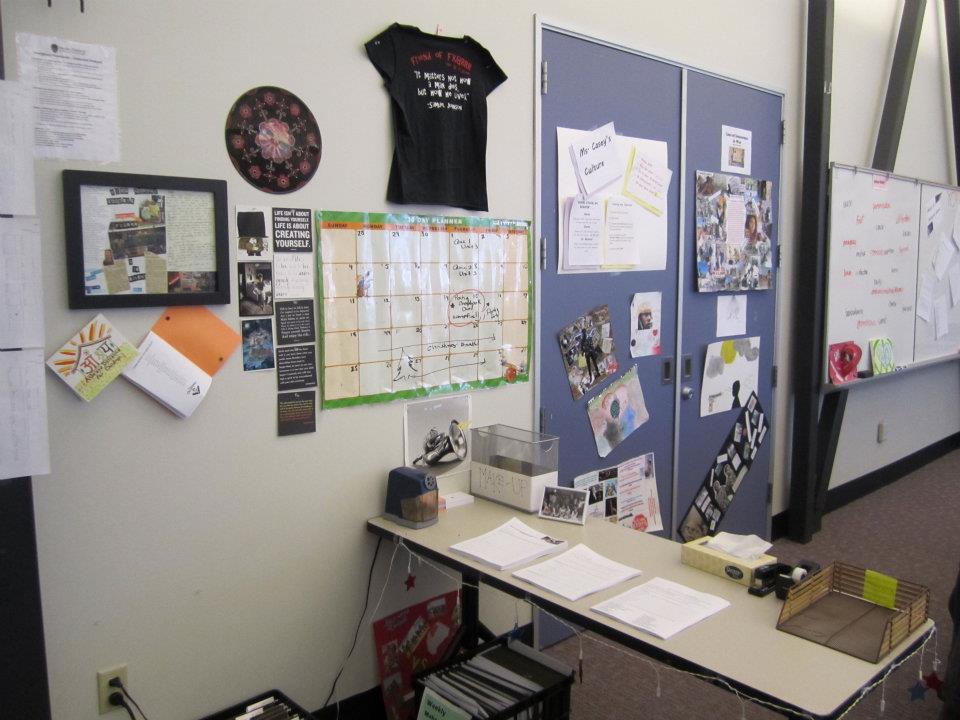
“This is the entrence to my classroom with the most important items. Handouts are always placed on this table for the day and students pick them up on the way into class – routine. To the far left is the ‘Make-up Bin’ and to the far right at the corner of the table is the ‘Homework Bin.’ In center is always a stapler and tape – for those last minute submissions that need some organization.”

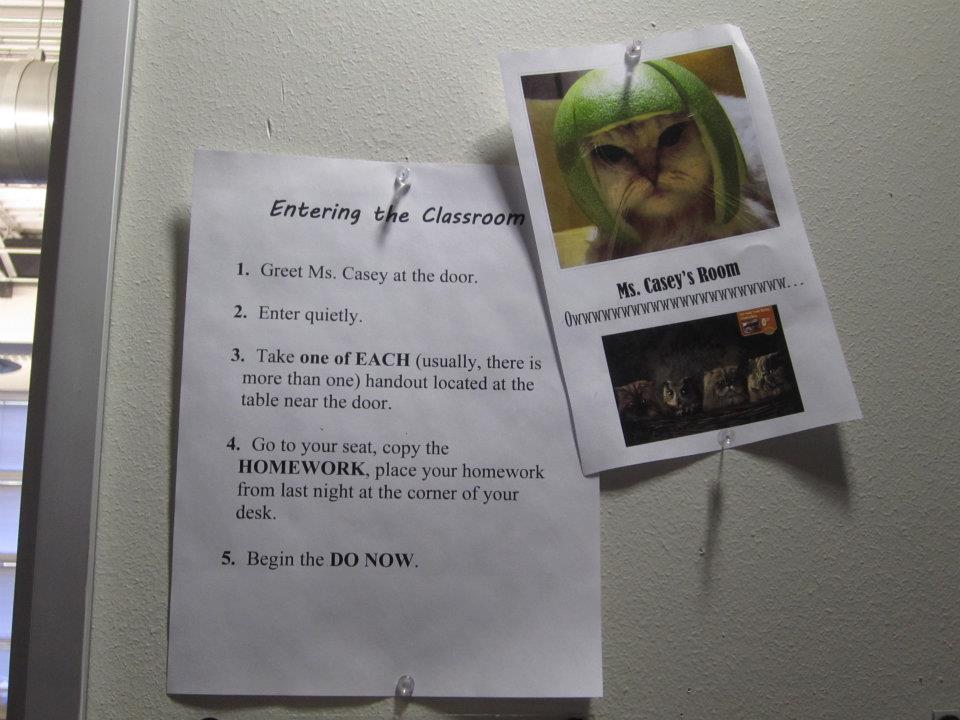
‘How to Enter the Classroom’ instructions. Trust me, freshmen needs this. . .

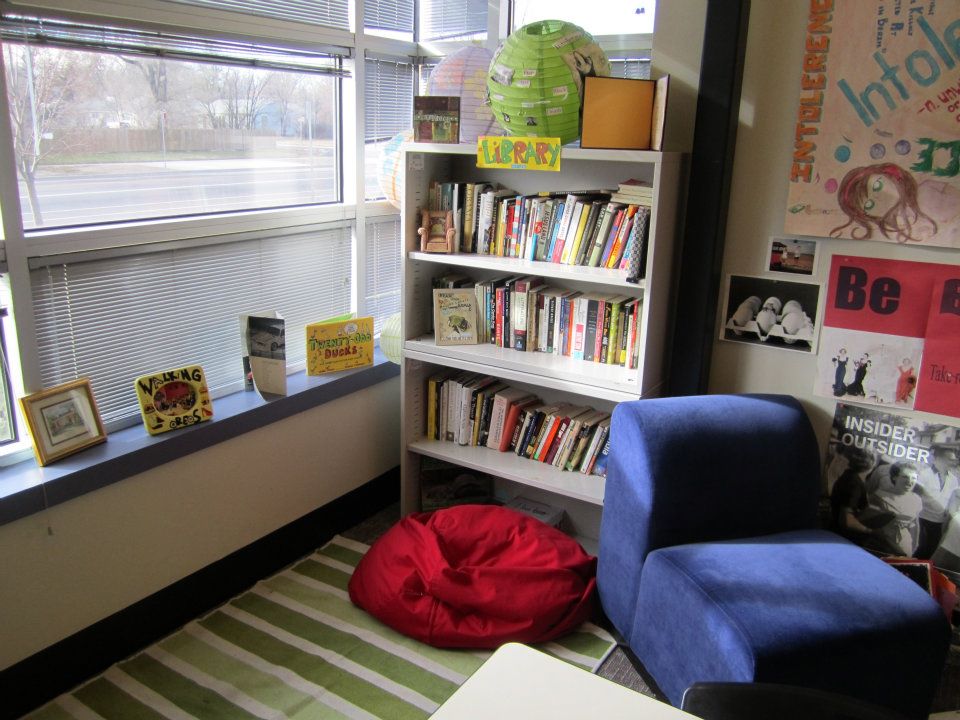
Our Library – a cozy must!

Describe your teaching style in one word: Capricious

Ms. Casey’s paraphernalia.

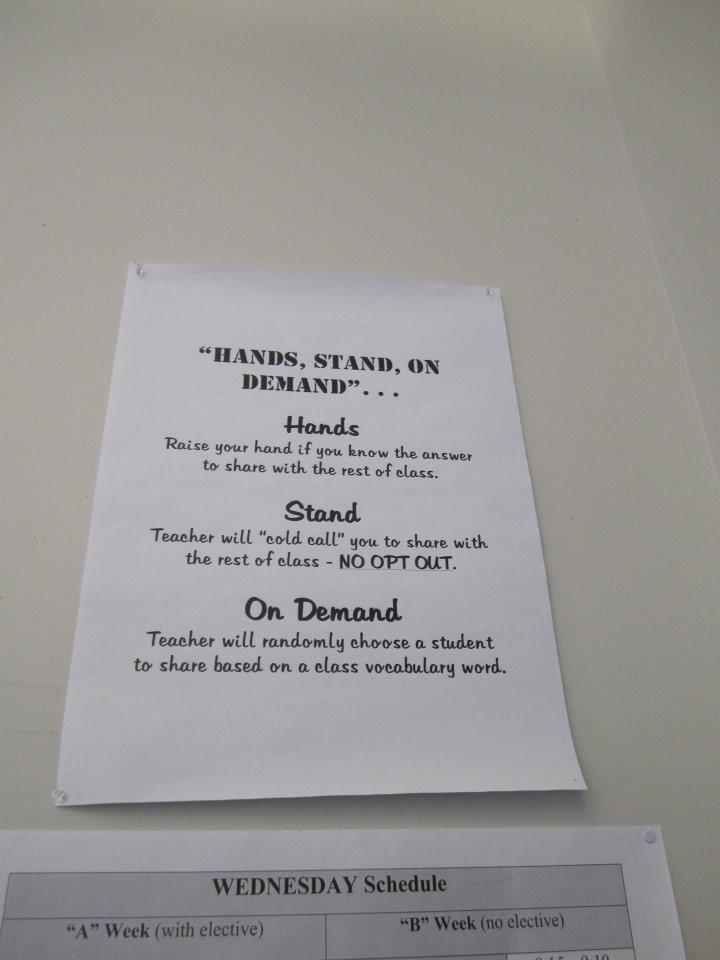
“Hands, Stand, and On Demand” system. ‘ Hands’ is straight forward, for ‘Stand’ you cold-call, and for ‘On Demand’ wacky photos that represent vocabulary words.

What is your go-to literacy strategy? The Art of Close Reading (click here for more info). *Nik also sent along the handouts and power points she uses to introduce herself and her classroom systems to her students during the first three days of school:

Desk arrangement in what I call “debate style” with two sides of the classroom facing each other. Vocabulary cards are on the desks.

Vocabulary Cards – a word, its definition and an awesome picture/photo to help a student remember the meaning of the word (tackling all five of the human senses) is located at each table seat throughout the classroom. We use this to learn the words via tactile activities.

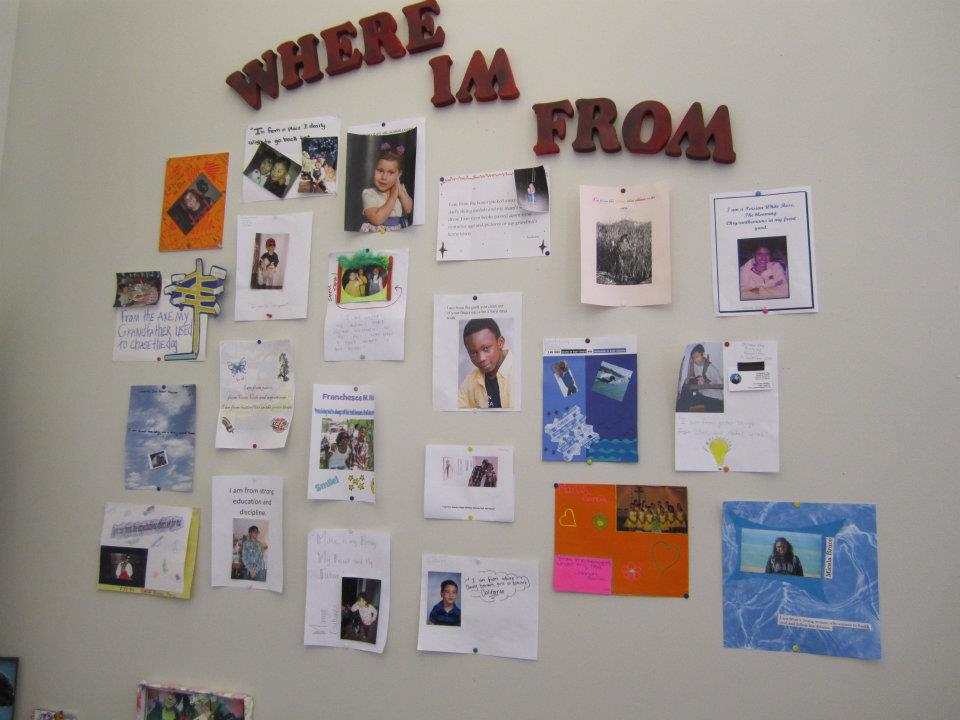
This is last year’s ‘Where I’m From Wall’ – it is about my students, all about them. It includes their “Where I’m From” poems, posters.

This year, I changed the “Where I’m From Wall;” students now come up with at least 40 descriptive, juicy words that represent who we are and these words were then used to create a Word Cloud on Tagxedo. Kids loved it! I taught imagery as the standard to drive this activity. This is an example of what one of my students created. All of this places special focus on the idea of one’s identity and what affects or molds us into who we are and who we choose to be.  This unit’s essential question is: “where does our sense of identity come from?”  In the following units, we focus on a different essential question in regards to one’s identity – what impacts it and how we impact others, our community, our world ect.  Essentially, I have carefully planned each question to mesh gracefully with each text or Literature Circle Unit I teach.

How do you build student motivation in your classroom? Snazzy hooks.  Rigor.  More rigor.  Inspiration.  Passion.  Lots of passion.  TEDx.  Iron Poetry Competition.  Guest Speakers: Holocaust Survivors, Refugees, New York Times Best Sellers.  Oh, and creating FUN.

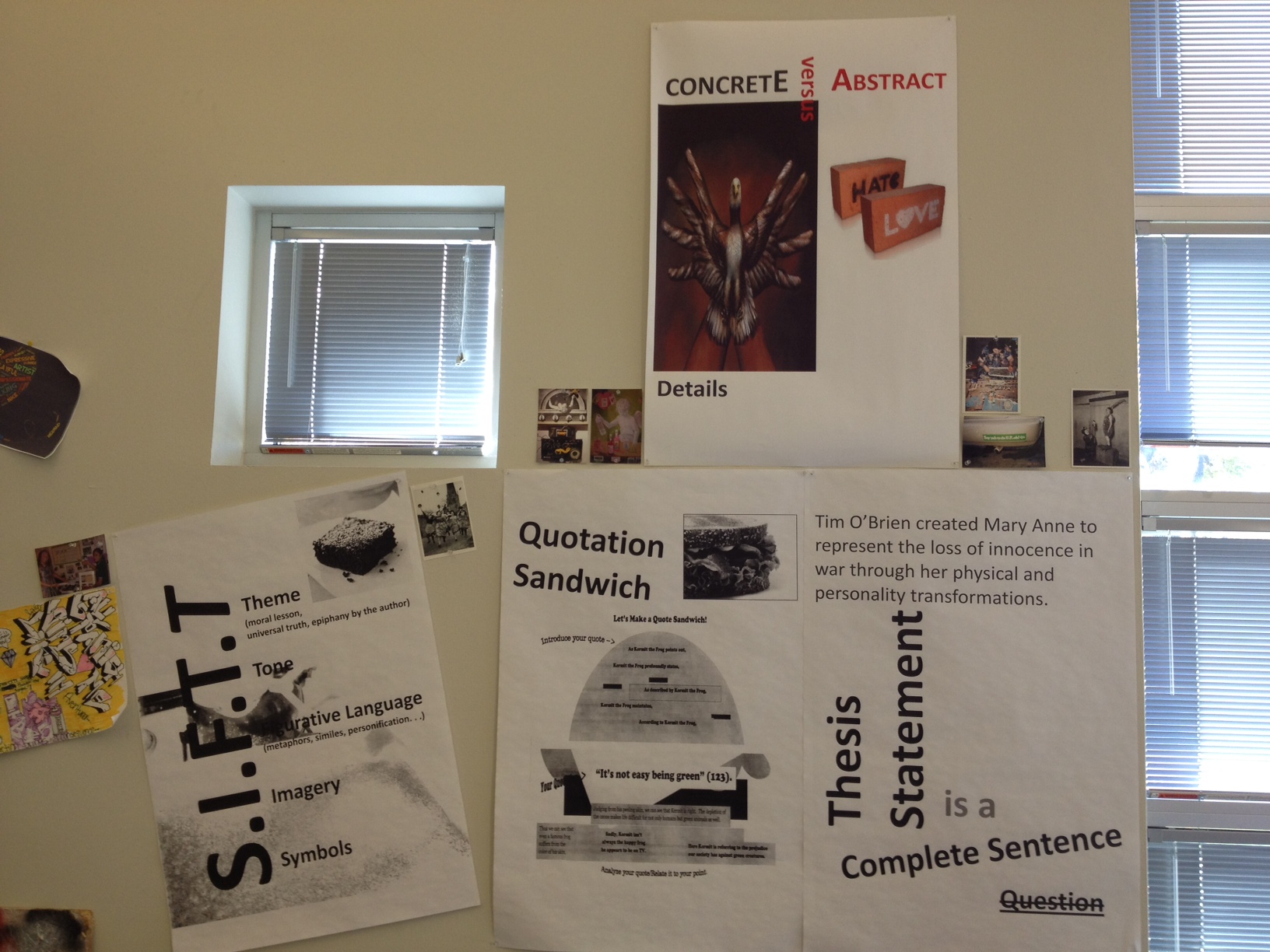
This is my visual culture wall containing some of the key concepts/skills the need to master throughout the year.

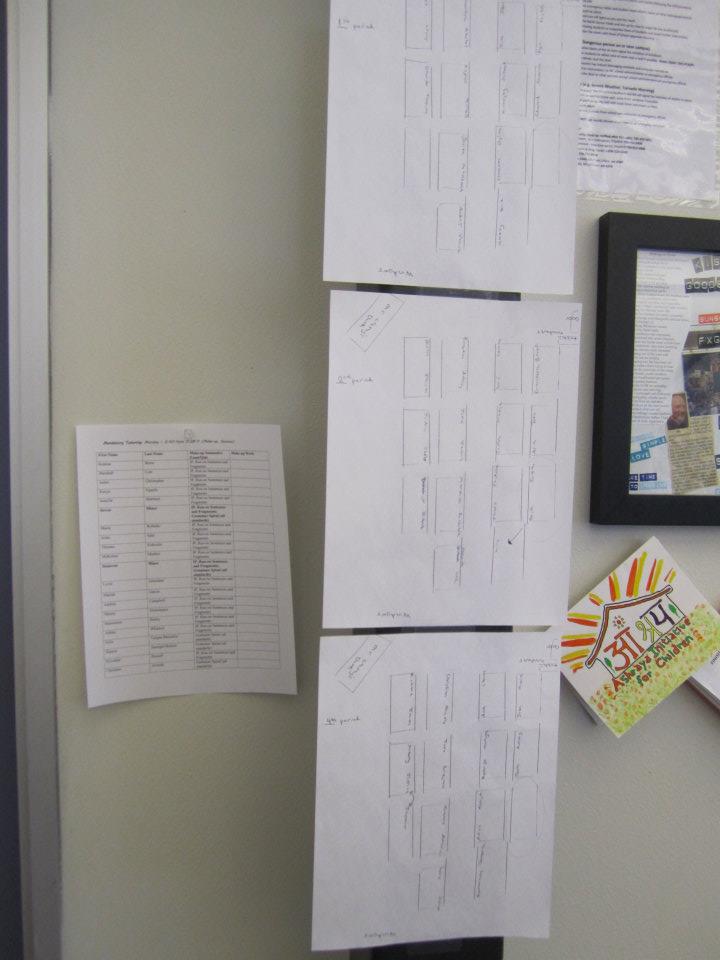
I keep my Mandatory Tutoring List posted by the door. I also have the seating chart up so I don’t have to repeat myself – I just point.

These are examples of one of the major projects we do in Humanities known as the Poetry Chapbook (five different kinds of poem assessed on ten different standards, all free verse, with the freedom or designing the book format in whatever form).

Close-up of the cool ‘record’ chapbook.

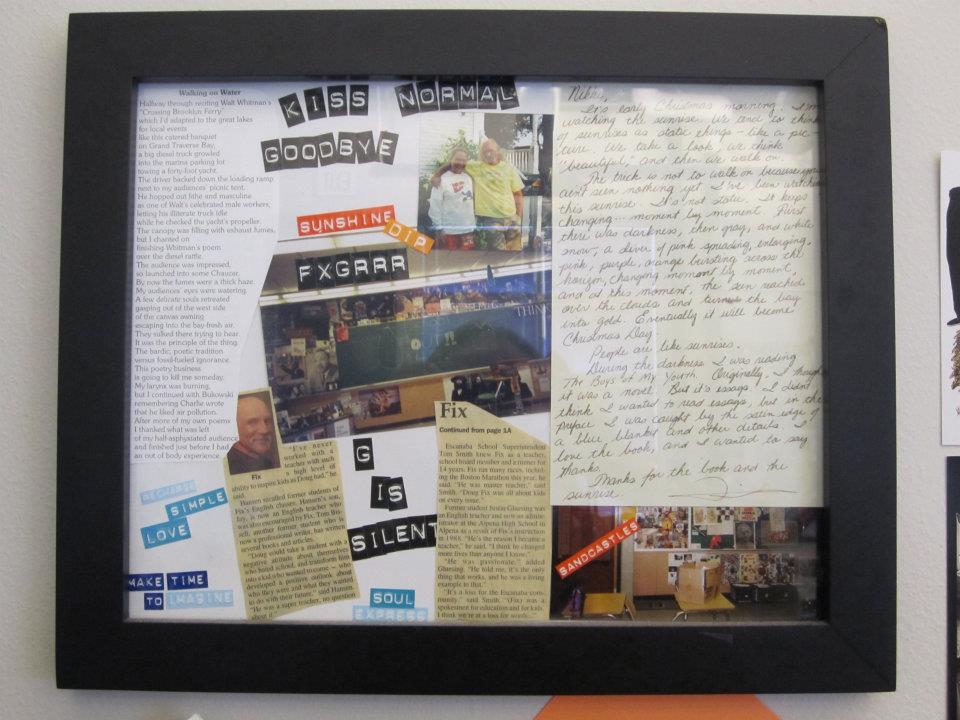
Inside the frame is a letter/card that my high school English teacher gave me – thanking me for the piece I wrote for him in his honor; also, there is a clipping about the teacher of the year award he received in Michigan and photos from his classroom. He is the reason why I teach or, what got me into teaching.

‘About Me Boxes’ – super cool project. Students create a box of some sort (I’m very open to size and shapes) and decide what they want to reveal about themselves that is reflected in their writing – for example, some students keep their boxes shut because they don’t want others to know what they can’t see. . .

‘Be Bold’ is our class motto. From the quote: “Think Big. Be Bold. Drive change.” I use the awesome organization, “Echoing Green” as a sound board for our classroom. Pennants of colleges/universities add a nice reminder as well. Using board space well is key to student success. Here we have: Daily Agenda, Do Now, and Homework Assignment.

The quotation is from Henry Miller.

Tagxedo

What Tagxedo spit out for The Sacred Profession – I picked the shape and colors

I wanted to share a cool resource from this weeks classroom tour (coming later this afternoon!) teacher Nik Casey. She turned me on to a site called Tagxedo which lets you either take websites, articles or type in words and produce images like the one above I made by inputing this blog’s website. A world of ideas opened in terms of classroom applications. You could use the site as a means for students to share information about themselves in a public way (see an example in Ms. Casey’s classroom tour later today). You could also use images of authors and historical figures to create a nice visual/verbal description (see below).

Or of current events:

So many ideas. Check it out and if you come up with something awesome please share it with us! Thanks Nik!

Ms. Scheinfeld’s Classroom

The teaching profession is shifting and more and more of us are taking on split or hybrid roles where part of the day is in the classroom and part is spent coaching or writing curriculum. So what do you do when you have to 1) share your room with a colleague and 2) hold classes in the library because that is the only available space? I am so pleased today to share the multi-functional classroom of my dear friend Melissa Barkin Scheinfeld. Melissa and I were in the same collaborative group at our pre-service teaching institute in 2005 and have been friends ever since. Whenever I have a particularly tricky teaching situation or just need a really brilliant thought partner I ring up Melissa. It is no surprise to see what an amazing classroom she has made despite some logistical challenges. Thank you for sharing your classroom Melissa!

Where do you teach?  I teach in Austin, Texas at KIPP Austin Collegiate.  We are the only KIPP high school in Austin.Who are your students?  My students are seniors who are currently applying to college and getting ready to take over the world.  They are brimming with personality and we will be in good hands when they are the ones making decisions for this city.  The majority of them come from Hispanic, low-income backgrounds and they have been KIPPsters since anywhere from 5th to 9th grade.

What do you teach? I teach Government and Economics.  This is my first year teaching this course after a long stint in World Geography and AP World History.  I am loving the opportunity to write new curriculum and teach Political Science.

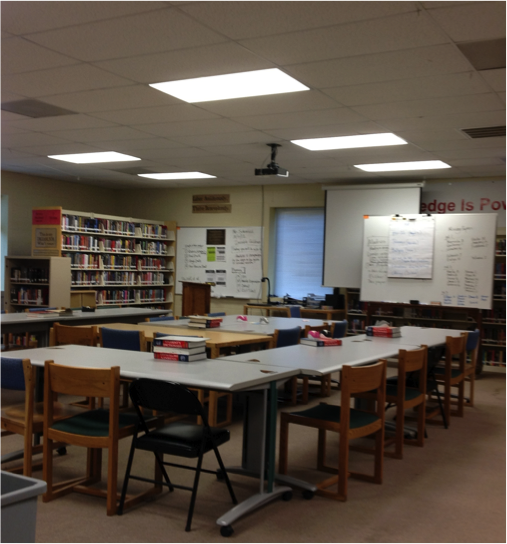
The white board floating at the front of the room is on wheels and the English teacher and I rotate it depending on whose class is being taught. For additional writing space, there are packets of poster paper attached to it with binder clips. When there is additional information I want in front of my students, I put it on the chart paper and flip back and forth in the stack to get to the key info. It can be a bit of a challenge as it all adds a few more tasks in order to get set up for class, but for the most part it’s working great this year.

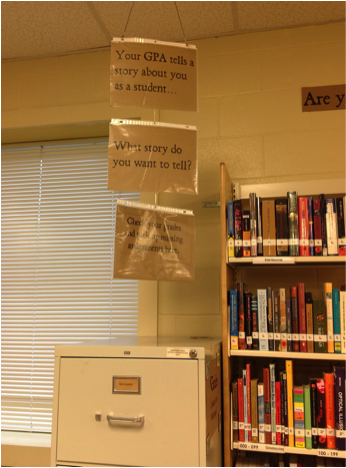
I have a filing cabinet in my classroom for students to pick up anything they are missing. The sign above it says, “Your GPA tells a story about you…what story do you want to tell? Check your grades and pick up missing work here.” The key to this system is that I don’t have to be around for a student to figure out what he/she needs to do to improve their grade or to help him/her find the missing/replacement handouts to get organized. Every teacher in my building has a system like this and we all know that if we’re supporting a student, we can send the student to another room to find extra copies of the assignment that needs additional attention.

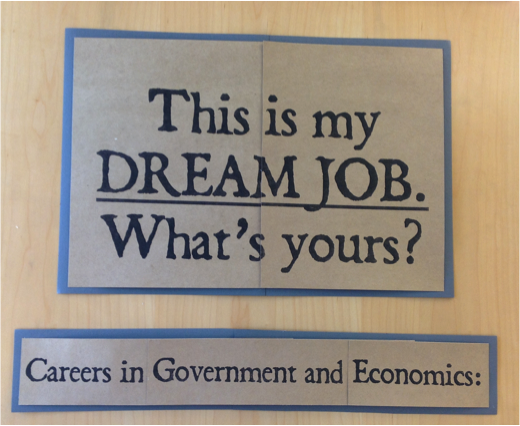
There are two signs that I’ve had up in my room every year since Abby gave me the brilliant idea… “This is my Dream Job. What’s yours?” and “Yes, I really do love you.” It’s incredible how many times students have referenced these two signs when I talk to them about our class years later. They are very empowering messages. And, I love to shamelessly promote careers related to the class I’m teaching, so the rest of the wall includes a list of jobs that this class might lead toward.

Describe your teaching style in one word. Disciplined

What is your go-to literacy strategy? I am a very strong proponent of peer revision in my classroom as a way for students to improve their writing skills.  My go-to strategy (which I, of course, learned from fantastic colleague several years ago) is called “clocking.”  I’m not sure where she got the name for it, but it stuck.  It’s basically speed dating for essay revision.  It requires three planning details:

       1. Clocking worksheet: I give students a document with 5 text boxes, each labeled with a different area from their essay rubric.  Each section has a title (straight from the rubric) and a place for the “reviser” to write his/her name.  In each box there are two sections, one for “This is what you wrote…” and the other, “I think it should be…”

       2. Seating arrangement: I move students into two long rows, or an inner circle or an outer circle, depending on the shape of the room.  The key is that each kid is sitting across from another student and they have a table in between them to work.  After each round, one of the circles or rows stands up and rotates.  Each student then has a new partner and a fresh set of eyes on his/her paper.

     3. Mini-lessons: I do a quick mini-lesson with strong and weak student examples at the beginning of each round.  When students are facing their first partner, I model feedback for the first skill (i.e. thesis statement, citations, claim and evidence in every paragraph, spelling, etc.) by revising 1-3 student examples that are almost perfect, if they just had one more piece of feedback.  Often I make them up myself because I haven’t read everyone’s rough draft.  The ideal examples are those that are mostly strong, but need one piece of clear, specific feedback to improve.  I try to bring samples of the most common student mistakes so students can see a model both for how to write well and how to give good feedback.  Students then pass both their essay and their “clocking worksheet” to their partner.  Each has 5 minutes silently to give feedback on the worksheet, then they have 3 minutes to explain their feedback out loud.  After eight minutes, one of the rows rotates, I give a new mini-lesson, and student trade papers with the new partner.

One of my students e-mailed me this picture last week for us to use on future “clocking worksheets.”  Obviously it’s intended for scientific research, but I like his interpretation of it for our Social Studies essays.

How do you motivate your students? Every single thing we do in class is tied to a college-readiness skill.  Students’ grades are based 100% on their demonstration of that skill by the end of the semester.  I’m experimenting this year with this policy of “standards-based grading” and finding it to be an incredible motivator.  I learned an anecdote a few years ago from an RBT training that I use to explain the concept of grading-for-mastery.  Imagine two students in medical school.  Student #1 scores an 80% on every assignment all year long.  Student #2 scores 50% for the first half of the course, but scores 100% for the second half of the course and earns a 100% on the final, cumulative exam.  With a traditional grading system, the first student’s score in the course is 80% and the second student’s score is 75% for the course.  The next questions is…who do you want performing your open-heart surgery?  I would want the student who performed perfectly by the end of the course.  So in this new grading system, the final grade reflects the 100% at the end of the course, regardless of how long ittook student #2 to get there.

The part of my old classroom that I miss the most is the world map that you can see in the background of this photo. I installed two sheets of metal onto the wall and painted it with a world map. It’s magnetic and visible from all parts of the classroom. The teaching potential is endless…for the new World Geography teacher who has taken over the space.

What is your favorite way to check for understanding? I use a lot of “Cold-Calling”, and “Think-Pair-Shares” during class and an “Exit Ticket” at the end of class.  I would estimate that every 5-10 minutes during class I prompt students to write down an answer to a prompt, explain it to their partner, and then I call on a student randomly to share their thoughts.  It is consistently the most popular aspect of class on student surveys.  And, it takes no prep, gets every student voice in the room, and gives me a ton of information about what is and isn’t “sticky” in my teaching.

       At the end ofclass every day I give an “Exit Ticket.”  It’s a half sheet of paper containing 2-4 questions that prompt students to explain the key concepts from the period.  Sometimes I grade them, sometimes I read them and then recycle them, and sometimes I sort them into piles by right and wrong answers or other general trends to plan for a quick mini-lesson to re-teach something the following day.  This practice holds me accountable to know where I’m headed every day and gives me permission to not give individual feedback if it isn’t a strategic use of my time.

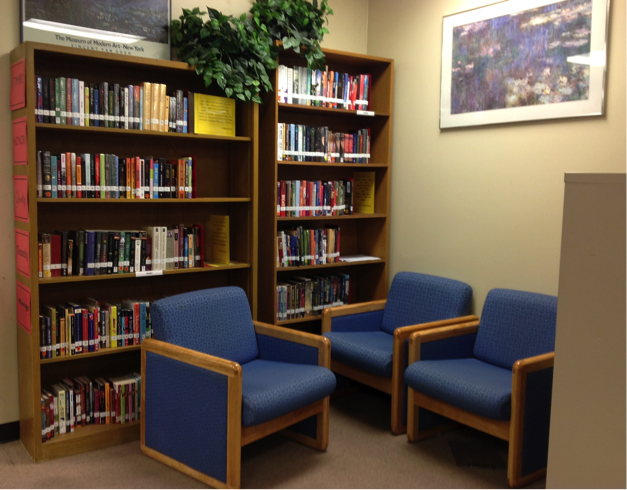
The biggest perk to being in the library is that we have fantastically comfortable furniture that students can use when we’re in small group work or writing independently. It’s pretty awesome to have a couple of nooks like this and for that I’m super grateful.
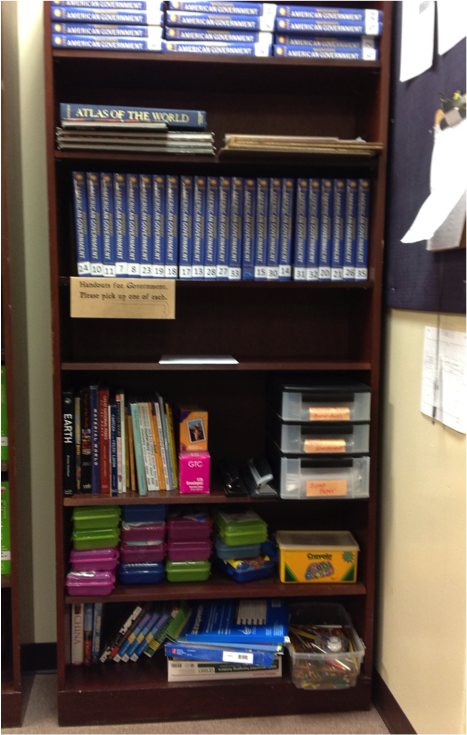
With super limited space this year, I don’t have a table for handouts, but rather an empty shelf. In addition, I leave student supplies on the same bookcase with easy access for students to get to the materials they need.
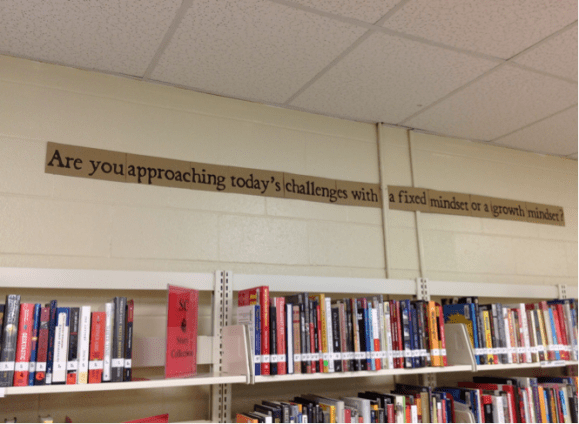
After reading Carol Dweck’s Mindset, I started teaching an annual lesson about fixed and growth mindsets to my students to help them identify both in themselves. I point to this question on the wall every time I return work to students with critical feedback or offer challenging corrections in order to support them moving more often towards embracing a growth mindset.

Ms. Thompson’s Classroom

The classroom tour is back this week with the amazing Heather Thompson! I met Heather two years ago when we both worked the same summer job. I immediately gravitated towards her because she’s an incredibly knowledgable educator and she’s an all around fun person. Our coolest connection is that we taught about 5 or 6 of the same students; Heather had them in 1st grade and then I taught them in 12th grade. In addition to being a great teacher, Heather also writes the funny (and helpful!) fashion blog Regular People Wear Their Clothes. She and another fellow teacher take pictures of their outfits everyday, write a highly readable reflection and post sourcing information. I’ve written about their blog in a past post about what teachers should wear and I highly recommend checking out their site. I am so excited to share her dynamic classroom today, thanks Heather!

My classroom door is a little dark and uninviting, so here’s a picture of me in the classroom library instead. This is where the magic happens anyway! Welcome to third grade!

Where do you teach? Oakland, CA.

Who are your students? The student population at my school is primarily low-income and English language learning. Our school’s instructional program values and focuses on critical thinking skills and curiosity. We have a very stable school community with low student turnover, so most of the students have been at the school since Kindergarten. This means that by third grade they are amazingly deep thinkers.  My class this year is also very creative and artistic.

What do you teach? I teach third and fourth grade.

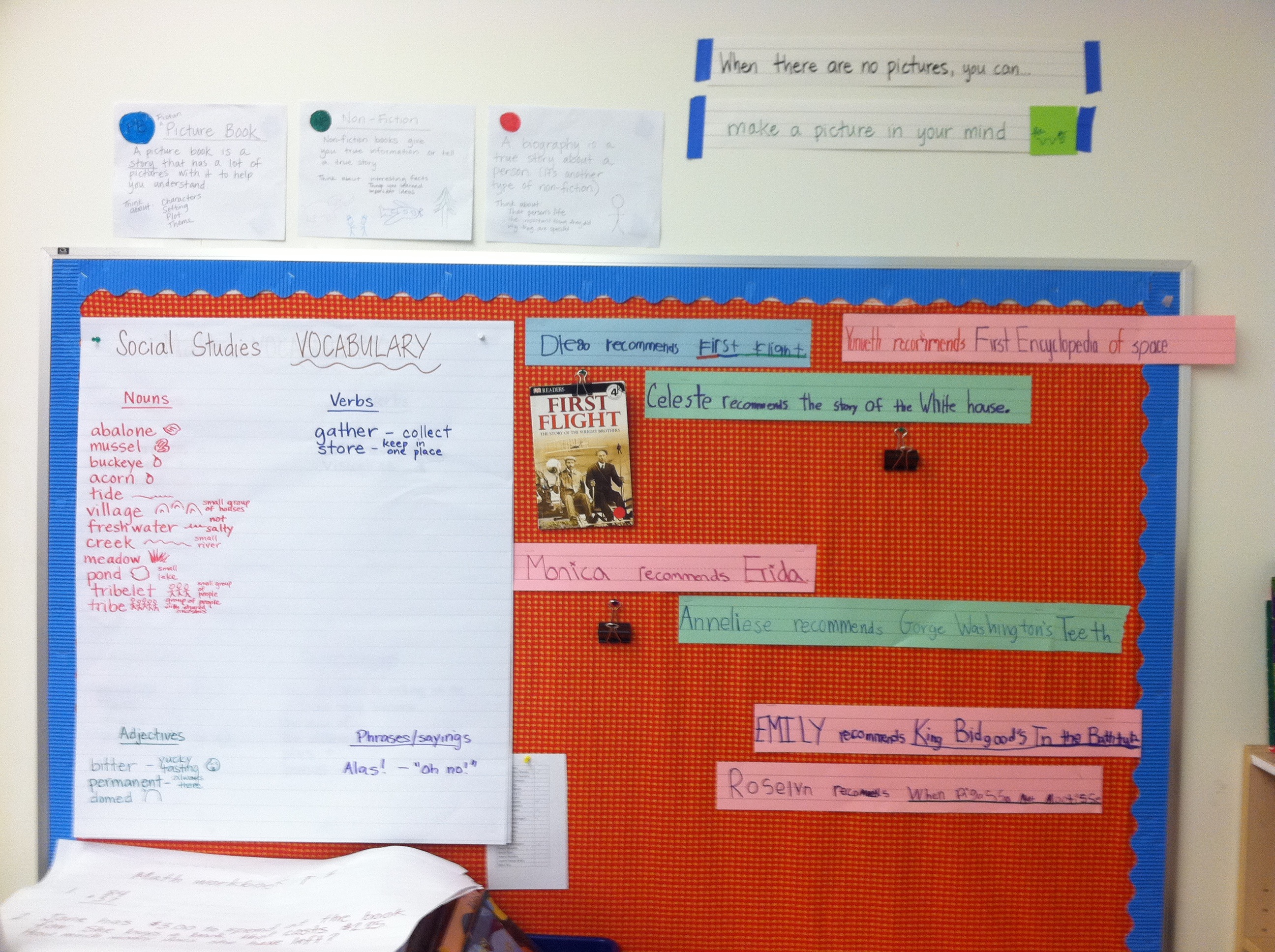
This is one of two bulletin boards at the front of my classroom. I use this one for vocabulary and book recommendations. You can see that a lot of the recommended books have been checked out by other students! The vocabulary is organized on posters by subject, so I can easily swap the posters out depending on what lesson I’m teaching.

We’re lucky to have giant windows in our classrooms. A lot of teachers cover them with posters or put furniture in front of them. I understand this, since wall space is at a premium, but my aesthetic sensibilities have over-ruled my desire to be able to keep posters up. Instead, I hang student work from the windowsill. (It’s magnetic!) And yes, we have pet birds. Word to the wise: birds are much easier classroom pets than hamsters or turtles. I should know—I’ve tried all three.

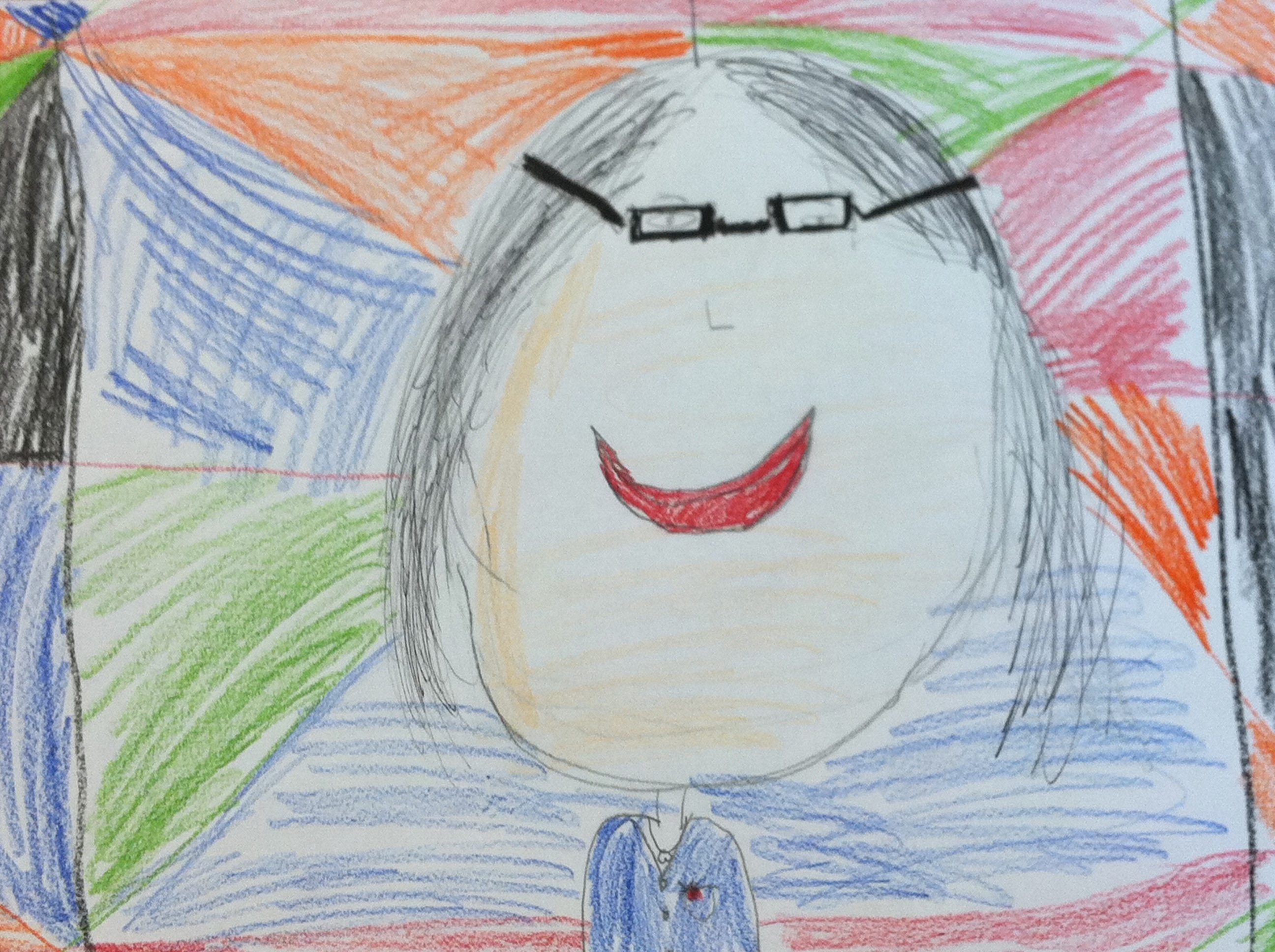
Don’t worry, someone made a portrait of me, too

Describe your teaching style in one word. I would describe my teaching style as “professorial.” We definitely have fun, but I also really try to help students develop the habit of thinking carefully and thoroughly about each task they do.

What is your go-to literacy strategy? Reading notebooks (see below)

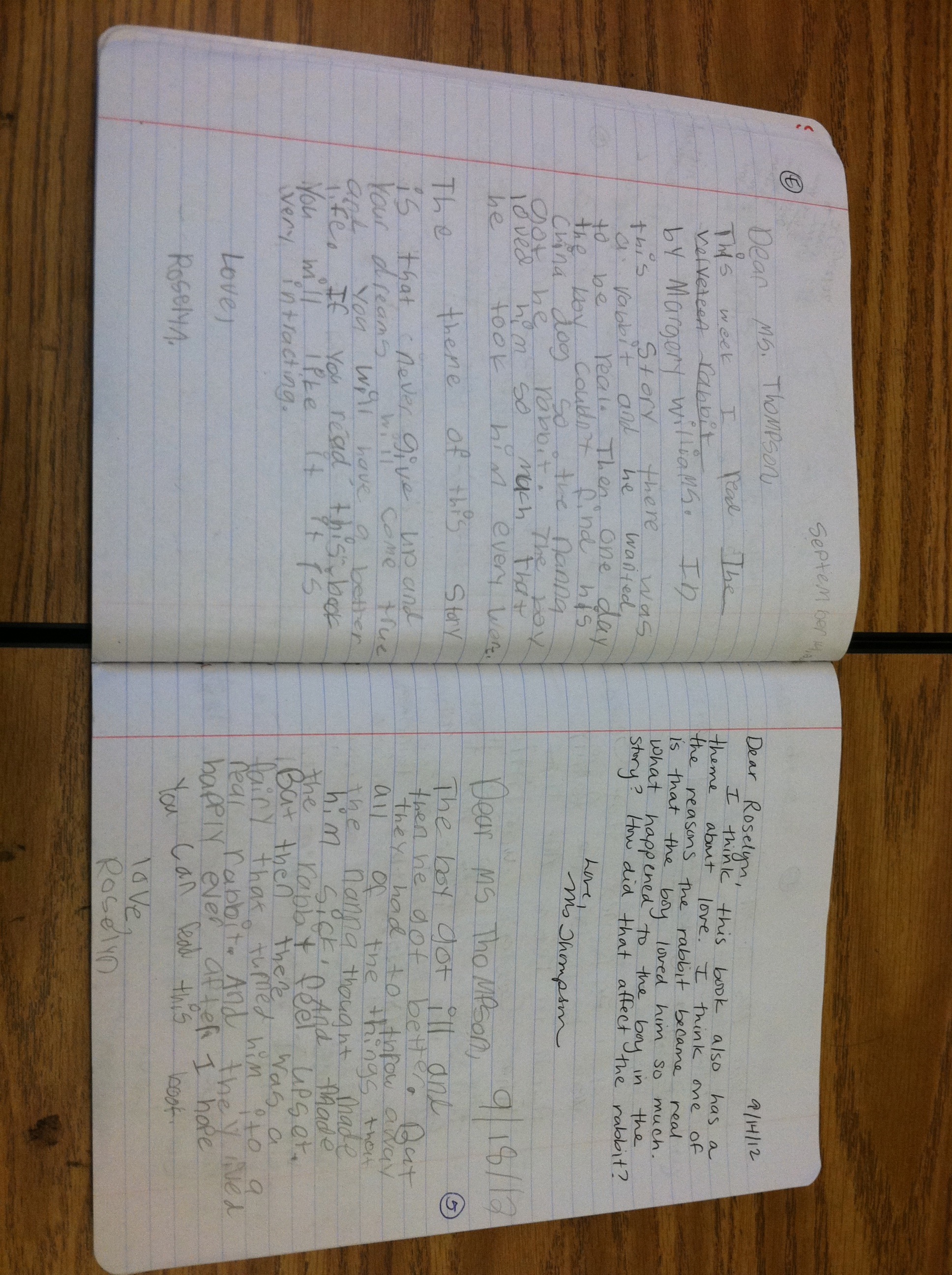
We also use a notebook for most of our reading assignments. I love reading notebooks! My students write a short entry (1-2 sentences) every day, and then on Fridays they write me a letter about what they’ve been reading that week. I write them back over the weekend, and on Monday their entry is a response to me. When I grade their notebooks, I give grades based on the quality of their entries, and I also keep a running list of who has demonstrated understanding of key learning targets. For example, this student is starting to show an understanding of theme, although it’s not solid yet.

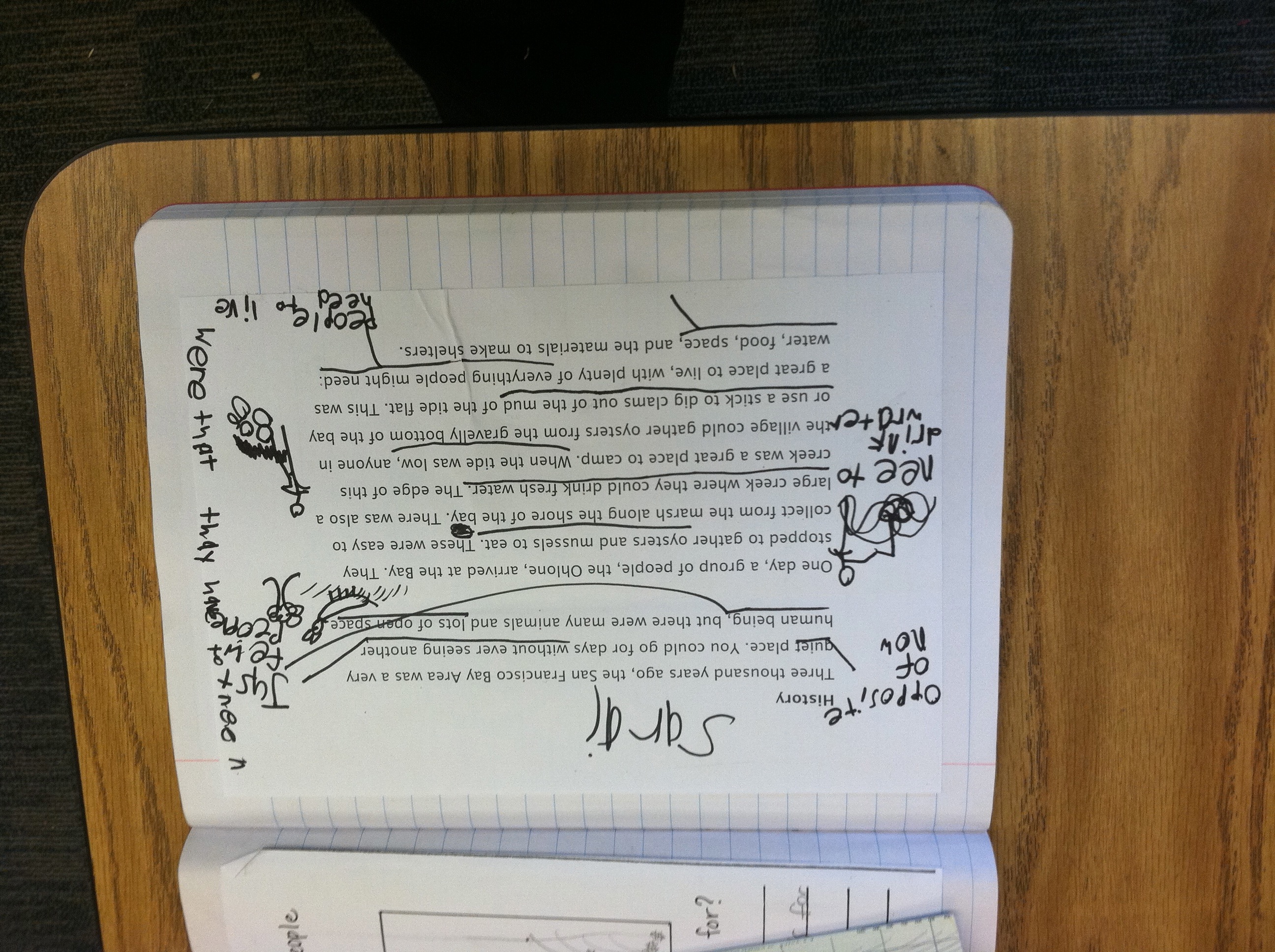
Here’s an example of a social studies reading assignment. We read and annotated the passage together. I always integrate reading and content whenever possible! Because my class loves art, we also do a lot of reading and sketching to help us visualize. *Abby’s Note: Annotating primary sources in 3rd grade = Common Core compliance and general butt-kicking awesomeness
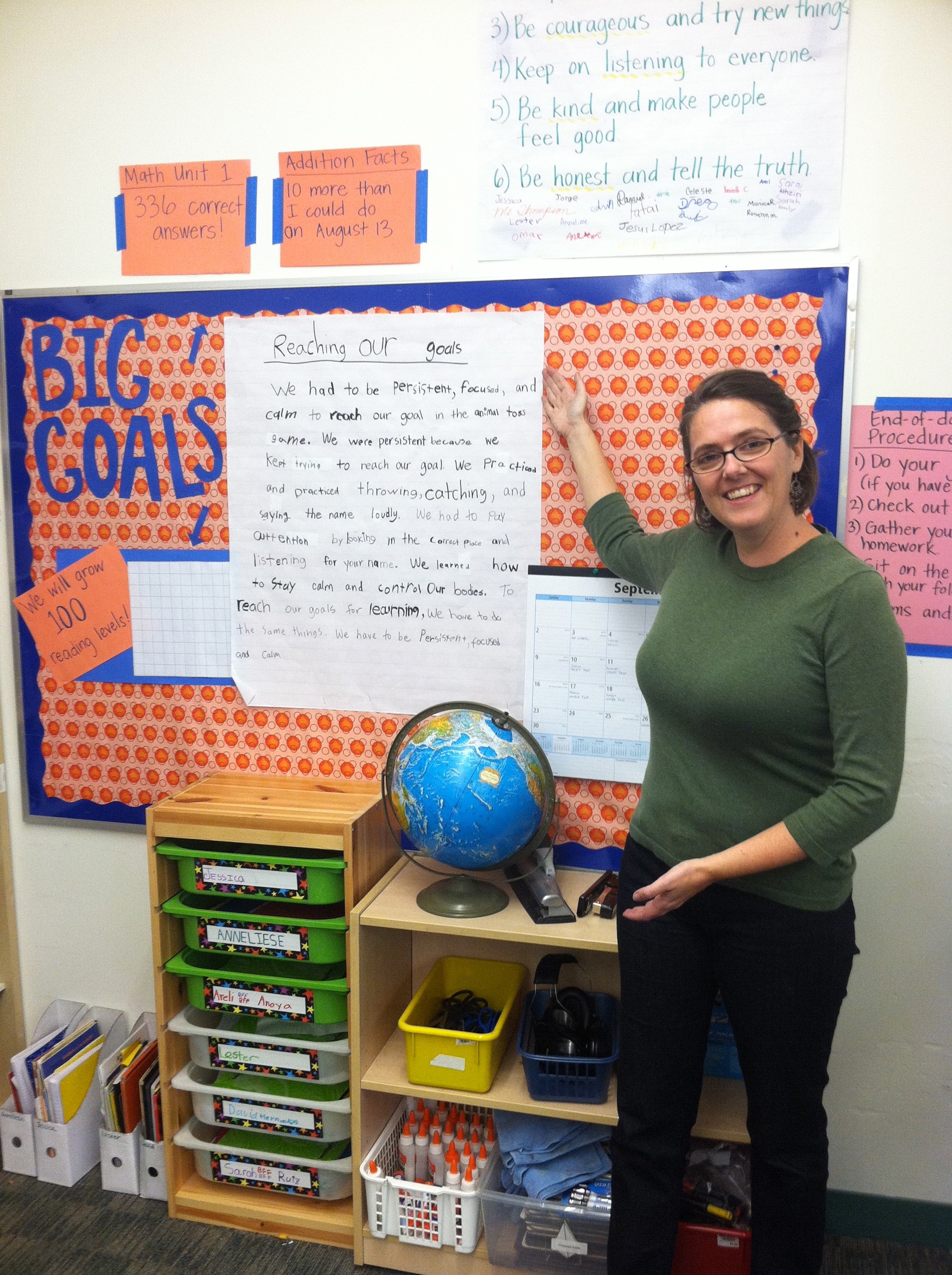
How do you motivate your students? I try to set goals that help us compete against ourselves and celebrate improvement, rather than goals for absolute mastery, which can feel scary to kids who are struggling. I assess student reading levels each month, and when they grow a level they color in a square on the reading level chart.  For the math goal, I add up how many correct answers the students get on a pre-test, and then figure out how many answers we would need to get correct if everyone grew 20 percentage points.

To help students learn what it takes to reach a goal, I start every year with a group game we call “Animal Toss.” It’s a bit complicated, but basically it involves throwing multiple stuffed animals around at the same time while trying not to drop them. We set a goal for how many animals we can get going simultaneously, and then practice every day. After the game we talk about what we did to get us closer to the goal, and what we still need to work on. When we finally reach the goal (it took us four weeks this year—not gonna lie, I was starting to wonder), we write a paragraph about how to reach goals.

What is your favorite way to check for understanding? I am constantly assessing my students. As a multiple subject teacher, it’s especially hard to keep 4 or 5 assignments a day organized.  Here are my two best organization tips (see below):

When students turn work in, they turn it in to a folder labeled with the subject area. This way at the end of the day I just pick up the folders, and all the work is organized by assignment. If someone turns something in late, they just find the correct folder and put it in, which saves me a lot of time. Most ongoing work is kept in a notebook. Third graders have a hard time keeping track of papers, so if things are glued down they can easily refer back to them. Additionally, I know that if I need to look back at a student’s work, it will be in the notebook.

Classroom rules, signed by all students.

Ms. Bisso’s Classroom

For our second classroom tour we have the amazing Emily Bisso – middle school teacher, literacy goddess, and fashionista. I had the privilege of working with Emily (or just “Bisso,” as she sometimes rolls) this summer and learned so much from her about teaching and staying positive. Here is her beautiful classroom . . .

Ms. Bisso welcomes you to her classroom!
There are little Miami Redhawks with creepy kid faces cut-out on top, and my trusty peace plant.

Where do you teach? I teach in Brooklyn, NY, in a neighborhood called Ocean Hill. It is very small and between Brownsville and Bed Stuy. My school is Ocean Hill Collegiate Charter School (part of Uncommon). I was on the founding team in 2010.

Who are your students? The most amazing, caring, ready 10-year-olds in the planet. They are generally from Caribbean heritages, and our parents are super supportive. They almost all live in the direct neighborhood. You can find more information about our kids at the school’s website.

What do you teach? I teach 5th grade History and I’m the network History chair for 5th grade and our school.

“I eventually cover all those windows in words (put backing on them so they don’t fade, or butcher paper – it still lets light through) and you can’t see well, but each couple of panes is already marked off as one of my units. They are color-coded in an OCD way to match the library color codes (purple is Native Americans, for example). I can easily pull the shades down when it’s time for a quiz, and boom – words covered. Always thinking. My biggest yay moment is that when kids want to stare out the window…they CAN’T. Up on top is some of my timeline, roughly years 1400-1777”

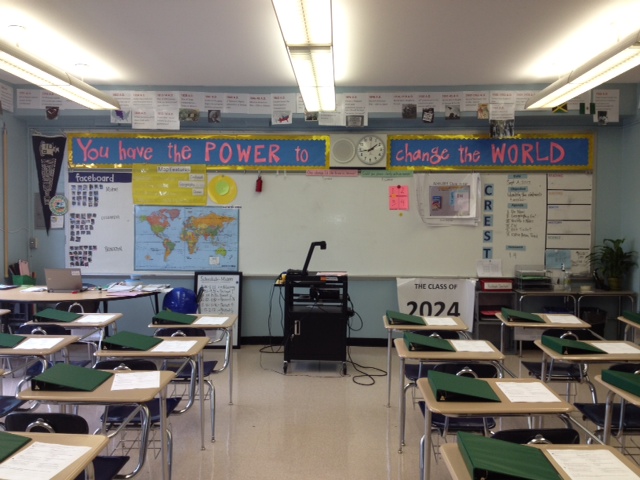
“Big motto (You Have the Power to Change the World) for staring, word wall JUST for geography (see image below for what it becomes), the map (again, see below for end product). Direct teaching happens up here, faceboard is up here for conferences which’ll start in Oct., and homework/notes, listening board, etc.”

“Last year’s geography word wall in June”

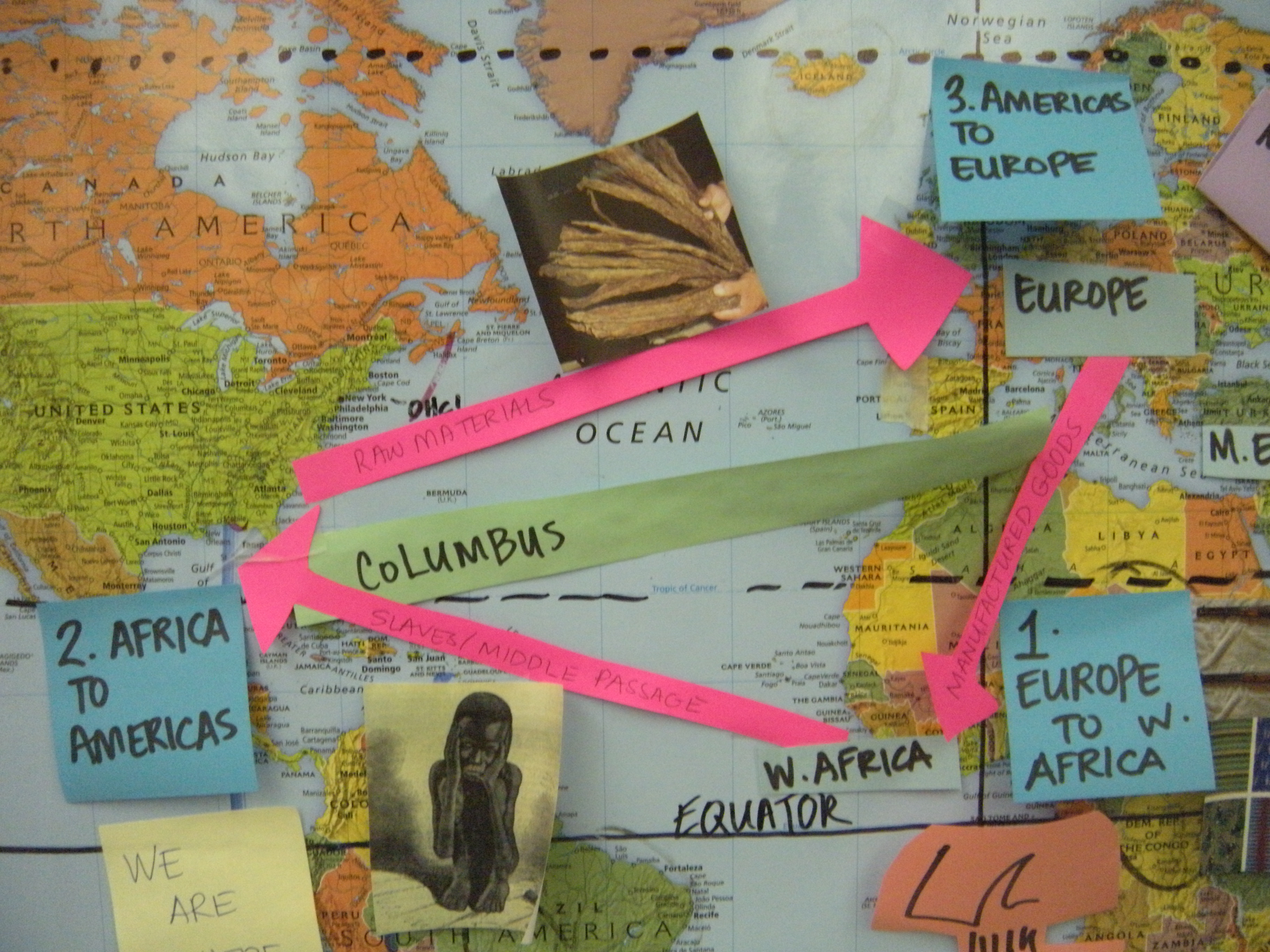
“The map at the end of the 2011 – 2012 school year”

Describe your teaching style in one word. Relaxed.

What is your go-to literacy strategy? I love RAFT – role, audience, format, topic – to get kids to think about what it would be like to be someone else, something else – my favorite RAFTs are when weird 10 year olds want to be inanimate objects.

How do you motivate your students? I like to put wigs on kids . . . it’s weird. I’ve also used trackers – kids love to track their growth! We set individual goals and I have check-ins around their data to make it personal. I don’t do a whole lot of shazam-type stuff – it’s not very me – so I stick to cutting out pictures of my children, pasting them on different mediums, and data. Nerdy, true.

“Two big flags – a political cartoon one that kids ask about all year that connects to our big theme of “You can create great change” and the Miami one that my gung-ho adorable Advisory partner got and helped me hang. You can see the library on the left, which has a close-up…plants…and my three color-coded tracking charts that correspond to the kids’ tracking charts in their binders. We track exit ticket and quizmastery – only quiz mastery goes up there (they can track ETs all they want, I get weirded out). The board has lots of blank space – I hang work all cray like. Stars everywhere. It marks our units – I’ll hang the big nontraditional assessments and save ones from previous years to show as examples. On the bottom you see binders, which are labeled by class.”

“My classroom library by unit”

“Classic kidney table for conferencing with students – Faceboard behind it”

What is your favorite way to check for understanding? I love a good old-fashioned quick write followed by a share. Sue me. Especially when you have kids evaluate afterwards.

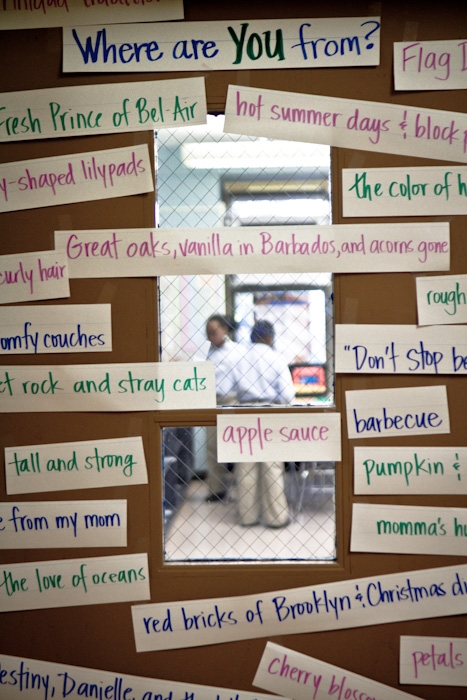
“I like to fill the door with student responses to various questions. Here they answered the question “Where are you from?” and I wrote out selected responses on sentence strips.”

Ms. Corroy’s Classroom

Today’s post kicks-off The Sacred Profession’s weekly classroom tour. Each week I will post an interview with and a photo tour of an awesome teacher’s classroom. To start the series off, we’ve got a teacher who I’ve written about before – Ms. Corroy. To you faithful readers (a.k.a. my mother . . . maybe?) who are wondering if I’m obsessed with Jenny let me be clear: I’m not obsessed with Jenny, I’m enamoured with her.

Ms. Corroy welcomes you to her classroom!

Where do you teach? IDEA Donna College Preparatory in Donna, Texas

Who are your students? My students are 12th graders in their second year of the IB Diploma Programme. They are predominately lower-income, Hispanic students living in the Rio Grande Valley.

What do you teach? Language A English at the Higher Level (an advanced English Literature course)

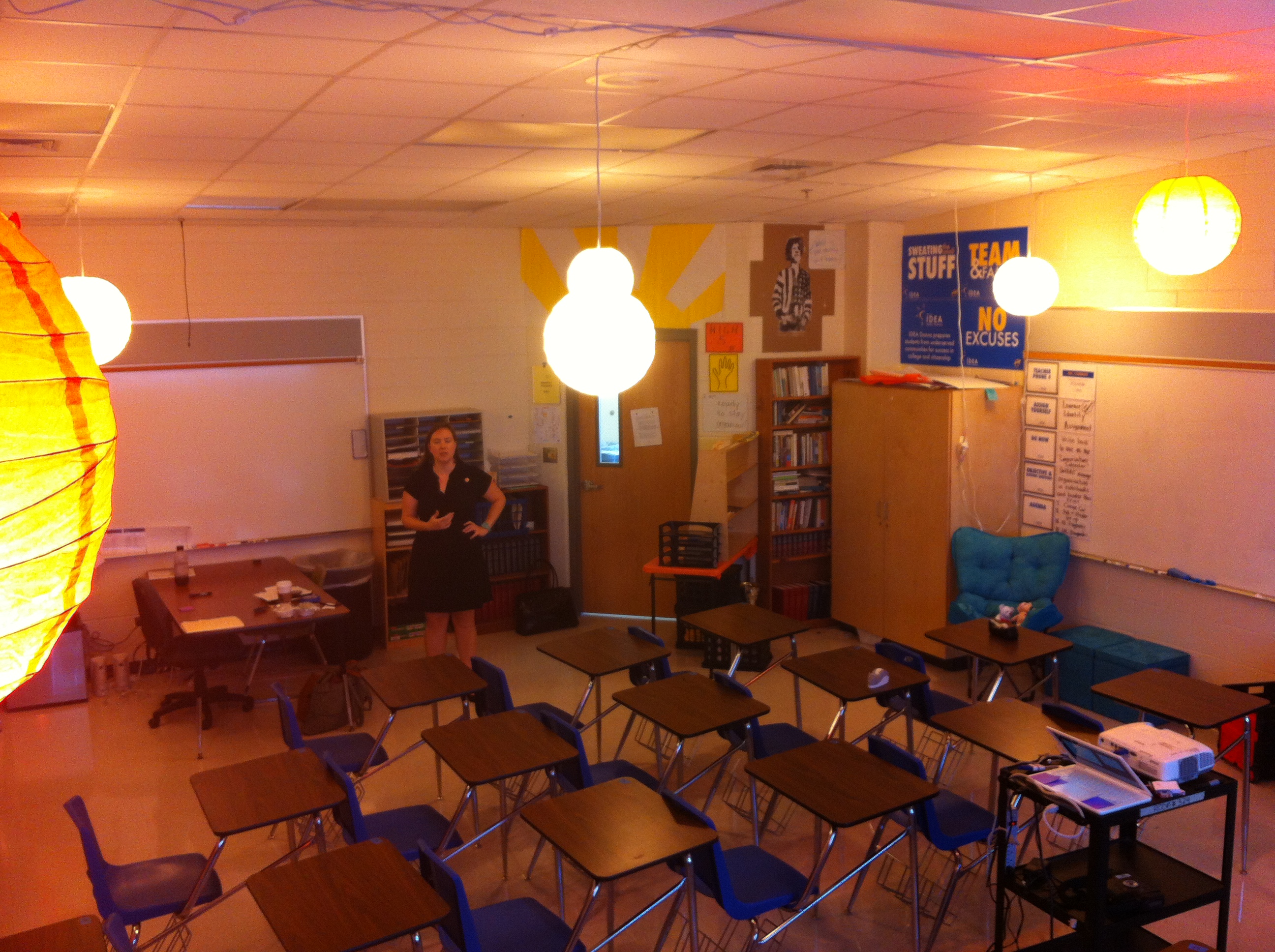
“Rocking the paper lanters WITH lights in them as well! I haven’t turned my overhead lights on yet this year. It seems dark but actually you get used to the light pretty quickly and students can clearly see. It also casts a nice sun-set glow on everyone in the room.”

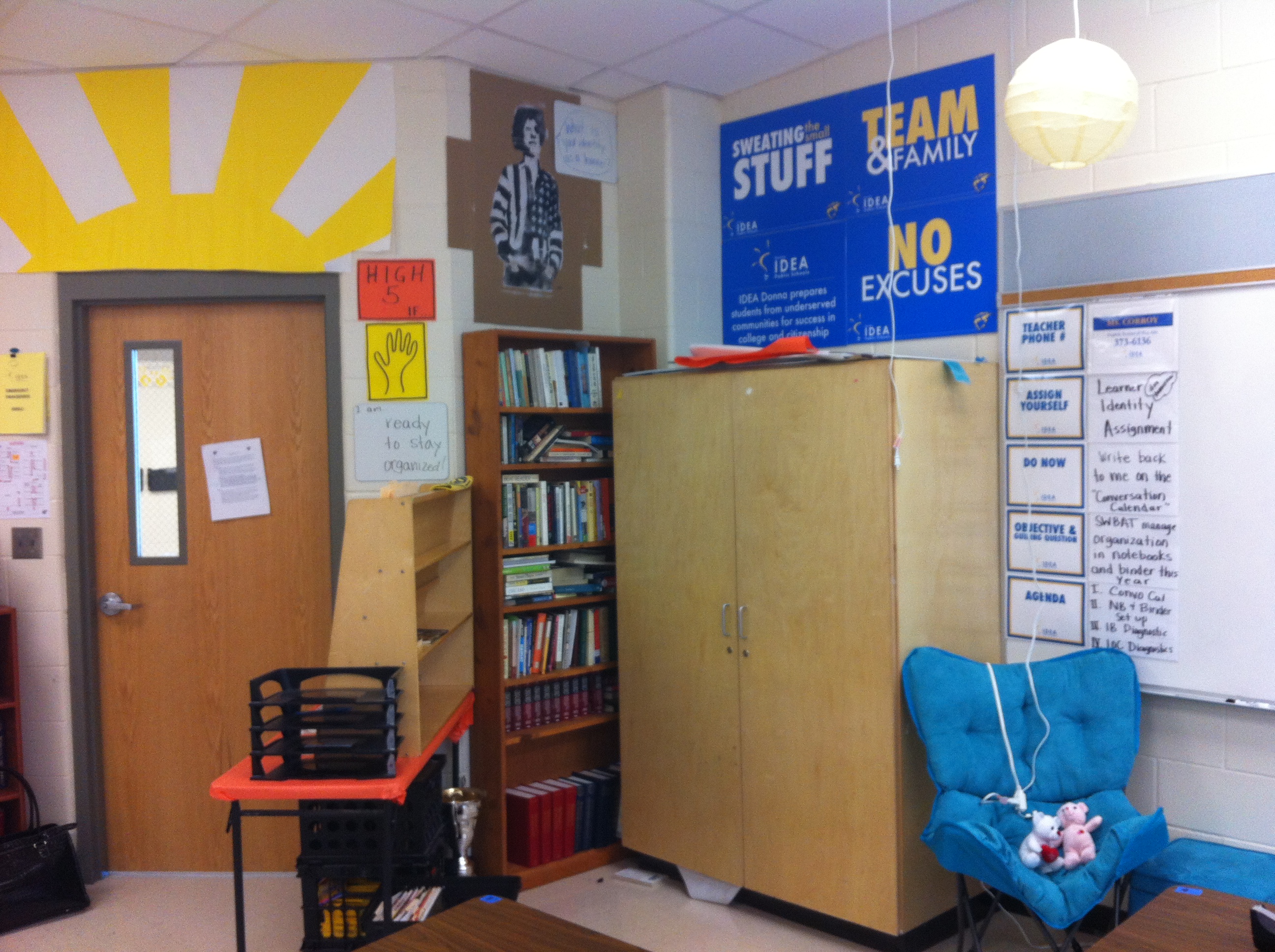
“This is the entrance to the room. The sunburst above the door represents the four major assessments my students will take this year. Every time they complete an exam I will have them place a sticker of their choice on the sunburst thus marking our progress towards earning college credit. Last year, I cut this up into little pieces and framed one for each of my students; some even took it with them to college! Notice the print of Abbie Hoffman above my classroom library – it was made by one of my students last year and says “What is your identity as a learner?” Students pick up papers at the table to the right of the door as they come in.”

“On top of one of my shelves I have a “Shrine to Myself” with my diplomas, certifications, awards, and other special items – like the Wisconsin Badger. This shows students how seriously I take teaching as well as revealing a little of who I am personally.”

Describe your teaching style in one word. Responsive

What is your go-to literacy strategy? Color-marking a text to annotate it

How do you motivate your students? (see below)

“This is a get-to-know-you strategy I use at the beginning of the year. Students write whatever they want for me to read in the top boxes and I write back to them in the bottom box. They ask me random questions, I ask them questions, and we get to know each other on a low-risk yet one-on-one basis without spending too much time outside of class.”

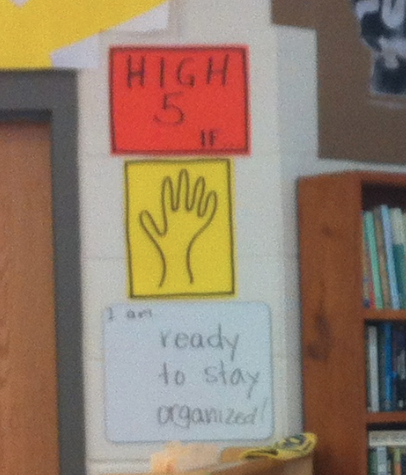
“Every day as students leave my classroom they give a high-five to the yellow hand if they ____. Today it was “I am ready to stay organized” and everyday I change what is written on the white board below the yellow hand. This is a fun way to sometimes check for understand as well as give a last minute reminder as students leave the classroom.”

What is your favorite way to check for understanding? Fist-to-five to gauge reaction. I like it because I can see the spread of responses and quickly differentiate. I often use this to allow students to self-identify the level of support they need from me.

“I put one of those book display shelves for elementary classes on top of a table to make the station where students grab papers everyday. I also posted reminders so that if they’ve forgotten something they can run to their locker quickly before class begins. Notice the continuation of my orange and yellow color scheme . . . as well as my class slogans. Independence of thought, analysis of literature, precision of language.”

Looking for a Do-It-All Seating Chart?

I want to start by acknowledging this post firmly labels me as a hopeless teaching nerd and establishes the fact this blog, while practical, is just not cool. This Seating Chart Template is one of those teacher files I stole years ago (from Brent Maddon if you know him!) and have adapted. The grid to the left is roughly set up like the rows or groups in my classroom but it allows me to take attendance by looking at empty desks. I just draw a little line through the student names who are absent, if they show up I add another line (like an X but with out the top-left line) to show they were tardy.

I have a special little clipboard upon which I have one of these templates per period cliped. In addition to attendance, I will also use the template to track other items such as behavior (positive/negative), participation during class discussions, etc. I use the right-hand side to keep an alphabetical list of last, first names (which I’ve deleted) so I can also see grades for the week at a glance.  I really love this template because I can see attendance, behavior, and grades for the whole week at a glance. At the end of the week, I punch holes in them and pop them into a binder because it is super-smart to cover your bases with a physical paper trail (anyone else been traumatized by an electronic grade book that ate your grades?).

When students walk into my classroom I hand them a card with a number on it that corresponds to a desk. This way I can break up obvious friend pairs (in order for everyone to get to know each other better) as well as strategically position students who look like they might need a little more physical proximity to me. Then I pass a list around and they write their name next to the number they picked up so I can build a seating chart for the first couple of weeks from the list. I typically rotate seats every 3 weeks to keep it fresh as well as make strategic seating assignments given academic performance and/or behavior.

Additionally, a seating chart like this can be really helpful for when a colleague or coach is observing you. Have them watch an entire lesson and put a ? on the student’s name when they ask a question, a + when they provide an answer or contribute positively and a – when they are audibly disruptive or off-task. Put a check mark every time you (the teacher) specifically address a student. It is incredibly enlightening to see a record of your classroom in this manner.

Any one else have a seating chart they love?

Coming Soon: Classroom Visits

I always learn so much from observing other teachers or even just going inside a colleague’s empty classroom. So here’s the gist: every Thursday I will post pictures of an awesome teacher’s classroom as well as an interview with that teacher full of tips and advice. Once classrooms are setup and students are back look for the classroom visit posts to start rolling out!

Teaching Rocks My Face Off

2012 IDEA Donna Graduation

Me excited to be at my students’ graduation on June 7, 2012

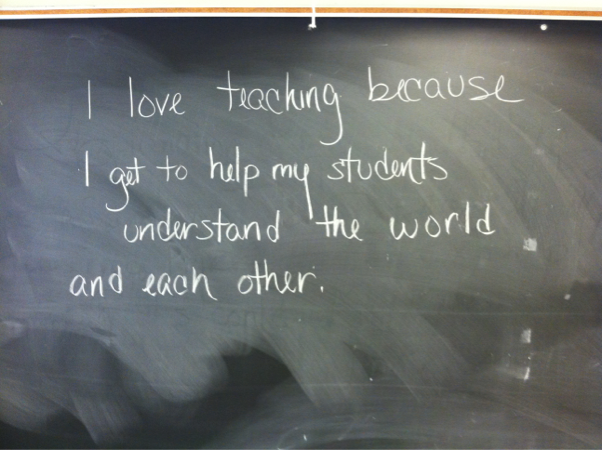
I love teaching. I have found my biggest professional gains come when I get out of my classroom and fight the isolation that sometimes comes with this profession. This blog is one way I am hoping to breakdown some walls and learn/share/collaborate more around a truly noble profession.