Author Archives: Abby Morton-Garland

What to do with a half day? Symposium!


Does your school have those quirky days where students come for just the morning? Do half days pop-up just before a holiday break or for extended professional development in the afternoons?  At my former school we struggled with how to use this day effectively. Cutting classes down to 25 – 30 minute whirlwinds was crazy but at the same time we wanted to make sure we maximized learning time. A couple of my colleagues and I came up with the idea of conducting mixed grade level reading, discussion and writing seminars called symposiums.

Because our school is an International Baccalaureate (IB) school we centered each symposium around one of the IB Learner Profile traits:

We selected Risk-takers as our first trait and then crafted a central question to frame the readings and discussion within the symposium: What is a good risk? We wanted to build a session that started with an ice-breaker, included both collaborative and independent reading time, whole and small group discussion, as well as independent writing time. We choose the following texts for our Risk-takers symposium:

Text Genre Synopsis
“The Road Not Taken” Robert Frost Poetry The famous poem about taking “the road less traveled by”
“Woman Hollering Creek” Sandra Cisneros Short Story A young woman leaves her family in Mexico to get married to a man in Texas; he treats her terribly and she is faced with another decision
“Letter from Birmingham Jail” Martin Luther King, Jr. Letter King defends his decision to come to Birmingham – even though it landed him in prison
“Reviving Ophelia” Mary Pipher Nonfiction Pipher explains her research that shows how girls become less and less confident in school when they enter middle school
“After Long Decline, Teenage Pregnancy Rate Rises” Tamar Lewin Newspaper This article looks at the trend of increased teenage pregnancy and interviews experts on the subject(see link below)
Frieda Kahlo Artwork  Self-Portrait with Cropped Hair, 1940 and Self Portrait with Thorn Necklace and Hummingbird, 1940

If you would like the full teacher and student guide for the Risk-takers symposium it can be downloaded here. The discussion with my group of 20 9th – 12th grade students was lively, fun and informed by the texts. It was a great way to incorporate both fiction and non-fiction texts into a source-based discussion and writing experience for students. It also allowed students to get to know kids from other grade levels which helped get at some cross-grade tension we were experiencing. I enjoyed watching my 12th grade students take the lead on answer and posing questions during our discussion time as well as help clarify misunderstandings during group work.

The downside was us teachers spent from 8 – 12 without so much as a bathroom break; however, I have had years where my planning period isn’t until the last period and I run that schedule anyways. The upside was one collective planning effort served as lesson plans for the entire high school. At any rate, it was a whole lot better than movies and class parties!

Anyone else have an innovate approach to half days?


Guest Blogger: Reviewing Math Problems for Understanding

The best professional development I’ve had has come from having the privilege of working with outstanding colleagues. Who needs to go to trainings when you have an amazing teacher right down the hall? One of these great teachers is Dianne Allan Garcia who is not only a genius (MIT and Harvard), an award-winning and results getting teacher (crazy percentage of AP Calculus passing rates – think Jamie Escalante), but also one of the most kind and caring people I know. I am so honored to introduce her as a guest blogger on The Sacred Profession . . . Thanks Dianne!

“In my early years of teaching I [thought]….becoming a good teacher meant mastering a set of delivery techniques and knowing all the answers to my students’ questions. In those years it had not yet occurred to me that good teaching hinged upon what I knew and understood about the learners themselves and about how learning happens.”

– Mark Church, teacher, as quoted in Making Thinking Visible: How to Promote Engagement, Understanding, and Independence for All Learners, p. 9

When I reflect on my first five years of teaching, I realize that my biggest missed opportunity in helping students develop mathematical understanding and proficiency was the time spent in class going over the answers to problems they had just worked on. I would usually talk through the problem step by step while writing the work out and then ask if anyone had any questions. Meanwhile, students who had gotten the problem right tried not to nod off while they had to listen to it again and students who had made an error had no idea what they did wrong and just copied in the right answer.

A few years of observing math classrooms made me realize that I had to completely reframe my approach to problem review. Instead of getting to the right answer, I now see reviewing problems as a way to uncover student misconceptions, help students understand what they did wrong, and give them an opportunity to practice explaining their thinking. Now that I’m back in the classroom part-time, I’m finding ways to make this happen and watching the magic as students engage in rich discussions about things they don’t understand. Here are some strategies that I’ve been practicing to review problems more effectively:

  • Show the answers right away. Remember the goal is not to explain the steps that you did and go through each problem. It’s to figure out as quickly as possible who made errors where and to start talking about them.
  • Write and discuss the most common mistake that you saw. Especially as you begin this process, students might not feel comfortable admitting that they made a mistake so I will often walk around as they’re checking their work and then I will say, “Here’s what I saw a few people write for problem x…what’s going on there? What are they thinking? Is this a valid approach? Why? Or why not?”
  • Ask questions to search for misunderstandings and encourage the process. I often use questions like: Which ones do you want to review? Who got a different answer? Who solved it differently? I also encourage and praise students who contribute a mistake that they made. I’ll tell them that’s a really common error that I’ve seen or that I made that mistake too when I first tried the problem (sometimes, I’ll admit, I’ve said this even when it’s not true!). Teach your students that the discussion is more important than having the right answer.
  • Make mistakes and put up wrong answers on purpose. Unpredictability promotes engagement and critical thinking so every once in a while I will purposely put up a wrong answer and then go through the standard questions (Who got something different? What did you do differently?…and, eventually, what mistake did I make? How do you know?).
  • Ask multiple students to re-explain the same idea in their own words. Once you’ve started uncovering misunderstandings and discussing where students went wrong, students should start making connections and developing new understandings. When this happens, I will often call on several students to re-explain the idea in their own words or will ask an analogous question of a few different students to make sure everyone’s gotten it.
  • Have students write in words their new understanding, preferably in a brightly-colored marker. After the discussion, I ask them to write what they just learned on their sheet or on a separate learning log. I remind them that writing it out in words is going to help them remember for next time, especially when you write it in marker. (This is not research-based, just my opinion really…and writing things in marker is fun!)

What other strategies have you used to review problems and promote understanding in your math classroom?

Eating the Marshmallow Might Be A Good Idea If You’re Poor

Chances are you have heard of the Stanford marshmallow experiment in which researchers looked at the ability of 4 year-olds to delay gratification. The 1960s experiment involved setting a marshmallow in front of  the child and telling him or her they could either eat the marshmallow or wait 15 minutes and get a second marshmallow. Researchers have tracked these children over the years and found that the child’s ability to wait predicted their future success in high school, in college and even in forming stable families, marriages, and careers.

When I read this study years ago I immediately saw the connections for my classroom. Delayed gratification was the key to getting 100% of my students to achieve academically! I taught the study to my students and likened waiting for the marshmallow to choosing to study for the AP or state exam; not immediately satisfying but more beneficial in the long run. I made a poster with the slogan “Don’t Eat the Marshmallow . . . Yet!” for my classroom and passed out marshmallows on the day of the exam. My buddy, Melissa Barkin (whose beautiful classroom can be seen here) designed her classroom motivation system around this study; she put “Don’t Eat the Marshmallow” on all of her handouts and referenced the study often.

This month a new study by the University of Rochester added a twist to the Marshmallow Test (thanks to Melissa for sending it to me!). Children were given the Marshmallow Test after a series of experiences where they were promised a reward if they waited. Half of the children received the rewards if they waited, the other half were told “there weren’t enough supplies” or some other excuse and were not giving the promised reward; then came the Marshmallow Test. Children who actually received the promised reward wait on average four times longer (ex. 12 minutes instead of 4) during the Marshmallow Test than children were not given a promised reward. Researches concluded:

“Delaying gratification is only the rational choice if the child believes a second marshmallow is likely to be delivered after a reasonably short delay,” [study author Celeste Kidd] said. Self control isn’t so important, it seems, if you don’t think there’s anything worth controlling yourself for.”

As someone who teaches students from predominately low-income backgrounds, the implications of this student were as staggering as they were obvious. Students with a history of disappointment – whether from the harsh inequalities of poverty and/or the disfunction of adults in their lives – will eat a Marshmallow if it is placed in front of them because they have learned not to trust an unseen reward. This reality is so obvious and intuitive we have saying built around it: “A bird in hand is better than two in the bush.” If delaying gratification is critical for long-term success how can we help instill this trait into our students if life outside of school (and often inside school) is teaching them the exact opposite?

Survive Suctober

October is the month of crisp weather, turning leaves, and depressed teachers. A month with no national holidays and no end in sight; October is so far from June. It’s the point in the school year where the honeymoon period is over and students are earnestly pushing boundaries as far as possible. But this slump can be overcome! Here are my go-to survival tips for Suctober:

  • Take a Wednesday off: I recommend this coming Wednesday because the third week of October is the worst. Wednesdays are particularly decadent because you can’t go out of town or do anything three-day-weekend-spectacular worthy – you just read, watch TV, or (let’s be honest) sleep. Your students will be fine without you and in fact, they will have a better teacher because you will return to them rested and eager to do it again. RESIST the temptation to make this a “catch up day” and grade or plan. Do not do it. Rest.
  • Watch your favorite movie: If you have a particularly bad day you should watch your favorite movie. Maybe not all the way through but at least a nice little chunk of it. Subsequently, in our house, October is the month of Jason Bourne and You’ve Got Mail (no judging my husband for loving a Meg Ryan flick . . . ok so that’s me).
  • Stop paying close attention to the news: I am not advocating ignorance here but there is no question ignorance can bring a little bliss. My rule lately is I listen/read until I become angry or disgusted which, in an election year, is pretty darn fast.
  • Exercise: Go for a run or walk or whatever you do to get the endorphins flowing.
  • Avoid talking to negative people at work: Typically you can handle Ms. Negative in the teachers lounge however in October she is toxic. It may feel good to indulge in a little talk about how your school is the very source of evil but it will bring you down in the long run. In fact October might be a good time to just avoid hanging out with too many teachers. Even the best of us are feeling crappy.
  • Remind yourself why this work is sacred: Tap into the reasons why you became a teacher. Hang an inspirational quote about being a teacher in your classroom. Tell your students you have the best job in the world. Watch a cheesy, teacher glorifying movie. Take 10 minutes of class to have students write a thank you note to one of their teachers.
  • Really, really try hard to keep nights and weekends work free: This is tricky but it’s possible. One approach is to dedicate an entire Saturday or Sunday to catching up on grading and planning. Then follow a weekly schedule to keep ahead of yourself. Some of the darkest moments of my life have been October mornings battling the copy machine and the clock. For more advice about keeping a reasonable work-life balance click here.

How do you combat Suctober blues?


Uniforms: An easy way out of character education?

Recently I had a pass-out-it-is-so-good pupusa lunch made by one of my dearest friends. Over lunch we talked about how four of her children are doing in school this fall. It was good reports all around but my soft-spoken friend talked about how difficult it was for the family to purchase a specific, and expensive, brand of kaki pants mandated by the school’s newly updated uniform policy. Because they could not buy the pants some of her children had been assigned detention in which they were required to pick up trash around campus. My friend was told requiring a particular brand of pants was a means of preventing bullying. I have known this family for a decade and asking the school for either charity or an exception from the rule is not an option. I imagined her respectful, hard-working children walking around the campus after school picking up garbage instead of doing homework or practicing volleyball. I imagined the jeers of their classmates, the inevitable jokes that come with public shame. Bullying prevention indeed.

I understand why schools implement uniforms: it builds culture, it is an equalizer, it eliminates some of the distractions of  teenage preening, it makes for a respectful looking student body, and it provides visual order that often translates into on-task behavior. I am currently reading How Children Succeed by Paul Tough (book review to come!) and it is making me think deeply about the ways we teach character to our students. Does wearing a uniform build the traits necessary for success Tough writes about like grit, self-control, zest, social intelligence, and curiosity? I find the strictest uniform codes are at college preparatory campuses – both public charters and traditional private prep schools. However, prep schools often have uniforms like this:

Male students at Philips Exeter, the high school of Presidents . . . and don’t they look it!

Blazers and ties comprise the base of a uniform that actually prepares students for a real world job. Whereas in public charter schools, particularly those made up of predominately low-income minority students, uniforms often look more like this:

While certainly respectful and clean-cut, these students look more ready to take my order at Burger King than to be my future doctor or lawyer. Full discolosure: I have a good amount of cognitive dissonance around this issue. I have enforced and defended a dress code similar to the one depicted above. However, it was always unnerving when we would have “professional dress days” and girls would come to school looking ready for the club while boys would show up in the morning without a tie (there wasn’t a tie in their house) or unable to tie it if they had one. My colleagues and I would sigh in exasperation and cross our fingers they would figure it out before an important job interview. How authentically college-preparatory is a school that isn’t explicitly teaching and giving students the chance to practice dressing appropriately?

As for the cool-kids-wear-Abercrombie-and-Fitch-and-you-don’t-so-you-suck phenomenon it seems like uniforms are an inappropriately indirect way to teach tolerance and respect. It’s like the Kurt Vonnegut short story Harrison Bergeron about a distopian future where beautiful people are required to wear masks, athletic people to wear chains, and quick thinkers to wear earpieces filled with shrieking bells that interrupt their thoughts. Uniforms do not eliminate socioeconomic inequalities in our students. More importantly, students from low-income backgrounds who go to college will inevitably encounter peers who are expensively dressed and might even be dismissed for their own cheap clothing.

What can we do to address these touchy questions of income inequality, professional dress, and bullying in our own classrooms? Here are some ideas I use in my own classroom:

  • Model professional dress: My husband, the 8th grade science teacher, refuses to wear jeans and a t-shirt on Fridays (or if he must he wears a blazer over it). He wears a tie and slacks everyday and makes a point of telling his students he does so because he respects them. Lord knows I have certainly taught in jeans (and not just on Fridays . . . more like my entire last trimester both times I was pregnant) but I do try to put a little effort into dressing like the serious professional I hope to be (more tips on teacher dress here).
  • Provide opportunities to teach professional dress: Field trips, college visits, guest lectures, important class presentations all merit special attire. Teach students how to dress appropriately and then have them practice doing so. Make sure to give feedback when dress is both appropriate (“You look like a future president!”) and inappropriate (“The length of that skirt does not match the serious, intelligent woman you are and want to be perceived as.”) Even if you teach in a school with a strict non-preparatory dress code ask your principal if you can have an exception for professional dress a few times in a year (more if you teach seniors).
  • Speak openly about social inequality: Although we often tip-toe around the realities of poverty at school our students live with it in blunt, everyday ways. Find natural ways to talk about poverty and engineer situations (via readings or speakers or lessons) to teach students about the innate dignity of all people regardless of income.
  • Do not tolerate bullies: Immideiately assign consequences for any and all disrespectful behavior. Directly address clothing discrepancies. Make it known that you do not value your students for the price of their clothing but for the content of their minds and character. Tell stories about how what is fashionable will come and go. Compare a 2012 A&F hoodie to a 3 foot powdered wig from 1760.
  • Check out the gold mine that is Teaching Tolerance: This organization has so so many resources on exactly this topic and they are so power and so well-made. Check it out!

How do you teach tolerance in your classroom? What are your thoughts on uniforms?

“Over the partisanship and through the bickering”

We will never solve our education crisis if we meander around the extremes of our party platforms. Rather, we must reward methods that yield success and abandon those that continue to fail, regardless of politics.

– Gabriel Ozuna, college sophomore at Yale University writing for Pass the Chalk

I’m am feeling pretty proud today because one of my former students has a measured, thoughtful and hyperlink-filled posting over at Teach For America’s blog “Pass the Chalk!” After last night’s Presidential town hall/cage fight it was refreshing to hear a call for solutions over partisanship from the next generation.

What I find interesting about education and politics is how everyone agrees reform is urgent and necessary yet there seems to be a lack of creativity in implementing solutions. Certainly NCLB, Race to the Top, and the Common Core represent bold strides into new territory however I also believe the time has come to correct the agressive swing towards frequent high-stakes testing and return to a measured, yet accountable, approach that includes the arts and humanities.

At the same time I am unsurprised by the lack of federal solutions to what I believe is a local problem. If education is the Civil Rights movement of our time we can hardly expect legislatures and bureaucrats to do the work of what must be a grassroots movement. Though it is one small contribution it feels pretty great to have had the privilege of teaching a young man who is already taking part in demanding more from his elected officials. I was once told “our students are the messages we send to a future we will not see.” With former students like Gabriel and his classmates, I am more than hopeful about seeing an education revolution well within my lifetime. Indeed, it is already underway.

“AP Classes are a Scam”

Those of you who know me or who have been reading my blog will know I am an ardent and public enemy of Advanced Placement and so I was delighted to see the article “AP Classes Are A Scam” on The Atlantic website. The article’s author, John Tierney, claims AP classes are “one of the great frauds currently perpetrated on American high-school students.” I would only add that for minority students in under-served schools or areas of high poverty, AP classes become inadvertent tools used to perpetuate underachievement in the communities who need to succeed the most. Students with the highest academic performance are tracked out of mainstream classes and promised a college preparatory curriculum but instead receive a frustrating and ultimately ineffective education in random minutia. Add to this the additional problems brought on by a teacher who teaches her AP class by assigning lengthly readings from a college-level text and lecturing for 40 minutes or more every day and our struggling students are completely left behind and even less ready for the potential rigors of college. I know because this is how I rolled for 5 years – long enough for my students to graduate, spend a year or more in college, drop out and return to campus to ask me why I didn’t prepare them to be successful. Ummm . . . I was too busy teaching you to pass the AP exam?

AP classes are necessarily aligned to AP assessments which do not mirror college-level rigor, require broad and trivial fact memorization (a skill Wikipedia has made obsolete everywhere but on Jeopardy and 3G-less West Texas), and fail to build critical skills like expository writing based on research. Tierney does a nice job outlining the problems with AP courses in his article. Read the full article here and thanks to Jenny Corroy for bringing it to my attention.

What is your experience teaching or taking AP classes?

Popular Pedagogy: Project-Based Learning

Recently there has been a buzz around both flipped instruction (where students are exposed to material at home via online content before practicing in class) as well as project based learning (PBL). I experimented with flipped instruction last year using Edmodo as a launch point for online content I linked to my class. I felt so-so about the experience but chalked it up to being 8 months pregnant and a fist time flipper. However, I’ve never really given PBL a fair shake. But I’ve recently seen more articles and resources out there on project based learning. I wanted to share them here and see if anyone else has advice for teachers who might be considering making the switch to PBL.

  1. “The Flip: The End of a Love Affair” by Shelly Wright – This teacher describes why and how she shifted her instruction from the flipped model to project based learning. It is a quick read but also a well thought out argument in favor of using projects to engage students in authentic learning.
  2. “For Authentic Learning, Start With Real Problems” by Suzie Boss – This is a condensed explanation of what project based learning is as well as some resources for making it work in various types of classrooms.
  3. Project Based Learning at Edutopia – A clearinghouse of examples and tips for teachers looking to try out project based learning.

What is your experience with PBL? Please share links, stories or potential help for others (OK, so help for me) if you have a moment.

Considering the Un-Thinkable

I was a senior in high school the year of the Columbine massacre and I remember thinking it would be an isolated incident that would never occur again. By the time I became a teacher, I realized I should at least think about what I would do if I found myself in a similar situation. Most of us have been trained on some sort of “Code Black” protocol where we lock the door, turn off the lights and get away from windows but yesterday on NPR I heard a story about an alternate approach – fighting back. The report centered around what is called “ALICE” training which stands for Altert, Lockdown, Inform, Counter, and Evacuate.  ALICE trainers assert school shooters end up hitting more people because students and teachers hide and stay still. Instead, they recommend strategies like barricading the door, throwing a large number of items all at once at the attacker to distract from a rushing tackle, and running in zig-zags to avoid being shot.

It is hard to know what you would really do under in an actual situation but I believe it is worth some mental planning. Consider David Benke, the now famous math teacher in Colorado who tackled a gun man at his school in 2010. Benke thought about what he would do if a shooter ever entered his school and he said, “If something happens and there’s something that I can do about it, I want to try and do something about it.”

This is not a topic I have discussed at length with my fellow colleagues but I am interested to hear your thoughts. As teachers, what is our obligation here?

Ms. Scheinfeld’s Classroom

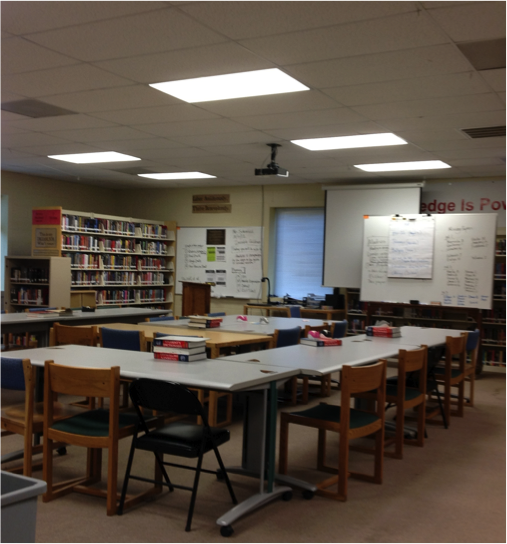
The teaching profession is shifting and more and more of us are taking on split or hybrid roles where part of the day is in the classroom and part is spent coaching or writing curriculum. So what do you do when you have to 1) share your room with a colleague and 2) hold classes in the library because that is the only available space? I am so pleased today to share the multi-functional classroom of my dear friend Melissa Barkin Scheinfeld. Melissa and I were in the same collaborative group at our pre-service teaching institute in 2005 and have been friends ever since. Whenever I have a particularly tricky teaching situation or just need a really brilliant thought partner I ring up Melissa. It is no surprise to see what an amazing classroom she has made despite some logistical challenges. Thank you for sharing your classroom Melissa!

Where do you teach?  I teach in Austin, Texas at KIPP Austin Collegiate.  We are the only KIPP high school in Austin.Who are your students?  My students are seniors who are currently applying to college and getting ready to take over the world.  They are brimming with personality and we will be in good hands when they are the ones making decisions for this city.  The majority of them come from Hispanic, low-income backgrounds and they have been KIPPsters since anywhere from 5th to 9th grade.

What do you teach? I teach Government and Economics.  This is my first year teaching this course after a long stint in World Geography and AP World History.  I am loving the opportunity to write new curriculum and teach Political Science.

The white board floating at the front of the room is on wheels and the English teacher and I rotate it depending on whose class is being taught. For additional writing space, there are packets of poster paper attached to it with binder clips. When there is additional information I want in front of my students, I put it on the chart paper and flip back and forth in the stack to get to the key info. It can be a bit of a challenge as it all adds a few more tasks in order to get set up for class, but for the most part it’s working great this year.

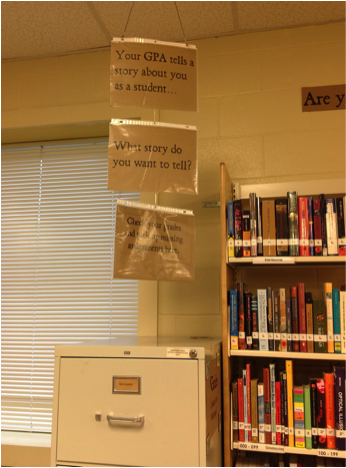
I have a filing cabinet in my classroom for students to pick up anything they are missing. The sign above it says, “Your GPA tells a story about you…what story do you want to tell? Check your grades and pick up missing work here.” The key to this system is that I don’t have to be around for a student to figure out what he/she needs to do to improve their grade or to help him/her find the missing/replacement handouts to get organized. Every teacher in my building has a system like this and we all know that if we’re supporting a student, we can send the student to another room to find extra copies of the assignment that needs additional attention.

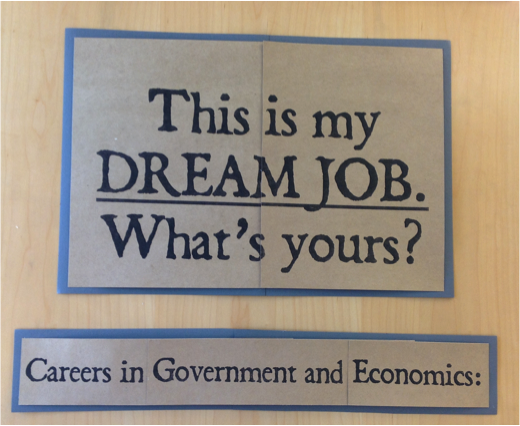
There are two signs that I’ve had up in my room every year since Abby gave me the brilliant idea… “This is my Dream Job. What’s yours?” and “Yes, I really do love you.” It’s incredible how many times students have referenced these two signs when I talk to them about our class years later. They are very empowering messages. And, I love to shamelessly promote careers related to the class I’m teaching, so the rest of the wall includes a list of jobs that this class might lead toward.

Describe your teaching style in one word. Disciplined

What is your go-to literacy strategy? I am a very strong proponent of peer revision in my classroom as a way for students to improve their writing skills.  My go-to strategy (which I, of course, learned from fantastic colleague several years ago) is called “clocking.”  I’m not sure where she got the name for it, but it stuck.  It’s basically speed dating for essay revision.  It requires three planning details:

       1. Clocking worksheet: I give students a document with 5 text boxes, each labeled with a different area from their essay rubric.  Each section has a title (straight from the rubric) and a place for the “reviser” to write his/her name.  In each box there are two sections, one for “This is what you wrote…” and the other, “I think it should be…”

       2. Seating arrangement: I move students into two long rows, or an inner circle or an outer circle, depending on the shape of the room.  The key is that each kid is sitting across from another student and they have a table in between them to work.  After each round, one of the circles or rows stands up and rotates.  Each student then has a new partner and a fresh set of eyes on his/her paper.

     3. Mini-lessons: I do a quick mini-lesson with strong and weak student examples at the beginning of each round.  When students are facing their first partner, I model feedback for the first skill (i.e. thesis statement, citations, claim and evidence in every paragraph, spelling, etc.) by revising 1-3 student examples that are almost perfect, if they just had one more piece of feedback.  Often I make them up myself because I haven’t read everyone’s rough draft.  The ideal examples are those that are mostly strong, but need one piece of clear, specific feedback to improve.  I try to bring samples of the most common student mistakes so students can see a model both for how to write well and how to give good feedback.  Students then pass both their essay and their “clocking worksheet” to their partner.  Each has 5 minutes silently to give feedback on the worksheet, then they have 3 minutes to explain their feedback out loud.  After eight minutes, one of the rows rotates, I give a new mini-lesson, and student trade papers with the new partner.

One of my students e-mailed me this picture last week for us to use on future “clocking worksheets.”  Obviously it’s intended for scientific research, but I like his interpretation of it for our Social Studies essays.

How do you motivate your students? Every single thing we do in class is tied to a college-readiness skill.  Students’ grades are based 100% on their demonstration of that skill by the end of the semester.  I’m experimenting this year with this policy of “standards-based grading” and finding it to be an incredible motivator.  I learned an anecdote a few years ago from an RBT training that I use to explain the concept of grading-for-mastery.  Imagine two students in medical school.  Student #1 scores an 80% on every assignment all year long.  Student #2 scores 50% for the first half of the course, but scores 100% for the second half of the course and earns a 100% on the final, cumulative exam.  With a traditional grading system, the first student’s score in the course is 80% and the second student’s score is 75% for the course.  The next questions is…who do you want performing your open-heart surgery?  I would want the student who performed perfectly by the end of the course.  So in this new grading system, the final grade reflects the 100% at the end of the course, regardless of how long ittook student #2 to get there.

The part of my old classroom that I miss the most is the world map that you can see in the background of this photo. I installed two sheets of metal onto the wall and painted it with a world map. It’s magnetic and visible from all parts of the classroom. The teaching potential is endless…for the new World Geography teacher who has taken over the space.

What is your favorite way to check for understanding? I use a lot of “Cold-Calling”, and “Think-Pair-Shares” during class and an “Exit Ticket” at the end of class.  I would estimate that every 5-10 minutes during class I prompt students to write down an answer to a prompt, explain it to their partner, and then I call on a student randomly to share their thoughts.  It is consistently the most popular aspect of class on student surveys.  And, it takes no prep, gets every student voice in the room, and gives me a ton of information about what is and isn’t “sticky” in my teaching.

       At the end ofclass every day I give an “Exit Ticket.”  It’s a half sheet of paper containing 2-4 questions that prompt students to explain the key concepts from the period.  Sometimes I grade them, sometimes I read them and then recycle them, and sometimes I sort them into piles by right and wrong answers or other general trends to plan for a quick mini-lesson to re-teach something the following day.  This practice holds me accountable to know where I’m headed every day and gives me permission to not give individual feedback if it isn’t a strategic use of my time.

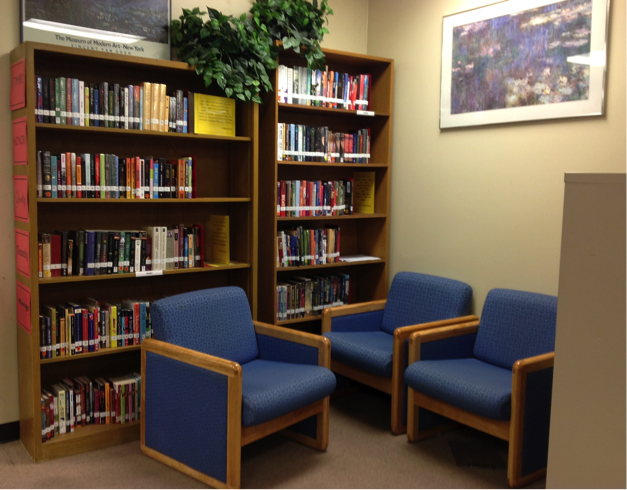
The biggest perk to being in the library is that we have fantastically comfortable furniture that students can use when we’re in small group work or writing independently. It’s pretty awesome to have a couple of nooks like this and for that I’m super grateful.
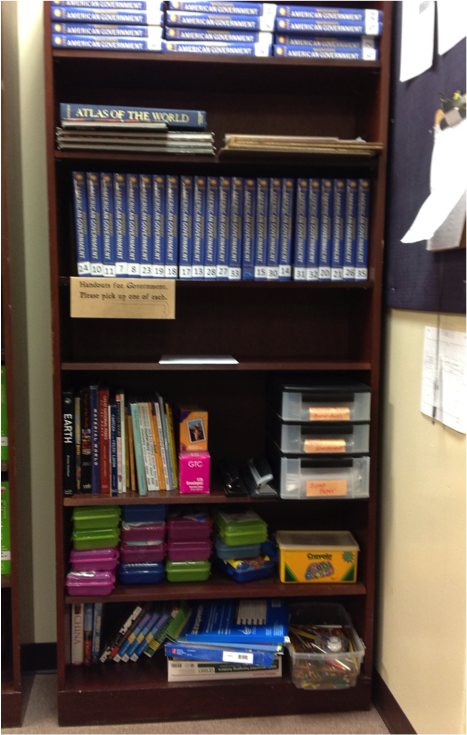
With super limited space this year, I don’t have a table for handouts, but rather an empty shelf. In addition, I leave student supplies on the same bookcase with easy access for students to get to the materials they need.
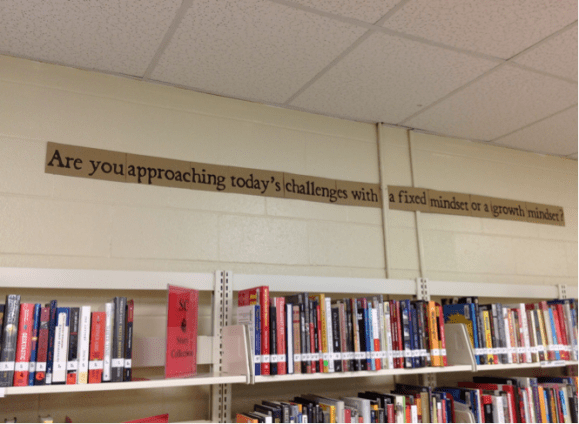
After reading Carol Dweck’s Mindset, I started teaching an annual lesson about fixed and growth mindsets to my students to help them identify both in themselves. I point to this question on the wall every time I return work to students with critical feedback or offer challenging corrections in order to support them moving more often towards embracing a growth mindset.