

Spring is the time of year when teachers typically do not have time to call their mothers, exercise or even stream a 22 minute television show off the internet so I know a book recommendation might not be of peak interested for you. That said, if you have not read Mindset by Carol Dweck please forget the phone call to your mom, any kind of exercise, and the latest Office episode (what?!? it’s has NOT played out and I’m not over it . . . don’t judge) and read this book.
In Mindset, psychiatrist and researcher Carol Dweck identifies the characteristics of the two mindsets – fixed and growth – under which we all operate. The chart below explains the basic traits of each:
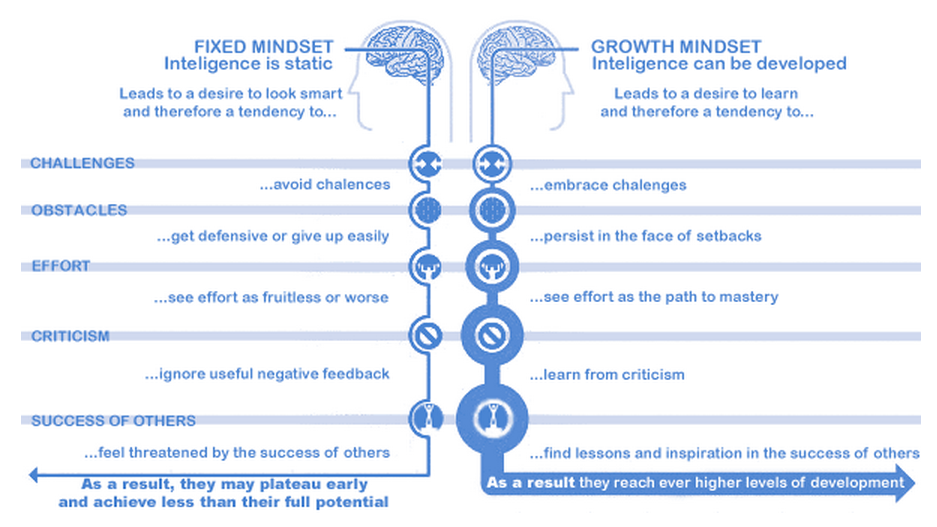
As a teacher, I read the chart above and immediately thought “I need to find a way to shift all of my students into a growth mindset.” Cultivating this shift in our students might be the most important gift a teacher could give her students. I have drawn a lot of inspiration from my buddy Melissa Barkin Scheinfeld who has used Mindset in her classroom for several years now (check out her classroom tour here) but as I actually read through the book, I focused more on the implications of teaching within a fixed or growth mindset. This book provoked some serious reflection and self-evaluation not just of my teaching but also my parenting and adult relationships. Don’t have time to read this fantastic book? Below are my big takeaways:
- When we give up on students, it is often because we doubt our own abilities as educators. Dweck tells the story of the famous violin teacher Dorothy Day who has taught some of the greatest violinist of our time. This teacher rejected the idea that talent was in-born and taught her students that it could be acquired She said “I think it is too easy for a teacher to say ‘Oh this child wasn’t born with it, so I won’t waste my time.’ Too many teachers hide their own lak of ability behind that statement.” I have personally come to see difficult students as a really exciting challenge. It is helpful to remember that when we are unable to make a break through with a child we must look beyond the tools we currently have. Who else could help us be a better teacher? Is there a resource or ally we could bring on board?
- Don’t judge, teach. Part of our job as educators is to evaluate. Often times this role is highlighted by the fact we give grades and send out report cards. It is easy to see how students might see us as judges and they are either “good” or “smart” or “bad” and “dumb.” However, these labels – and often grades themselves – are unhelpful and often very subjective. At the same time it is critical not to give every kid a smiley-face sticker and a pat on the back when they can’t read. We must be able to differentiate performance levels and determine when students have met expectations. Growth-minded teachers tell students the truth and then give them the tools to close the gap.
- Confront failure honestly and openly then teach your students to do the same. When we are in a growth mindset, it is OK and even good to mess up because we know that is when we learn the most. Dweck describes how college students with fixed mindsets study like “vaccuum cleaners” re-reading and trying to memorize as much as they can. If they fail, they dismiss the subject as something they simply are not good at. Growth-minded college students approach exams as challenges that are surmountable with effective strategies – as opposed to sufficient intelligence which they either do or do not have – and so they look for overarching themes and ideas. More specifically these growth minded students carefully look over areas they do not understand or problems where they have made mistakes in the past. Because they are growth-minded, looking at their past failures does not bother them; indeed, they specifically study where they went wrong in order to avoid the same mistake in the future. As Dweck explains, “they were studying to learn, not just to ace the test. And, actually, this is why they got higher grades – not because they were smarter or had a better background in the [subject].”
- Speed and perfection are the enemy of difficult learning. It was difficult for me to wrap my head around the idea difficult learning happens when students are progressing slowly and with many mistakes. Here are some phrases copied from Mindset to use in a growth-minded classroom:
When students are wrong or fail, say: “Everyone learns in a different way, let’s keep trying to find the way that works for you.”
When students finish a task quickly and without mistakes, say: “Woops. I guess that was too easy. I apologize for wasting your time. Let’s do something you can really learn from.”
When students are struggling and moving slowly, say: “I know it’s frustrating but we’re learning.”
Have you read Mindset? What other tips do you have for keeping yourself in a growth mindset?

 The Sacred Profession