Monthly Archives: April 2013

First, We Fail

There is a moment in my teaching career I have been mulling over recently. It was  Spring and I’d just passed back feedback for the big research papers my students were writing. Before students turned in their papers I passed out a “No Excuses” checklist (see below) and told them that if any of the items on the list were missing I would immediately stop reading their paper and return it to them to correct. They would then receive a consequence for having submitted a late paper.
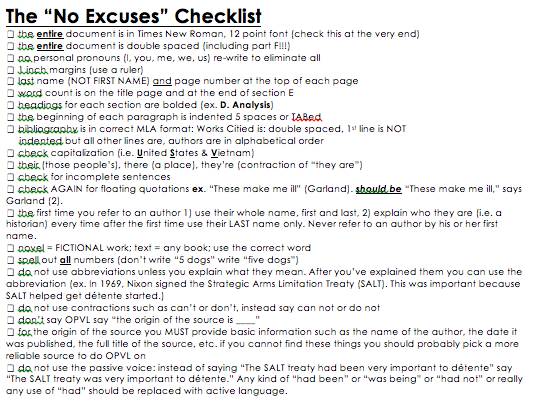
No Excuses checklist

Because I went over the items on the list many, many times most of the students who neglected items on the list were a little embarrassed when I returned it to them without my feedback and quickly made revisions. However, I remember one student who was completely outraged that I had refused to read her paper. She came to me, sobbing with furry, and accused me of hating her and wanting her to fail. “How am I supposed to get better if you don’t tell me what to do?” she yelled. I pointed out I did tell her what to do, in fact I typed it out on a list and gave her time in class to look for those changes. “Good teachers don’t let their students turn in bad papers,” she shot back, “If you really cared you wouldn’t let me fail.”

The student later apologized and even thanked me for holding her to high expectations; however, her words stuck with me. Do good teachers let their students fail? It is a question that has become central to my professional development this year and one I finally feel like I can answer. Not only do good teachers let their students fail it is actually a hallmark of excellence. Great teachers provide a safe environment – safe from a ruined GPA, safe from social ostrasism, safe from a negative self-image – where students can fail over and over again.

Even though I certainly did not execute it perfectly in the example of the irate student above, it is best practice to set students up to make classic mistakes that directly lead to a deeper understanding of the content. I could tell my students the difference between “their, there, and they’re” but I know they really learn it when they use the incorrect form, catch their own mistake and make the correct substitution. Want to see this principle in action? John Mahoney is a 40+ year classroom veteran math teacher who teaches in Washington D.C. – I am fortunate to call him my friend and colleague with the America Achieves Fellowship.

John Mahoney

John has posted an excellent video online of a lesson he taught where students learn a concept by looking at problems and determining if they were solved correctly or not. They discuss the problem in small groups and then debrief as a class. The vulnerability students show in explaining their thinking as well as their total calm when John says “You are wrong” is a testament to the power of letting students learn from mistakes. The video is posted online here and is well worth the watch (you might have to go through a simple registration process but it is worth it! This Common Core website is a hugely beneficial tool).

Every concert violinist starts out a beginner and every pro basketball player picks up a ball for the first time at some point. Paul Tough has written about the importance of failure in building character in children both in The New York Times as well as in his book How Children Succeed (my review of that action is here), he describes how:

we have an acute, almost biological impulse to provide for our children, to give them everything they want and need, to protect them from dangers and discomforts both large and small. And yet we all know — on some level, at least — that what kids need more than anything is a little hardship: some challenge, some deprivation that they can overcome, even if just to prove to themselves that they can. As a parent, you struggle with these thorny questions every day, and if you make the right call even half the time, you’re lucky.

Next year I might make my class theme “We fail to prevail” which I know is cheesy but I think could really be a helpful way to invest kids in really struggling and engaging rigorous academic tasks. Here are some other ways you could set your classroom up for failure (in a good way):

  • Reject perfection and speed: Carol Dweck in her book Mindset describes how our society idolizes doing something faultlessly and effortlessly, as if it is an inherently bad thing to actually struggle, or God forbid, break a sweat. Dweck suggests that when teachers see students who are quickly able to complete a task to perfection we should give them a more difficult task and apologize for “wasting their time.”
  • Model mature mistake making: It is easy to feel like, as the teacher, we have to be perfect ourselves or we will lose credibility. Do not be afraid to apologize and own your mistakes. Students respect honesty and transparency and lord knows they scorn a faker.
  • “No, this is not for a grade:” Some times the pressure of earning a grade needs to come off in order for students to relax and let themselves fail OR in order to actually try because they know the assignment isn’t simply another F to add to the stack.
  • “Yes, this is for a grade:” At the same time, students need to be allowed to experience authentic failure. One bad grade will not kill them – particularly if there is a way to earn redemption by demonstrating actual mastery and improvement.

What thoughts do you have about creating a classroom safe enough to fail?
Transform Your Classroom: Assign a Research Paper


At a time when our students can access information with the click of a button or the swipe of a finger we must dedicate our classrooms to evaluation and synthesis in place of traditional memorization. In many states, Social Studies courses are largely untested and, where they exist, most state exams lack the rigor necessary to prepare students for college. For years my students earned fantastic state test scores and then went on to college unprepared to write a referenced-based expository essay. When my first group of 10th graders returned at the winter break of their first year at college and said “Why didn’t you teach us how to write papers?!? It’s all we do in college!” I knew I needed to make a fundamental shift in the way I was teaching. Since that time, I have made research papers the cornerstone of how I teach. Each unit involves some kind of expository essay that requires students to cite sources.

  • Research papers are excellent means to bring the Common Core’s close read and non-fiction texts to the Social Studies classroom.
  • Research papers prepare students for the real work of college. Think back to your own experience with humanities classes in college: how many essays did you write in a given semester?

Research papers work best when they become the center of your classroom practice as opposed to the “icing on the cake.” Begin by having students read a number of model papers using the format and citation style you will require in place of other readings. Continue by collectively scoring a sample paper using the same rubric you will grade their papers with; this could be done whole group with some partner or group CFUs. I have also set up a gallery walk of “Introductions” one day, “Body Paragraphs” the next and finally “Conclusions” and had students walk around the classroom grading in groups and then checking scores against mine at the end of the walk. The point is for students to be extremely familiar with both the format and the rubric before they begin.

Below I have outlined how the research paper process happens in my high school Social Studies classroom however I think, with a few tweaks, the system could be adapted for younger grades:

Picking a Topic:

  • While it is certainly easier to simply assign students topics, allowing them to struggle through figuring out what interests them is critical. I try to have one or two individual conferences on this topic because I’ve found making sure they get a manageable topic is half the battle. I recommend students select topics that:
    • Begin as a topic and end up as a question after a preliminary research
    • Do not have a clear “yes” or “no” answer
    • Are potentially local in scope. (i.e. “What was the incidence of PTSD in Hispanic veterans of the Vietnam War from McAllen, Texas?” is much better than “How did Vietnam impact soldiers?”)
    • Narrow, even extremely narrow, scope. Students need a lot of help with this and I often struggle to advise them. I always ask myself, “Is this something a PhD student would consider too broad?” It is much harder to write a quality paper on a question like “What were the causes of the American Civil War?” Students do better with a question like “What were the direct outcomes of the battle of Gettysburg?”
    • Have students pick a general topic and then spend a week generating a specific research question to investigate by 1) reading Wikipedia articles (so easy! So good for this! And don’t turn your nose up at it, it’s what we do too . . . just don’t let them use Wikipedia as an actual source) and 2) gathering/reading reliable sources.
    • When you conference with them have them show you what sources they’ve found and begin to work together to form a research question out of their general topic.

Writing the Paper:

  • Provide students with a model: I distribute copies of a high scoring paper from a previous year (the first time, I wrote it myself) as well as the rubric on which it was graded. I instruct students to look at its format as they write their own paper.
  • Provide students with time in class to write each chunk: The class where they wrote the intro would look like this:
    • Do Now: students read, annotate, and score to the rubric ONLY the introduction of the model research paper – debrief and reveal what it actually scored in whole group
    • Model: take about 10 minutes to model how you would go about writing an intro. In past years, I’ve written a research paper (on a question and topic I actually found interesting) along side my students. Actually type it or write it long hand in front of them. Show them how what you are doing meets the requirements for an excellent introduction.
    • Work in Partners: I allow students to write with the support of a peer. Often times, they don’t need this additional support however it can be extremely helpful for those who need to talk through what they are doing.
    • Check progress at the end of class and require students to bring a typed, completed draft to class the next day. Ideally, they’ll have finished in class, if not, its homework. In the next lesson add a quick peer review for grammatical conventions before the Do Now and then proceed to the model Body Paragraph. Students who come to class unprepared loose the right to work with peers and should be closely monitored throughout the next lesson.
    • I’ve found the above process typically takes a week. On the last day, have students spend the class doing a peer review of what is now their completed rough draft. They then go into the weekend with the assignment of making changes as needed.
    • On the following Monday, we talk through common pitfalls (lack of evidence, weak sources, no analysis, floating quotations, poor citation style, etc.) by having 2 – 3 randomly (or not) selected students put their drafts on the document camera in front of the class. Students then work in pairs to make structural changes.

Evaluating the Paper

  • Grade the research papers with a highlighter and a rubric. On the back of the rubric make a list of the most common mistakes (misspellings, capitalization is incorrect, floating quotations, etc.) and simply highlight the item on the list when students make the mistake. Taking time to mark up every paper will quadruple your grading time and make you less likely to assign a second (much less a third, fourth or fifth) research paper.
  • When you pass the papers back, grade your own paper publicly and have them grade their paper along side of you. They should fill out a rubric as they grade. Collect their self-graded rubrics and then begin to call them up for individual debriefs. It is always SO SO much easier to deliver verbal feedback to students than to spend 10 minutes writing a detailed note. I talk and they take notes as I talk. I’ve found these one-on-one conferences to be THE most effective instruction I do when it comes to writing of any kind.

What tips do you have for writing research papers in your classroom and context?

*The post above is adapted from a resource I put together for KIPP:Share.

New Gallup Poll: “U.S. Teachers Love Their Lives, but Struggle”

Last week Gallup released a super interesting poll that looks at how people rate the quality of their lives, emotional health and workplace environment based on job type. I was unsurprised to see that, after doctors, us teachers love life more than anyone else.

Life Evaluation Index


AND we’re as emotionally healthy as forest rangers and famers and much more emotionally healthy than waiters and the sales clerk at Macy’s.

Emotional Health Index


But when we start talking about work place environment its a different story. This seems to be mainly because we don’t like our bosses:

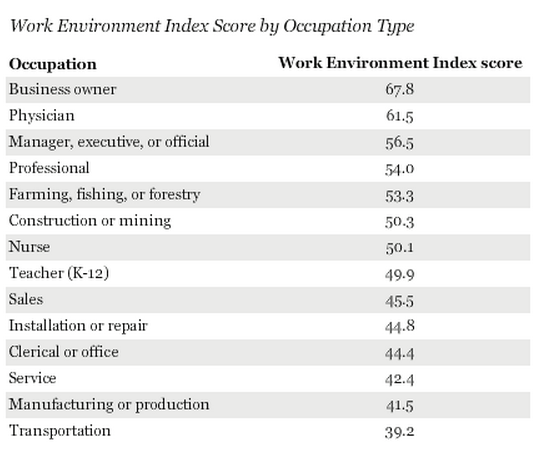
Despite earning top marks in most areas of wellbeing, teachers’ answers to various questions about their workplace produces a 49.9 Work Environment Index score, which is eighth out of 14 occupation groups. The nation’s educators rank sixth in saying their “supervisor treats me more like a partner than a boss.” And they are dead-last –14th — in saying their “supervisor always creates an environment that is trusting and open.”


Work Environment Index Score


So colleagues, does the shoe fit? Do you love your life but feel dissatisfied with your work place environment?

Strange Bed-Fellows and Why We Should All Climb In Too

I love education policy and enjoying keeping on top of issues as much as any teacher/mother/sane/healthy person can but it drives me crazy when folks in education start to cat fight. The incredibly pressing crisis of education in our country is such that those of us in this demanding field really do not have time to attack each other. Charters vs. districts, unions vs. administrators, reformers vs. traditionalists, TFA vs. old guard – it feels like cannibalism.

This is why I was so pleased to see this article in the New Republic which was co-written by Gates Foundation director Vicki Phillips and AFT president Randi Weingarten. The self-proclaimed “odd-couple” advocate for the following six steps towards more effective, and fair, teacher evaluation systems:

1. MATCH HIGH EXPECTATIONS WITH HIGH LEVELS OF SUPPORT.

2. INCLUDE EVIDENCE OF TEACHING AND STUDENT LEARNING FROM MULTIPLE SOURCES

3. USE INFORMATION TO PROVIDE CONSTRUCTIVE FEEDBACK TO TEACHERS, AS BEFITS A PROFESSION, NOT TO SHAME THEM. 

4. CREATE CONFIDENCE IN THE QUALITY OF TEACHER DEVELOPMENT AND EVALUATION SYSTEMS AND THE SCHOOL’S ABILITY TO IMPLEMENT THEM RELIABLY.

5. ALIGN TEACHER DEVELOPMENT AND EVALUATION TO THE COMMON CORE STATE STANDARDS.

6. ADJUST THE SYSTEM OVER TIME BASED ON NEW EVIDENCE, INNOVATIONS, AND FEEDBACK.

The recommendation I particularly appreciated was that teacher development, and not only evaluation, be tied to the Common Core State Standards. Many people are too quick to jump on the link-test-scores-to-evaluations boat with the CCSS and while that linkage is important it should only come after several years of test vetting and professional development for teachers.

What is truly remarkable about this article is the collaboration of what have been two polarized factions within the education world. Instead of focusing on areas of difference, this article highlights areas of agreement and consensus; a process that can hopefully be a model for moving forward. Finding commonality is always so much more productive and helpful for popular movements than lines of difference. What is also remarkable is the flack they have taken from their traditional allies who would rather they no “lend credibility” to the “opposing side.”

I say bravo! Yes! Amen! More of us need to look for common ground where we can work together because the truth is when adults fight about what we should do in our schools it is our students who are the real losers.

What do you think about reformer/traditionalist collaboration?

Great Book: Mindset

Spring is the time of year when teachers typically do not have time to call their mothers, exercise or even stream a 22 minute television show off the internet so I know a book recommendation might not be of peak interested for you. That said, if you have not read Mindset by Carol Dweck please forget the phone call to your mom, any kind of exercise, and the latest Office episode (what?!? it’s has NOT played out and I’m not over it . . . don’t judge) and read this book.

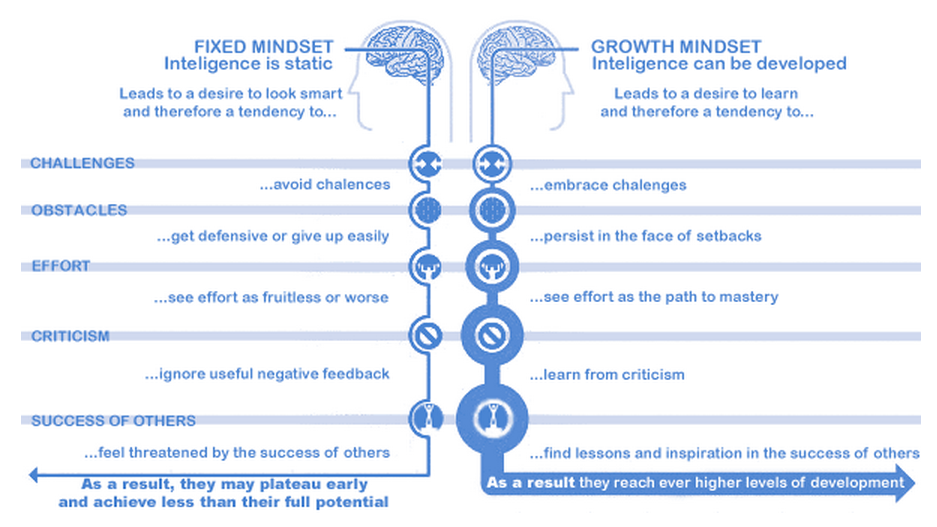
In Mindset, psychiatrist and researcher Carol Dweck identifies the characteristics of the two mindsets – fixed and growth – under which we all operate. The chart below explains the basic traits of each:

Fixed and growth mindsets chart

As a teacher, I read the chart above and immediately thought “I need to find a way to shift all of my students into a growth mindset.” Cultivating this shift in our students might be the most important gift a teacher could give her students. I have drawn a lot of inspiration from my buddy Melissa Barkin Scheinfeld who has used Mindset in her classroom for several years now (check out her classroom tour here) but as I actually read through the book, I focused more on the implications of teaching within a fixed or growth mindset. This book provoked some serious reflection and self-evaluation not just of my teaching but also my parenting and adult relationships. Don’t have time to read this fantastic book? Below are my big takeaways:

  1. When we give up on students, it is often because we doubt our own abilities as educators. Dweck tells the story of the famous violin teacher Dorothy Day who has taught some of the greatest violinist of our time. This teacher rejected the idea that talent was in-born and taught her students that it could be acquired  She said “I think it is too easy for a teacher to say ‘Oh this child wasn’t born with it, so I won’t waste my time.’ Too many teachers hide their own lak of ability behind that statement.” I have personally come to see difficult students as a really exciting challenge. It is helpful to remember that when we are unable to make a break through with a child we must look beyond the tools we currently have. Who else could help us be a better teacher? Is there a resource or ally we could bring on board?
  2. Don’t judge, teach. Part of our job as educators is to evaluate. Often times this role is highlighted by the fact we give grades and send out report cards. It is easy to see how students might see us as judges and they are either “good” or “smart” or “bad” and “dumb.” However, these labels – and often grades themselves – are unhelpful and often very subjective. At the same time it is critical not to give every kid a smiley-face sticker and a pat on the back when they can’t read. We must be able to differentiate performance levels and determine when students have met expectations. Growth-minded teachers tell students the truth and then give them the tools to close the gap.
  3. Confront failure honestly and openly then teach your students to do the same. When we are in a growth mindset, it is OK and even good to mess up because we know that is when we learn the most. Dweck describes how college students with fixed mindsets study like “vaccuum cleaners” re-reading and trying to memorize as much as they can. If they fail, they dismiss the subject as something they simply are not good at. Growth-minded college students approach exams as challenges that are surmountable with effective strategies – as opposed to sufficient intelligence which they either do or do not have – and so they look for overarching themes and ideas. More specifically these growth minded students carefully look over areas they do not understand or problems where they have made mistakes in the past. Because they are growth-minded, looking at their past failures does not bother them; indeed, they specifically study where they went wrong in order to avoid the same mistake in the future. As Dweck explains, “they were studying to learn, not just to ace the test. And, actually, this is why they got higher grades – not because they were smarter or had a better background in the [subject].”
  4. Speed and perfection are the enemy of difficult learning. It was difficult for me to wrap my head around the idea difficult learning happens when students are progressing slowly and with many mistakes. Here are some phrases copied from Mindset to use in a growth-minded classroom:

When students are wrong or fail, say: “Everyone learns in a different way, let’s keep trying to find the way that works for you.”

When students finish a task quickly and without mistakes, say: “Woops. I guess that was too easy. I apologize for wasting your time. Let’s do something you can really learn from.”

When students are struggling and moving slowly, say: “I know it’s frustrating but we’re learning.”

Have you read Mindset? What other tips do you have for keeping yourself in a growth mindset?

Speaking Truth to Power

On the 7th floor conference room of the Department of Education (hence the official flag) about to present to senior ED officials. Yup, I'm kind of flipping out.

On the 7th floor conference room of the Department of Education (hence the official flag) about to present to senior ED officials. Yup, I’m kind of flipping out.

Last week I had the enormous privilege of putting on my only suit (and this time, no Toms), flying to Washington D.C., and advising senior education officials on teachers’ perspectives on the Common Core (CCSS). Despite being from Texas which, along with being the best state in the union, is also not adopting the CCSS, I love the new standards and think they represent a higher bar for all students. I for one will shed no tears on the day when I trade a multiple choice Jeopardy trivia exam for a written expository essay that requires students to use primary sources.

Unfortunately, such an exam is a long way off not only because I’m in Texas but also because these “next generation” exams take time to develop and field test. We are still several years away from being able to extract standardized data from exams based on the CCSS. This however will not stop many states as well as charter schools from linking students’ exam results to teacher evaluations. My colleagues and I specifically advocated for restraint in this area.

While I believe in the importance of teacher evaluation, the goal should be growth rather than punishment or even reward. Student achievement is and should be the end goal of successful teaching however the exams used to evaluate student achievement need to be fully vetted. It is premature to actively move towards linking teacher evaluation to new CCSS exams when many teachers are unaware of what the CCSS shifts mean for their day-to-day instruction. Good teachers backwards plan their instruction to summative assessments. In order to do this well, teachers need to fully unpack and understand the objective they are teaching. Additionally, teachers need numerous examples of the the types of questions the new exams will use to assess each objective in order to create formative assessments that accurately mirror the final exam. The two testing consortiums – PARCC and Smarter Balanced – have not released nearly enough examples to develop curriculum materials which we can confidently say are fully aligned.

I also worry immediately linking teacher evaluation to CCSS exams might turn teachers off to the Common Core. The CCSS will only succeed if teachers are fully invested. Teacher evaluation is a tricky subject; everyone now acknowledges it must be done and done better than before however many questions still remain over issues like what percentage of the evaluation should be linked to student test results. We should first focus on issues like developing effective support structures for teachers that go beyond a mentor teacher the first year and an annual 15 minute observation from the principal. Teacher evaluation should provide constructive, growth-minded feedback for teachers throughout the school year.

In the same way we have a long way to go before the next generation exams roll out, most districts have a long way to go in building effective teacher evaluation and development systems. So let’s back off on creating evaluation systems that link 50% of teachers’ evaluations to any student exam, Common Core linked or otherwise and move towards evaluations that are actionable and aimed at cultivating our sacred profession.

What are your thoughts on the Common Core and teacher evaluation?