This TED talk from Sugata Mitra on slum children in India learning how to use a public computer by simply playing with it and working together makes for a nice finish to my listen-to-the-students themed week. Enjoy!
The Sacred Profession
Education Rooted in Justice, Growth, and Heart

Monthly Archives: November 2012
Pathbrite: Student Portfolios
Pathbrite is an easy to use, highly functional and free online portfolio system. I had the chance to meet the founders of this organization at Education Nation this year and I was really impressed with their commitment to designing a helpful tool for both students and teachers. I could see using Pathbrite over the course of a class as a place for students to collect their knowledge and respond to material. It could also be used as a means for students to build a 360 view of themselves in preparation for summer program or college applications. Looking for a way to help your students build a dynamic online portfolio either for your class or for college admissions, check out Pathbrite here!
Student Run Schools: Nightmare or Human Right?
Last March, Esquire revealed what it called the current “War on Youth.” In July, Newsweek dubbed millennials “Generation Screwed.” In the middle of this mayhem, young people have been left on the sidelines, given the cold shoulder, and ignored. In my life, I’ve been told to shut up, sit down, and listen. I witness this every single day at school. Top-down, rigid policies dictate word-for-word what students and teachers must do and learn. As a young person, very few seem to be on our side and even fewer attempt to strengthen our voice. Education thought leader Paulo Freire once quipped, “If the structure does not permit dialogue, the structure must be changed.”
In keeping with the “listening to students” theme this week, Nikhil Goyal over on Good has a short piece on Democratic Schools where students are empowered to choose their learning environment. The pro-reformer/charter school warrior in me reads the article’s subtitle “Adults need to get out of the way” and envisions a Lord of the Flies situation. Who among us teachers doesn’t have a little bit of the Hobbesian “nasty, brutish, and short” view of human nature? Have you seen what happens in PE when there is a substitute? Seriously.
The state of nature aside, I also know listening to children and allowing them to make meaningful choices are cornerstones of becoming self actualized people. What troubles me is which children are afforded the opportunity to attend these Democratic Schools; they are largely privileged and white (for a visual illustration of what I’m talking about, check out the contrast in uniforms between minority/low-income charters and white/wealthy private schools). At the same time all children need clear boundaries and students from underserved communities in particular need to be explicitly taught the rules and norms of what Lisa Delpit calls “the culture of power.”
As it often does, the answer here must lay somewhere in the middle. Could we potentially diagnose scaffold and assess our student autonomy in the same way we do their academic skills? What new school-wide structures could be built around this data set? I believe, along with Paulo Freire, that “to alienate humans from their own decision making is to change them into objects.” As educators we have an obligation to afford our students the opportunity to make choices that go beyond choosing between making a diorama or writing a poem for their book report on “The Giver.” Lord knows I have failed in this area but here are some thoughts I have:
- Allow students to choose topics that interest them: As much as possible, give students choice about what they learn and how they learn it.
- Let students create classroom charters and social contracts: Check out Ms. Thompson’s example here.
- We must change the way our school days are organized: When we want the same outcomes for all students (objective mastery or “college readiness”) we cannot expect all students to reach those goals in the same amount of time. Students who are behind or who have special needs will require more time to learn as well as more one-on-one feedback and coaching. At my former school we experimented with “Working Wednesdays” during which each 12th grade students were given an individualized schedule depending on their 1) needs and 2) ability to manage their time. I’d love to see a school where daily schedules were differentiated and lock-step progression was thrown out the window. Anyone know of examples?
- Our instruction should be authentic: Students absolutely crave the chance to be treated like an adult and to learn in relevant ways. Why not mix internships at local law offices, police departments, and city halls with a few lectures, papers and exams and call it a government credit? Why not teach World War II via a research project on your city’s involvement complete with field trips to the local museum or archive and guest lectures from local veterans?
Does anyone have experience teaching at a Democratic School? I am particularly interested in learning about people who have used these ideas in underserved communities – anyone? What other thoughts do you have about the role of student choice in our schools?
Listening to Our Students

A visual representation of what a group of teenagers at a Imagining Learning event wanted their education to look like.
I have noticed a theme in this week’s posts: Listening to students. First in the children’s book Iggy Peck and then in an op-ed by a well-informed (if not a little snarky) high school student. I found this super interesting organization called Imagining Learning that goes around the country holding “listening sessions” with teenagers centered around the question:
“How do we educate young people to thrive in a world of possibility?”
Students talk through their answers to the question and then collectively create a visual representation of their ideas. Interesting if not a little “hippe-dippy” as some of my math colleagues might say. However the exercise reminded me of how valuable this structure can be in an academic context. I often have students explore a topic via reading and discussion and then task them with creating visual representations in groups. I find this strategy to be more effective for non-factual, higher order questions like: “Who should be blamed for the Arab-Israeli conflict?” or “Was Hamlet actually crazy?” or “Is cloning ethical?” A great way to ensure this exercise is rigorous is to wrap up the class by having students write an evidence based response to the question that was studied, debated and illustrated. Alternately, the writing could occur the next day after students have had time to look at each other’s illustrations and form their own opinion.
How do you show your students you are listening to them?
Wait, Arne Duncan isn’t perfect?

Me presenting to Arne Duncan at this year’s Education Nation – notice the bright red and extremely unprofessional Toms I’m wearing. Colleagues, this is what happens when Texas bumpkins think they can rock heels in NYC for more than 5 hours. You get horrific blisters, are forced to wear Toms in front of the Secretary of Education, and then even your only suit can’t cover up your essential lameness. Lesson learned . . .
In our polarized political times it is really hard to find a government official with high approval ratings from all parts of the political spectrum. However, the Secretary of Education seems to be an exception; who doesn’t love Arne? He is both Obama’s basketball buddy AND was rumored to be on the short list for Mitt Romney’s potential Education Secretary. As a teacher, I have great admiration for Duncan’s deep respect for teachers as well as his commitment to educational equity for all of America’s children. So I was a bit taken aback when I came across an op-ed on NBC’s Ed Nation site titled “American Students Deserve Better Than Arne Duncan.” Even more interesting is the fact the piece is written by a 17 year-old high school student. While well-written, it is easy to recognize the classic adolescent tone I have come to love/have nightmares about:
Look, I wholeheartedly respect Secretary Duncan and I’ve met him a number of times, but the Department of Education deserves nothing more than a big fat F for its first term. Race to the Top has been an utter failure for brutalizing the teaching profession, adding irrational testing for preschoolers (I wish I was kidding), driving a national obsession over high-stakes testing, and pushing for charters to hijack public schools. It’s like a “Russian novel, because it’s long, it’s complicated, and in the end, everybody gets killed,” as one superintendent quipped.
Despite the youth of the author, this paragraph sounds par for the course in terms of what we get from most media outlets – this student has a bright future on talk radio, CNN, or FOX. While I might write “hyperbole” and “combative tone” in the margins of this essay, I tried to look past the “big fat” rhetoric and tease out her argument. She believes too much attention has been devoted to what is wrong with our schools, teachers and students while proposed solutions are inadequate and uncreative. True story angry teenager, true story.
Unlike this student, I don’t believe Arne Duncan is to blame for the current crisis in American education. The Secretary seems to be doing everything he can (and then some . . . click here for the most amazing Onion article). Solutions will come from us. Teachers have the on-the-ground experience, the daily love of kids and the creativity necessary to fix what is wrong with our system. Here are some thoughts and suggestions about teachers taking the lead:
- Don’t Wait for Superman, fix the problem yourself: Many of us get stuck in the trap of thinking “Oh I’m just a teacher, I can’t do anything about X . . . maybe if I were the principal or the superintendent or a millionaire.” Chances are you can make a difference; particularly if you get together with a couple of colleagues or parents and work together.
- More of us need to be campus leaders yet remain classroom teachers: We talk about how great it would be if teachers had career ladders that kept us in the classroom but how many of us are putting ourselves out there? Lead that after school professional development, volunteer to run that committee on turning around school culture, or meet with your principal about the proposal you have put together. The key to making this work is to have a great relationship with your principal. See this post for my tips on working with principals.
- Teachers have power in numbers: Maybe it is just my vantage point from the very non-union friendly state of Texas but I don’t hear many solutions coming from our national teachers unions. I think this is beginning to change however the change isn’t happening fast enough. How could we come together to elevate our profession? I love the Margret Mead quote that says “Never doubt that a small group of thoughtful, committed citizens can change the world. Indeed, it is the only thing that ever has.” Find some colleagues who want to work on the same problem you do and make it happen.
- Lobby your elected officials or run for office yourself: School board members, state representatives, congressional representatives and the Secretary himself are all interested in hearing solutions from the people who are actually doing the day-in-day-out job of educating children. Write those emails and letters. Pick up the phone. Get your name on a ballot.
If Arne Duncan isn’t going to wave a magic wand and make it better, what else can teachers do to contribute to solutions? I would love to hear your ideas, please leave them in a comment!
Our Students’ Interests & “Iggy Peck, Architect”

I read a lot of children’s books and many, many of them just stink; however, Iggy Peck, Architect by Andrea Beaty is an absolute gem. It has everything that makes a children’s book awesome: dazzling illustrations, a life-affirming polt line, and clever, rhyming text.

In the image above Iggy shows his early interest in architecture by building a tower out of dirty diapers (a beautiful idea that inspired disaster in my potty-training two year-old, don’t ask). The plot twist comes when the young savant’s second grade teacher, who has a fear of buildings, forbids the study of architecture in her classroom.

Shortly after Ms. Greer declares “We will not talk of buildings in here!” Iggy becomes disinterested in school. He slouches at his desk and mopes at the back of the line. It was at this point while reading to my daughter that my teacher brain clicked on – what was happening here? Check out the picture above. Notice the rows of compliant students sitting with folded hands, the towering Ms. Greer with her dagger-like feet, and then Iggy in the back of the room building a castle out of chalk sticks. I don’t know anything about illustrator David Roberts’ experience in school but looking at this picture makes it pretty easy to guess.

“Ha!” I thought, “Ms. Greer is such an idiot! What teacher would squelch such obvious talent?” And then I thought about the number of times I have asked students to stop doodling or humming to themselves in class. More subtly, I thought about all of the assignments and learning experiences I’ve assigned that simply do not allow any room for students to bring their own interests into my classroom. The problem is our students’ talents are rarely as obvious or conventionally valuable as Iggy’s architectural prowess. Below are my ideas for bringing student interests into our classrooms:
- Student Choice: As much as possible, allow students to choose both how they will learn material as well as how they will show you their learning. Standardized testing makes some forms of assessment inevitable, but try as much as possible to provide parallel assessments – I have never known a student with a particular passion for multiple choice exams (regardless of talent).
- Get to know your students: Student interest surveys (and more than just one in August!), parent conferences, home visits, one-on-one conferences, and sharing information with other teachers are all great ways to deepen your knowledge of students. If I had a dollar for every time I’ve learned something about a student and said “Wow! I had no idea!” I would have a well-stocked classroom library.
- Take ownership over students’ interest in your class: Kids sleeping in class? Lots of minor misbehavior? I found my classroom totally changed when I stopped blaming children for their lack of interest in my class and began to take responsibility. How could I convince them to like what we were studying? What did I need to do to really get them into learning? This mind shift seems subtile but it really is critical for successful instruction.
- Take a tip from Ms. Greer: At the end of Iggy Peck, Ms. Greer allows Iggy to give weekly presentations about architecture – he is ecstatic and re-invested in learning other content.

- Leverage their interests for your subject: A great gateway to their attention is through their interests. Look for ways to reference pop culture like using analogies from popular movies. Allow them to bring images of people and things they care about into your classroom via creating displays, decorating notebooks, illustrating word walls, etc. For example, I use Lady Gaga to teach a paragraph writing strategy called KEATEAL (check it out here).
Are you, like me, inadvertently acting like Ms. Greer? What do you do in your classroom to engage your own little Iggy Pecks?
“Better Science Teaching”

My childhood BFF and now geologist and science teacher extraordinare Dr. Chrissy O’Malley has started a great blog called Better Science Teaching and it is fabulous! Recently, she has been writing about common misconceptions students have about science and what teachers can do to address these misconceptions. Thanks Chrissy and check it out here.
Quitting On Principal

Imagine a law firm run by someone who is not a lawyer and has not argued a case in years. Imagine a medical practice run by someone who is not a doctor and has not treated a patient in years. Imagine a university run by someone who is not a professor and has not published scholarly work in years. Now imagine a school run by someone who is not a teacher and has not taught in years – oh wait.
Other professions – doctors, lawyers, and university professors – are typically organized into units run by the most accomplished and senior members. Lawyers become partners, doctors open their own practices, and esteemed professors become deans. High performing members of these respected careers continue to do the essential work at the heart of their profession even when they become leaders. Senior partners take the most important cases at law firms and well-practiced doctors perform the most demanding procedures on the sickest patients. Why is it that primary and secondary schools are not run by teachers but are often managed by people who have not been in the classroom for many years?
The answer to this question has roots in the history of inequality in our country. For years, some of the brightest people in the United States had no option but to become teachers. Women and minorities were welcome in the classroom but were not trusted to manage themselves; black and female teachers “required” a white man in an office to keep a school running. Granted the principal often took care of logistical issues as well as did the important work of hiring, mediating conflicts and dismissing ineffective teachers (as well as those who became pregnant, a common practice as few as 50 years ago). However the principal is a uniquely American institution which might have run its course in terms of usefulness.
Many agree education is at a critical juncture in the United States and that the elevation of the teaching profession would serve as lever to improve our entire system. But how can we expect more respect for a profession with no career ladder? Most foreign systems do not have the same problem because schools clearly divide operations from instruction and place a head teacher or head master (think of Dumbledore) at the helm. Traditional public schools in the US tend to ascribe a largely operational role to the principal; however, the school reform movement cast the principal as the “instructional leader” of his school. In this role principals observe, evaluate and coach teachers as they develop their skills. I have seen this model work effectively but more commonly I see principals become overwhelmed with operations, discipline, parents, and a thousand other priorities which are so much more immediate than providing instructional leadership to teachers.
More troubling is a growing body research that points to ineffective principals as the number one reason why teachers leave the classroom. This comes as no surprise to those of us in the classroom. An excellent principal who is supportive, humane, and offers constructive criticism for improving is an absolute treasure – and just as rare. How much more effective would an excellent and senior colleague be at the head of a school? Such a leader would be more empathetic because they would still actually be in the classroom to some degree as well as more credible because they are not removed from the essential task of teaching. I often hear district leaders bemoaning the small number of effective principals and I wonder how many good teacher might make good head teachers, as opposed to principals?
While a teacher run school might seem like pie-in-the-sky they exist already (interested? Click here and here for the websites of two teacher run schools and here for an article on another). I have the personal goal of teaching at such a school before the end of the decade but until that time here are my tips for making it work with your awesome or not-so-amazing principal:
- Walk a mile in her shoes: Principals deal with the worst, most thankless tasks schools offer like irate parents, surly children, and contrary teachers. Regardless of how frustrated you might be with your principal ultimately they deserve your pity not your anger.
- Always assume your principal is in it for the kids: It is so damaging to make judgements about your principal’s motivation and, unless you can read minds, you actually don’t know why they do the thankless job they do. Assume the best. Give your principal the benefit of the doubt. No one gets into education to get rich or go on a power trip. Seriously.
- Ask not what your principal can do for you but ask what you can do for your principal: Keep a mental record of how many requests you make of your principal and provide at least two solutions for every one favor asked. In other words, when you refer a child to the office for further discipline you now owe your principal one after school duty supervision and one mini-presentation during a staff meeting. Always be thinking of ways in which you could help your principal out by providing a solution to a problem. Think of what she needs and try to be the one who provides an answer or support.
- Be positive, be positive, be positive: As tempting as it may be not to, try to speak positively about your principal at all times. And, as our mothers always said, if you can’t say anything nice, don’t say anything at all. If others are trash talking the boss, walk away.
What tips do you have for working with principals?
77 Years in the Classroom

“The Lord will tell me when to stop.”
– Olivia Neubauer, who died this week at the age of 100 after 77 years in the classroom
As I read this story about Olivia Neubauer I vacillated between mild horror and a silent prayer of “Please God let that be me!” I have so much respect for a life time dedicated not only to education but to classroom instruction but how is it possible when somedays it seems like I will seriously not be able to teach beyond 6th period?
Clearly longevity is not the result of working yourself to the bone – it’s a marathon not a sprint. I personally reject the burn-out model of teaching, regardless of how glorious or productive it might sometimes appear, and believe we should help each other “teach in balance” as one of my mentors and friends says. What stood out to me was how in 1964, after 20 some-odd years in public schools, Neubauer helped found a private Lutheran school where she taught for the next 49 years. On the one hand she did not go into administration but on the other hand she surly must have directly impacted the way that Lutheran school was set-up and run. Additionally, I wonder if the same kind of longevity would be possible in a public school? The private school must have been able to accommodate her particular needs as she aged in ways a more regulated, traditional school could not.
Here is one lesson I am walking away with: teachers need to found or run more schools and then stay in the classroom while they continue to be campus leaders. I often feel one of the most frustrating aspects of being a classroom teacher is how absolutely powerless I am. Sure, a good principal listens and consults with her teachers however teachers are at the mercy of a principal’s collegiality and willingness to be influenced. Acting as a founding teacher should look more like shared or distributive leadership rather than a hyper-burn-out model for teaching; unfortunately, most of the founding teachers of various schools (mostly charter) that I know never stay more than 2 or 3 years.
Olivia Neubauer also reminds me to see the long game and forgive myself when a lesson, day, unit or year doesn’t go how I planned. Imagine what a life time dedicated to education contributes?
What would it take for you to teach 77 years?
“The New Majority”

Last year I noticed that I, at the lofty age of 30-something, was one of the oldest teachers in my building. I chalked it up to teaching at a charter school which often have a young teaching force but the graph above shows young teachers are what Teach Plus calls the “new majority.”

Teach Plus recently released a new report that compares the perspectives and opinions of the new majority to those of teachers with 11+ years of experience. The findings are both intuitive as well as surprising. Below is a table that highlights issues where both sets of teachers – the new majority as well as experienced teachers – strongly agreed with one another on survey questions.

What I found interesting here is that both groups of teachers believe there needs to be a clear and measurable standard for excellent teaching; however, they also both believe current evaluation systems are not getting the job done. Another critical agreement is class size. Although some research shows class size technically has no impact on student achievement (particularly at the secondary level) teachers clearly agree size does matter. Even more interesting are the areas where the new majority and experienced teachers disagree:
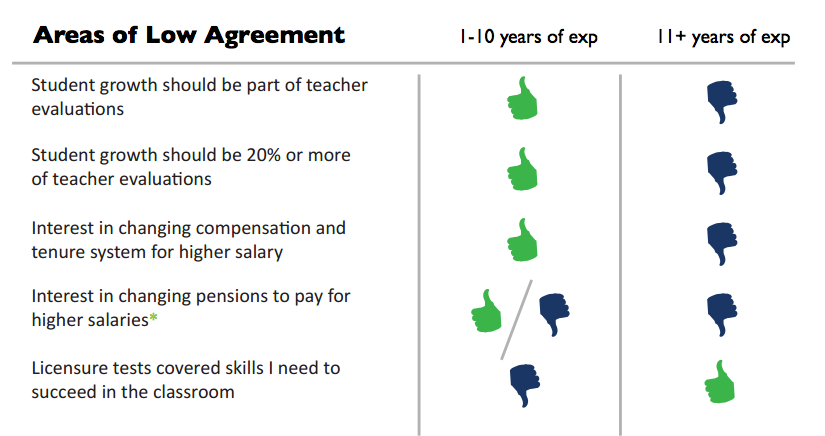
These shifts seem to line up with changing education policy and certainly are a nice validation for the Race to the Top stipulations. Regardless of the merit or challenges associated with policies like linking student growth to teach evaluation, I think this study shows an eagerness on the part of new teachers – now the majority of teachers – to see our profession reinvented. Unfortunately, we also know the new majority exist in part because three out of every five new teachers quit within the first five years of teaching. Clearly we have a unique window of opportunity with this young, open-minded teaching force (this is not to say those of us with 11+ years are not open-minded!!) however we should be careful to advocate for policies that both raise the bar for our profession as well as keep teachers in the classroom.
New majority teachers what would keep you in the classroom for the next decade?
 The Sacred Profession
