Monthly Archives: September 2012

The 10 Commandments of Getting a Life Beyond Your Classroom

After my rant against “heroic teaching” I thought it might be helpful to give some tips on what has worked for me. Let me be clear that I am still trying to get my balancing act together as well . . . do as I say not as I do. This is a tongue-n-cheek list I made a couple of years ago for a professional development session I did on balance:

  1. Thou shall backwards plan. This is how you get your life back. Ideally, you calendar objectives for each day for the whole year in the summer; this way you never have to ask “What am I teaching today?
  2. Thou shall backwards plan thy next unit or at least week this very Saturday and get ahead of the game.
  3. Thou shall plan thy planning periods – and not just do whatever has to be done.  A weekly routine is a good way to handle planning periods. Monday – plan make a to do list, catch up, grade; Tuesday – grade; Wednesday – write lesson plans for the next week; Thursday – create materials for the next week (handouts, gather equipment, put together readings, etc.); Friday – make copies
  4. Thou shall only use class time and planning time in service of thine assessments. Teach to the test – but make sure it is a good test.
  5. Hate thine enemy e-mail and only check it twice a day; once in the morning and once immediately after school ends. Never during your planning period.
  6. Verily I say unto you the copier is also thine enemy therefore do not make copies in the morning – inevitably this will lead to disaster.
  7. Thou shall work at school because that is what you are paid to do – you are not paid to work at home. Also working at home makes you loath our sacred profession if you do it too much. Therefore I say unto you, come early and/or stay late but seriously avoid working at home.
  8. Remember the Sabbath and keep it holy. (and this one I didn’t make up!) Pick one of the two weekend days and do not do any work on that day. Whatever you do, make sure you’ve stopped working by 6:00pm on Sunday.  Working Sunday night makes you loath our sacred profession.
  9. Thou shall be friends with thy colleagues. These people will get you through the worst days – don’t try to do this alone. Friends don’t let friends work themselves to death. Sometimes, bring your coworkers food/treats/coffee/etc..
  10. Remember if thou hast worked thyself to death this week, thou can try for balance again tomorrow or next week. There is always another chance to change your classroom and take control of your life.
“The Limits of Heroic Teaching”

My first year as a teacher I lived and taught with a wonderful roommate and teacher. For the first several months I would stay up late every single night trying to perfect my lesson plans and by November I was miserable because I wasn’t doing anything else but working. My roommate gave me some great advice: “You can always do more with a lesson, at some point just stop. It will never be perfect.”

This was the beginning of trying to balance a compelling and demanding profession with a personal life. Over the years I have known many teachers who have sacrificed so much for their students including their physical health, relationships, bank accounts, and mental well-being. I do not believe in a burn-out model of teaching and I do not believe this is what is required to be an excellent teacher. Unfortunately, many of the charter school systems I have worked with as well as TFA have spot-lighted teachers who put in 70+ hour weeks and inadvertently encouraged, or at times outright advocated with purposeful messaging (“Work Hard. Be Nice.” and “Whatever it takes” and “Relentless Pursuit”), personal life martyrdom for the achievement gap. Although this kind of all consuming teaching, which Wendy Kopp calls “heroic teaching,” may result in student academic growth within a single school year and/or subject – what happens the next year? Will the students sustain their growth with a new teacher? Will the teacher be able to sustain a career in the classroom? Kopp writes . . .

heroic teaching like theirs does not offer a likely path to educational opportunity for all. It is impossible to imagine a force of hundreds of thousands of teachers as rare in their abilities and commitment as [these teachers] are, and it is impossible to imagine hundreds of thousands of them sustaining the requisite level of energy and devoting the requisite amount of time not just for two years but for many years, and on a teacher’s salary to boot. We can’t expect all of our teachers to shoulder the responsibility of creating transformational classrooms within schools that often don’t have the mission or capacity to change students’ trajectories, let alone provide teachers with the training and professional development necessary to teach this way.

Although Kopp admits self-sacrificial teaching is unsustainable she certainly admires it – it is “heroic” – but I would argue the opposite. This kind of teaching is both unsustainable and ultimately destructive for teachers, students and schools.

One teacher does not close the achievement gap in one year in one class. Research shows students need at least three years of excellent teaching in order to make up performance differences (although some argue even three years with a great teacher isn’t enough). If a good teacher burns herself out after 2 or 3 years although her students might have had one great year the cost is high: her school looses a veteran teacher and potential leader, hundreds of other children will have to settle for a weakened school experience and that promising young teacher will never reach her full potential as an educator. Additionally, what kind of example for her students is a teacher who is not eating well or exercising or maintaining healthy relationships or improving her mind and soul through reading and non-education related activities like spirituality or hiking outdoors?

Rigorous and challenging professions with sustainable career paths exist (ex. doctors, lawyers, etc.) however making this possible for teachers requires systemic changes. In the meantime, fellow teachers, let us commit to balance and help lessen the burden by sharing resources and supporting each other. Set a timer when you write lesson plans and when the timer goes off put it aside and call it done. Use or modify resources from other teachers – don’t “reinvent the wheel.” Spend time on what is important (giving useful feedback to students, backwards planning to strong assessments, getting to know your students as people and learners) and less time on the small stuff (formatting documents, finding the perfect picture for that power point, obsessively tracking small knowledge bits instead of larger skills or themes). Breakdown the walls of isolation in your building and collaborate with your colleagues.

And if your colleague next door is burning herself out please stage an intervention like my roommate did with me 10 years ago. Let’s not call what is tragic heroic.

Superschools: Creating an Environment of Achievement

There is a quick, interesting article at the Time Ideas website on how some schools are able to produce an exceptional number of highly skilled math students – particularly female math students. The article by Annie Murphy Paul (who has an engrossing blog, here) explains how more than good curriculum or technology are needed for excellence. Paul points to two factors: expectations and environment. She argues these two factors are essential for leading students to achievement – even when they come to school with all sorts of advantages already in place. Read the whole article here.

What about the girls?

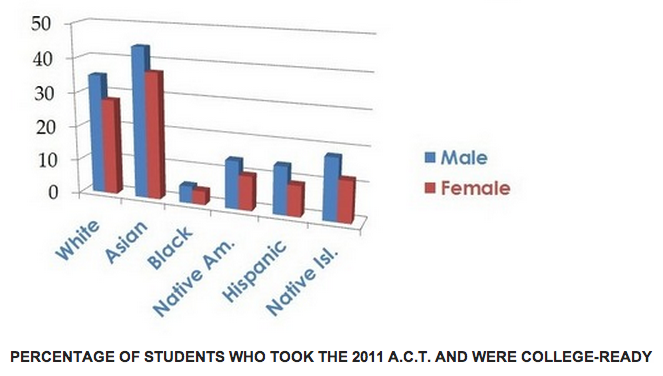
I came across this super-upsetting graph in an newsletter from the Department of Education (called Teaching Matters, you can sign up for it here). This data comes from a new report from the National Center for Education Statistics (NCES) on gaps in access and persistance in higher education (for full report, click here) I’ve found the ACT to be such a line in the sand in terms of college readiness and the chart above clearly illustrates the race and gender discrepancies in scores.

There are several really gripping findings in the study but another chart that jumped out at me was the one below which shows passing percentages on Advanced Placement exams by subject, race and gender.


This chart is even more troubling because more often than not AP classes are not open-enrollment and so these scores represent the top performing students and not the population at large. Although performance by race differed dramatically in many subjects I was stunned to see how wide the gap is for young women of color.

One of the central moments of my development as a teacher was in my second year when my principal sat in on my lesson and kept a record of student-teacher interactions (questions asked, hands raised, cold-calls, reprimands, etc.). At the end of class he wrote on a post-it “Interesting lesson! What about the girls?” As I looked at the chart, I was stunned to see that for every interaction with a female student I had almost three more with a male student. I was giving almost three times the attention to boys in my class. I was mortified. I had read Reviving Ophelia! I took TONS of women’s studies classes in college! I was only two years out from writing my undergraduate thesis titled Can We Milk This Tiger: A Study of Feminist Theory and Revolutionary Praxis in Central America and I there I was actually favoring my male students.

Unfortunately, the data above shows I am not alone. What about the girls?

Ms. Bisso’s Classroom

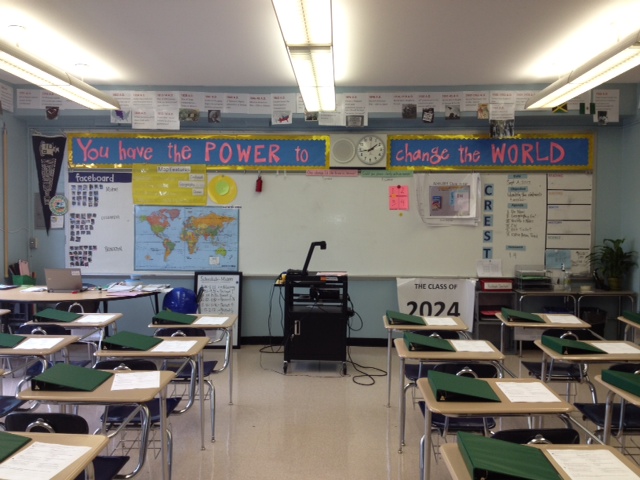
For our second classroom tour we have the amazing Emily Bisso – middle school teacher, literacy goddess, and fashionista. I had the privilege of working with Emily (or just “Bisso,” as she sometimes rolls) this summer and learned so much from her about teaching and staying positive. Here is her beautiful classroom . . .

Ms. Bisso welcomes you to her classroom!
There are little Miami Redhawks with creepy kid faces cut-out on top, and my trusty peace plant.

Where do you teach? I teach in Brooklyn, NY, in a neighborhood called Ocean Hill. It is very small and between Brownsville and Bed Stuy. My school is Ocean Hill Collegiate Charter School (part of Uncommon). I was on the founding team in 2010.

Who are your students? The most amazing, caring, ready 10-year-olds in the planet. They are generally from Caribbean heritages, and our parents are super supportive. They almost all live in the direct neighborhood. You can find more information about our kids at the school’s website.

What do you teach? I teach 5th grade History and I’m the network History chair for 5th grade and our school.

“I eventually cover all those windows in words (put backing on them so they don’t fade, or butcher paper – it still lets light through) and you can’t see well, but each couple of panes is already marked off as one of my units. They are color-coded in an OCD way to match the library color codes (purple is Native Americans, for example). I can easily pull the shades down when it’s time for a quiz, and boom – words covered. Always thinking. My biggest yay moment is that when kids want to stare out the window…they CAN’T. Up on top is some of my timeline, roughly years 1400-1777”

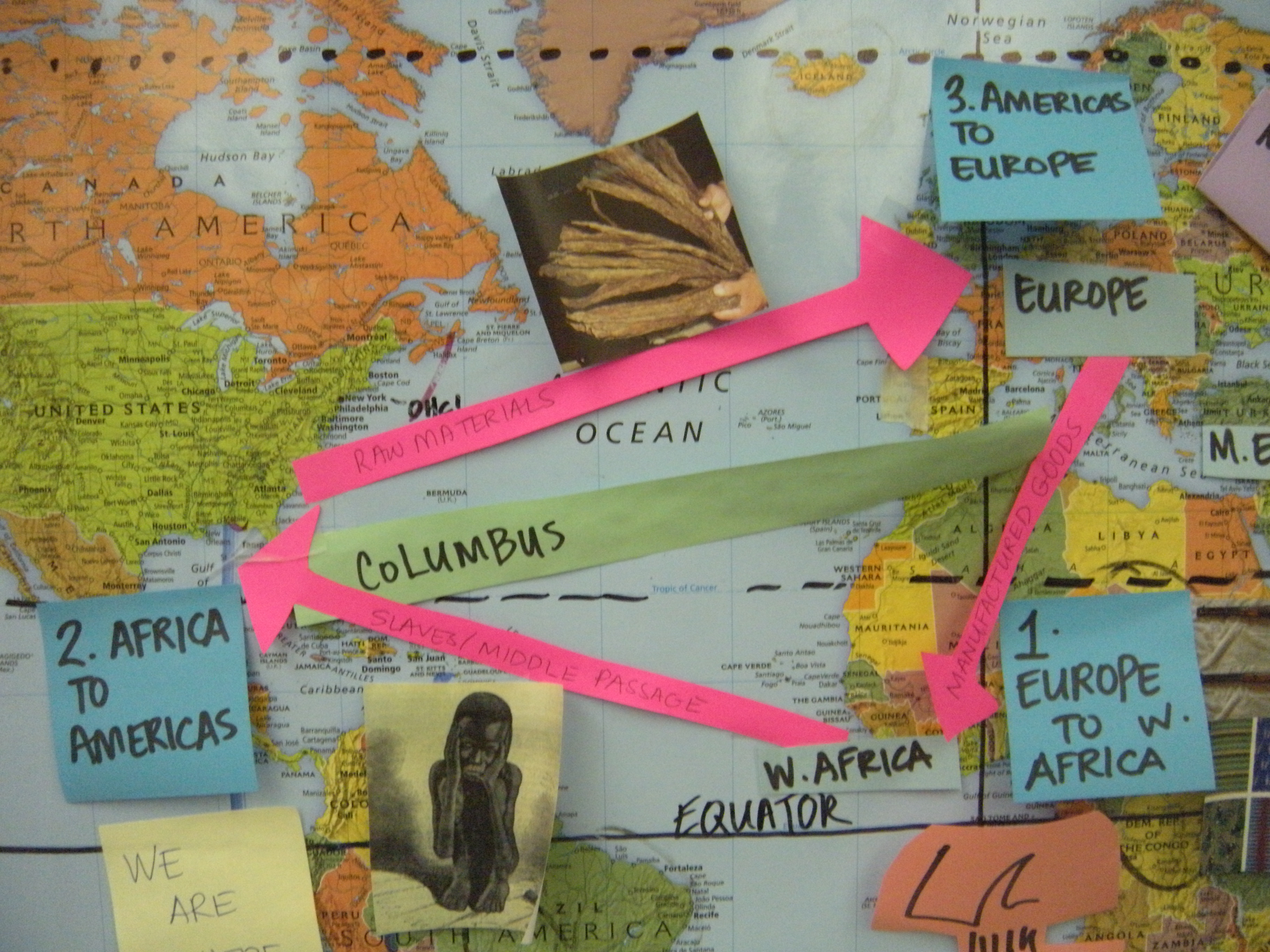
“Big motto (You Have the Power to Change the World) for staring, word wall JUST for geography (see image below for what it becomes), the map (again, see below for end product). Direct teaching happens up here, faceboard is up here for conferences which’ll start in Oct., and homework/notes, listening board, etc.”

“Last year’s geography word wall in June”

“The map at the end of the 2011 – 2012 school year”

Describe your teaching style in one word. Relaxed.

What is your go-to literacy strategy? I love RAFT – role, audience, format, topic – to get kids to think about what it would be like to be someone else, something else – my favorite RAFTs are when weird 10 year olds want to be inanimate objects.

How do you motivate your students? I like to put wigs on kids . . . it’s weird. I’ve also used trackers – kids love to track their growth! We set individual goals and I have check-ins around their data to make it personal. I don’t do a whole lot of shazam-type stuff – it’s not very me – so I stick to cutting out pictures of my children, pasting them on different mediums, and data. Nerdy, true.

“Two big flags – a political cartoon one that kids ask about all year that connects to our big theme of “You can create great change” and the Miami one that my gung-ho adorable Advisory partner got and helped me hang. You can see the library on the left, which has a close-up…plants…and my three color-coded tracking charts that correspond to the kids’ tracking charts in their binders. We track exit ticket and quizmastery – only quiz mastery goes up there (they can track ETs all they want, I get weirded out). The board has lots of blank space – I hang work all cray like. Stars everywhere. It marks our units – I’ll hang the big nontraditional assessments and save ones from previous years to show as examples. On the bottom you see binders, which are labeled by class.”

“My classroom library by unit”

“Classic kidney table for conferencing with students – Faceboard behind it”

What is your favorite way to check for understanding? I love a good old-fashioned quick write followed by a share. Sue me. Especially when you have kids evaluate afterwards.

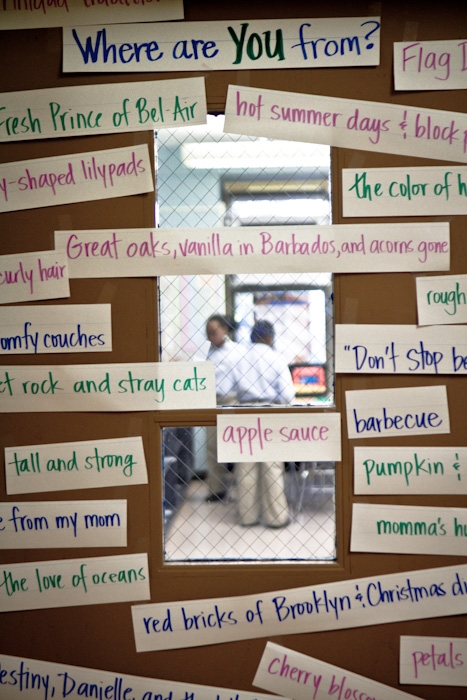
“I like to fill the door with student responses to various questions. Here they answered the question “Where are you from?” and I wrote out selected responses on sentence strips.”

The Sexy Six

In a perfect world, students would not be subjected to multiple choice exams as a measure of what they know – much less locked up quarterly in classrooms for entire days to take said exams. Don’t get me wrong, I believe strongly in teaching to rigorous tests as part of smart backwards planning; however, your average state exam is far from inspirational, much less rigorous. But we do what we got to do . . . so bring on the tricks and gimmicks! Each test has its own bag of tricks but one trick I come back to year after year is what I call “The Sexy Six.”

  1. Read & Underline the question
  2. Don’t look at the answer yet (wrong answer choices poison your brain!)
  3. Guess what you think the answer will be – write it to the side
  4. Cross out wrong answer choices, maybe dots beside possible choices
  5. Circle your answer and write it to the side
  6. Star & Skip questions you can’t get down to 2 answer, come back to them when you’ve finished the rest

The Sexy Six are a tried and true strategy for any multiple choice exam. I teach them at the beginning of the year and have a big poster with them on it at the front of the classroom. I even give exams where each question is worth 5 points – 1 point for the right answer, 1 point for underlining, 1 point for writing a guess to the side, 1 point for crossed out answers and maybe dots, and 1 point for writing the answer choice to the side. I model The Sexy Six in think-alouds when we review multiple choice Do Nows and I show how students can use them to answer seemingly impossible questions. By spring, The Sexy Six are second nature and colleagues, I’m pretty sure test taking skills are at least 51% of the battle on these standardized-monstrosities.

Why “Sexy?” Ok, ok, I’ll admit it . . . it’s a cheap trick. Nature has wired adolescents to flag information related to and around sex as “highest priority.” As skillful teachers, we can use this to our advantage and attach horrifically dry and mundane tasks (like multiple choice exam strategies) to the forefront of their brains. Appeal to that reptillian stem! I’ll admit for middle school “Super” might be more appropriate.

Is Teach for America working?

This past weekend the New York Times’ “Room for Debate” series considered the question: Is Teach for America working? Responses ranged from “It changed my life” to “No” to “If anything, they work to hard.” But the opinion piece that caught my eye was “A Glorified Temp Agency” by University of Texas professor Julian Vazquez Heilig. Essentially, Heilig makes the argument that “more than 80 percent of [TFA] recruits leave for graduate school or another career before their fourth year.” He explains how these teachers “see a teaching stint with Teach for America as simply a résumé builder” and how TFA “is a revolving door of inexperienced teachers for the students who most need a highly qualified one.”

I have heard this criticism before (the prize for most hilarious goes to the Onion’s point/counterpoint article titled “My Year Volunteering As A Teacher Helped Educate a New Generation of Underprivileged Kids vs. Can We Please, Just Once, Have a Real Teacher?”) and it really rankles me. Here’s why:

The problem of educational inequity is caused by a multitude of factors: poverty, poor healthcare, lack of nutrition, underperforming schools, etc. It makes sense that the solution to this problem will be multifaceted as well – there is no silver bullet for the achievement gap. In my mind, we need as many people as possible working towards inventing and implementing various solutions. So when I hear education professors taking education non-profits to task for not doing enough it kind of feels like cannibalism.

I’m not sure if TFA is “working,” or even what that might look like, but I do know it worked for me. I fell in love with teaching the first time I stood in front of my own students on August 25, 2003. I knew, deep in my heart, I was doing at that moment what I would do for the rest of my life. That being said I had (have?) many, many doubts along the way. I did not want to be a teacher because it seemed like settling for 3rd place (not even 2nd!). Our society thinks teaching is really un-sexy and certainly a waste of time if you have any brains or motivation to speak of at all (“Those who can’t do, teach”). Even my own grandmother said, “It’s just that I had such high hopes for you!” and she WAS a teacher herself!

Within Teach for America I found a group of exceptional people who were not only interested in teaching, they loved teaching. People spoke about teaching in hushed tones of reverence and absolutely poured themselves out to be better teachers. As much as I “do my own thing” regardless of what others think, I believe having a community of smart, accomplished people who really value teaching has strengthened my own commitment to the profession. As Arne Duncan said, “Teach for America made teaching cool again.” Add to that the countless resources, examples, role-models, and friends I have encountered through Teach for America and there is no question about the role the organization has played in my life – I am a 10 year classroom teacher because of TFA. Without it, I would be doing something much, much less cool.

Thoughts about TFA?

The Best Review Game of All Time

Although there are many elaborate review games out there I only use one – I call it The Game. I did not invent it however I have modified it over the years to be something that works for many grade levels, many contents and many situations. Students always, always love it. The only downside is that it can get so loud your colleagues will wonder what the heck is going on in your room.

Equipment Needed:

  • a small whiteboard for each row in your classroom (like the kind commonly used in math classes)
  • dry erase markers
  • a roll of paper towels to use as cheap-o erasers

The Game:

Teams sit in the same rows (from front of the room to back of the room) and come up with a name for themselves. I give them 90 seconds to think of a name and if they fail to do so or if the name is inappropriate I give them a name (the “electric pink chipmunk eaters” or the “puking pigeons” etc.). Write each team name on the front board and keep a running tally of points under each name. The whiteboards, markers and paper towels are then passed to the very back of the room and held by the last person in each team’s row.

You ask a question and the teams race to write a legible answer on their whiteboards and then pass them to the front of the room. The students in the first row hold up their team’s answer. Anyone on the team can write the answer, not just the last person. So if the last person doesn’t know they just pass the whiteboard up to the teammate that remembers the answer. Two points for the first team with the correct answer at the front and one point for each correct answer that isn’t first to the front. After each questions students move up a desk so that students are constantly on the move both by having to pass the whiteboard and switch desks after each question. This is the beauty of The Game – forced engagement and physical activity.

A few tips: Have students practice with a couple of questions before you start keeping score. This allows them to get the swing of things in a low pressure context. Take off points for trash-talking classmates as well as arguing with you about who was first or legibility issues, etc.

Any other review games folks like to use?