
As a teacher in the very non-union state of Texas I have had to stay on top of the Chicago developments (via the news as well as some friends who teach in that city) in order to understand what everyone is so worked up about. Here is an over simplification: the strike isn’t about salary, it’s about not having 50% teacher evaluations linked to student performance on standardized tests and getting laid off teachers re-hired (if you want a more information, checkout this article at the New York Times or the extensive coverage at the Chicago Tribune as well as the Washington Post’s summary here).
What is really interesting about this strike is it pits traditionally Democratic labor unions against a Democratic Chicago mayor with best-friend ties to the president. Opposition to the Chicago teacher’s union strike may be the one issue both Obama and Romney agree on! It is easy to look at this strike and quickly conclude these teachers are ridiculous. What on earth is wrong with firing bad teachers?!? And, if you’re doing your job, why worry about linking standardized tests scores to your performance evaluation? I’ve heard super-lefty education reformers AND Rush Limbaugh both make snide, dismissive remarks about Chicago teachers that make us picture our own worst teachers (you know, the one that played movies, joked around with the popular kids, and put you in detention when you called him out for being wrong?) holding a poster that says “Give me what I deserve!” and yelling populist chants as copious spit sprays from his wide-open mouth. Ok. Wipe the imaginary spittle off your face, surpress your high-school angst and let’s take a closer look.
Teachers are public sector employees who’s salaries are paid by tax payers and so they should be held accountable for what happens, or does not happen, in their classrooms. Period. That being said, figuring out how to measure teacher quality has proven to be exceptionally difficult. Currently, the popular means of doing this look like various rubrics that act as checklists which put teachers in a spectrum ranging from unacceptable to excellent. The Obama administration, through programs like Race to the Top and the NCLB wavers, has incentivized attaching standardized test scores to these rubrics. But why use a generic measure for what is a very specific, individualized performance?
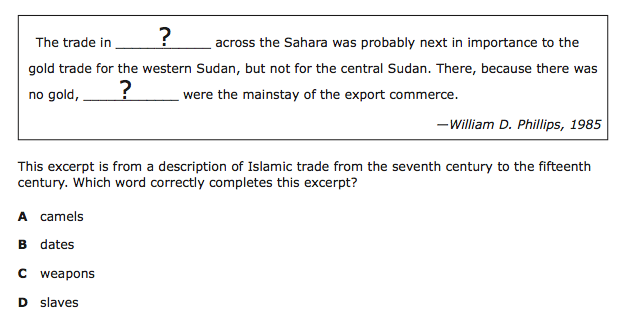
Teachers are not NFL quarterbacks whose performance can be measured anywhere and anytime with the same tool (i.e. yards thrown, run, touch downs, etc.). In fact, a truly excellent teacher is differentiating her instruction on a minute by minute basis for every single student depending on his or her needs. Standardized tests measure a students performance on on a single day on a small number of questions that are often sadly lacking. As a social studies teacher, these questions hardly get at the essential knowledge of my course and often don’t even touch on the skills foundational to understanding history (understanding bias in primary sources and defending a thesis). Check out the question below from the Texas 10th grade World History exam for an example of what I’m talking about:
And what if you teach art? Or PE or music . . . well you’ve most likely been fired given the current obsession with STEM and literacy to the exclusion of all other subjects so don’t sweat it. The truth is standardized testing results are not the products of teachers. Students who are more knowledgeable, skillful, and better equipped for citizenship are the products of teachers.
In a democracy, the role of public education is to provide a citizenry that will sustain the republic via informed voting, tax-paying, and activism. While the ability to take multiple choice test is necessary at times (SAT, GRE, LSAT, various professional accrediting exams, etc.) when was the last time you saw a job description that included the line “Must be a strong multiple choice test taker?” Additionally, teachers help children learn to cooperate with others as well as problem solve when interpersonal conflicts arise. Teachers also foster creativity and critical thinking – the cornerstones of what makes the US so innovative. Add to that character and value development (like a strong work ethic and empathy) and teachers are literally holding up our civil society. The impossibility of measuring these products through a standardized test is at the heart of what is bringing teachers to the streets in Chicago.
I would argue the people best suited to evaluating a teachers performance are the parents of our students. They are the tax payers and it is their children’s future on the line. This could look like a situation where parent evaluations where 50% of teacher evaluations but parents might lose the right to evaluate their child’s teacher if they did not attend a set number of parent-teacher conferences or volunteer for various classroom support roles. Every teacher I know would gladly put their job on the line if it meant guaranteed increased parent involvement. Studies show over 80% of parents are satisfied with their children’s teachers so I doubt such a move would result in massive teacher lay-offs (the link is about satisfaction with local schools but I’ve seen the same numbers for individual teachers, anyone out there know the study I’m thinking about?). Standardized tests could make up 20 – 30% of a teacher’s evaluation but the majority should rest with those who have the most to lose or gain from a teacher’s performance.
I worry the fight in Chicago is a nice way for Republicans to brush aside unions that play an important role in protecting labor rights while Democrats delude themselves into thinking they’ve found a solution for the achievement gap (teacher quality evaluation) that rest in the hands of the government rather than the people. In the United States our country’s physical size and extensive diversity makes individual participation in our democracy complex but teacher evaluation seems like the ideal place for a tax payer and parent to have a direct say.
*the official answer to the history question above is “A. camels” . . . don’t ask me to explain it, I’m just a history teacher







 The Sacred Profession