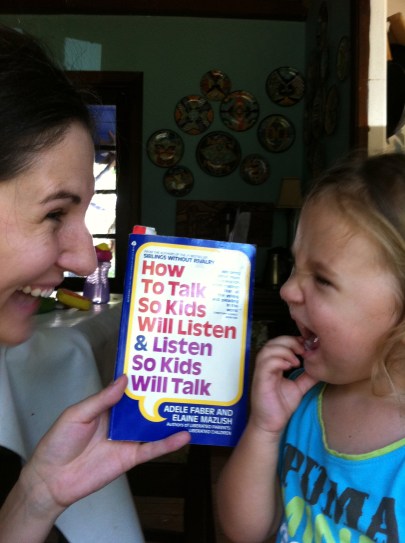
My daughter and I with my retro version of an amazing book. This particular copy is older than I am.
Reading How To Talk So Kids Will Listen & Listen So Kids Will Talk by Adele Faber and Elaine Mazlish did more than make me a better teacher – it made me a better person. The book was written primarily as a parenting guide for younger children however I have found it to be an invaluable guide for interactions with high school students all the way through 12th grade and even, at times, my adult relationships. Faber and Mazlish give plenty of examples and write in a clear, non-preachy tone that make their concepts easy to apply. They cover topics from “helping children deal with their feelings” to “alternatives to punishment” to “giving praise.” Here is an example of their advice on encouraging autonomy in children:
- Let children make choices
- Show respect for a child’s struggle
- Don’t ask too many questions
- Don’t rush to answer questions
- Encourage children to use sources outside the home [or for our purposes, the teacher]
- Don’t take away hope [or allow for a wide range of possibilities/outcomes]
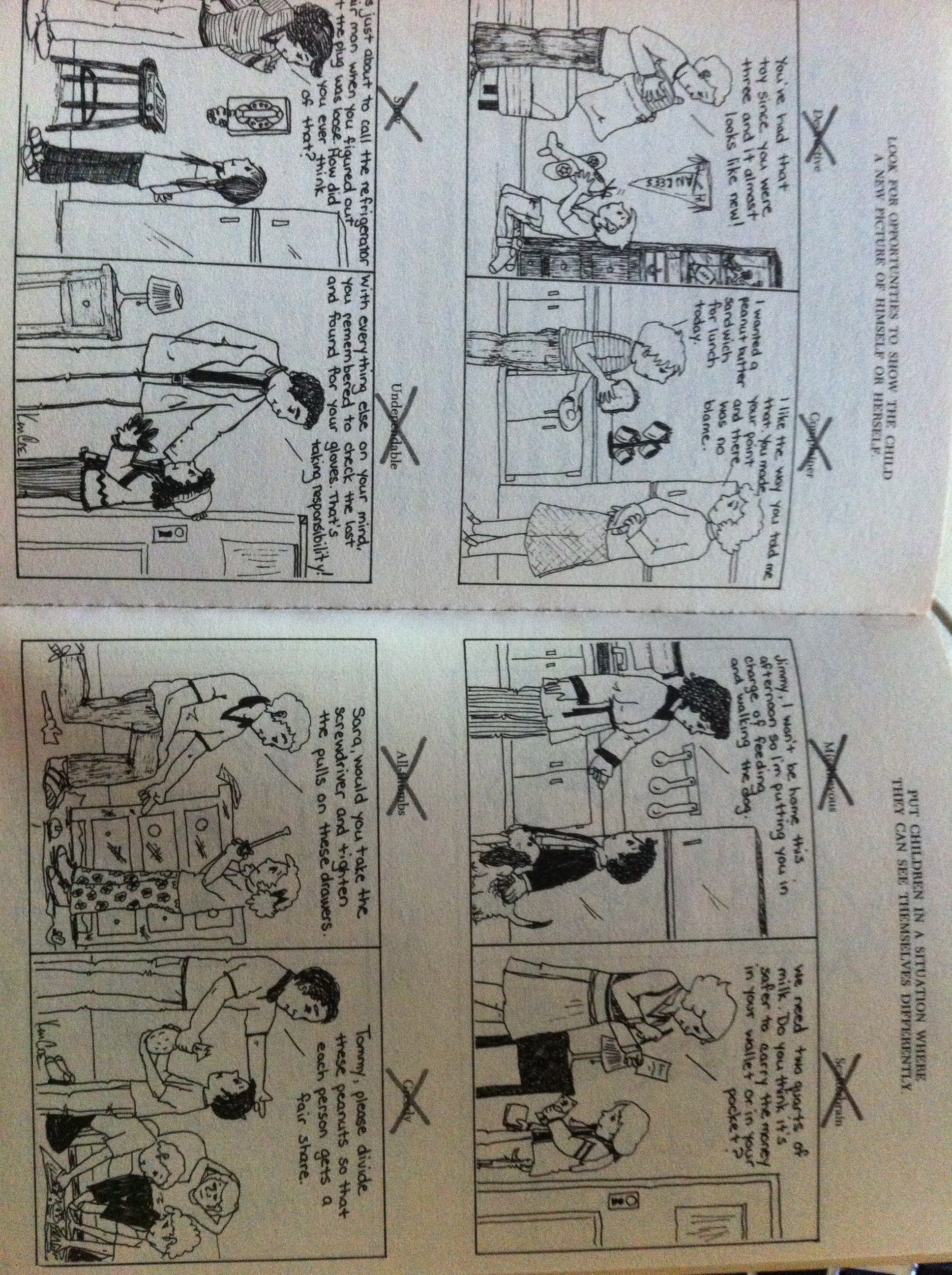
I personally took this list, photocopied it and kept in on my little podium at the front of my classroom to guide my actions when students worked in groups. This book is full of little such gems. Another amazing aspect of How To Talk is that much of it is written in cartoon format.

As teachers we don’t have very much time to read – but we can probably all swing what is essentially a comic book! The one cavat here is don’t be put off by the parent/young child format of the cartoons. Read the cartoons thinking “teacher/teenager” and the advice is still extremely aplicable. For example, to give effective praise instead of evaluating, describe what you see. “I see a clean floor and books neatly lined up on the shelf,” you might say. Then describe what you feel: “It is a pleasure to be in our classroom right now!” Finally, label the child’s praiseworthy behavior with one word, “You cleaned the floor and sorted the books. This is what I call organization!”
The chapter that most influenced my teaching is called “Freeing Children from Playing Roles.” Children are often “assigned roles” by well-meaning parents and teachers at a very young age such as shy, clumsy, or bossy. By the time we reach puberty, these labels have worked themselves into the essential fiber of our self-concepts. As educators, we should empower children to choose their own identities rather than accept other’s definitions of themselves. Below is a quick list of steps Faber and Mazlish advocate for accomplishing this task. The steps are the authors but I’ve written different examples to better fit our teaching context.
To Free Children from Playing Roles
- Look for opportunities to show the child a new picture of himself or herself. “What do you mean you’re bad a math?!? You just made a 100 on this quiz! You’re really good at math!”
- Put children in situations where they can see themselves differently. “Juan, would you please welcome our visitors and explain to them what we are doing in class today?”
- Let children overhear you say something positive about them. “Sarah worked silently during our reading time.”
- Model the behavior you’d like to see. “I find the language in this poem really frustrating and outdated but I’m not giving up. Ok, let me see if I can use context clues to figure out what glib means.”
- Be a storehouse for your [students’] special moments. “I remember the time we went on the field trip to San Antonio . . .”
- When the child acts according to the old label, state your feelings and/or expectations. “Hearing from you is really important to me. Despite your reluctance to talk, I expect you to participate in our discussion. Would you like to speak now or should we come back to you later?”
Anyone else a fan of How to Talk?



 The Sacred Profession