There is a quick, interesting article at the Time Ideas website on how some schools are able to produce an exceptional number of highly skilled math students – particularly female math students. The article by Annie Murphy Paul (who has an engrossing blog, here) explains how more than good curriculum or technology are needed for excellence. Paul points to two factors: expectations and environment. She argues these two factors are essential for leading students to achievement – even when they come to school with all sorts of advantages already in place. Read the whole article here.
The Sacred Profession
Education Rooted in Justice, Growth, and Heart

Daily Archives: September 7, 2012
What about the girls?
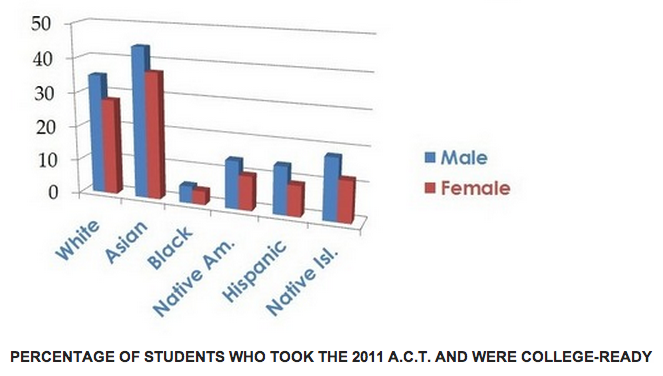
I came across this super-upsetting graph in an newsletter from the Department of Education (called Teaching Matters, you can sign up for it here). This data comes from a new report from the National Center for Education Statistics (NCES) on gaps in access and persistance in higher education (for full report, click here) I’ve found the ACT to be such a line in the sand in terms of college readiness and the chart above clearly illustrates the race and gender discrepancies in scores.
There are several really gripping findings in the study but another chart that jumped out at me was the one below which shows passing percentages on Advanced Placement exams by subject, race and gender.

This chart is even more troubling because more often than not AP classes are not open-enrollment and so these scores represent the top performing students and not the population at large. Although performance by race differed dramatically in many subjects I was stunned to see how wide the gap is for young women of color.
One of the central moments of my development as a teacher was in my second year when my principal sat in on my lesson and kept a record of student-teacher interactions (questions asked, hands raised, cold-calls, reprimands, etc.). At the end of class he wrote on a post-it “Interesting lesson! What about the girls?” As I looked at the chart, I was stunned to see that for every interaction with a female student I had almost three more with a male student. I was giving almost three times the attention to boys in my class. I was mortified. I had read Reviving Ophelia! I took TONS of women’s studies classes in college! I was only two years out from writing my undergraduate thesis titled Can We Milk This Tiger: A Study of Feminist Theory and Revolutionary Praxis in Central America and I there I was actually favoring my male students.
Unfortunately, the data above shows I am not alone. What about the girls?
 The Sacred Profession