Warriors and Worriers

There is a great article today in the New York Times called “Why can some kids handle pressure while others fall apart?” by Po Bronson and Ashley Merryman (authors of the great book NutureShock). The article describes new research that shows people carry genetic markers that tip their stress reactions towards one of two possibilities: Warrior or Worrier. Essentially, thanks to both helpful chemical reactions in the brain, the warrior reaction focuses and performs under stress whereas the worrier reaction, again due to chemical makeup, inhibits and even paralyzes.  About half of all people have a balanced combination of the two reactions but the other half favor either warrior or worrier reactions. The authors point out that human survival over the ages has depended on both types of overreactions – those who would fight under dismal odds and those who would put the breaks on when everyone starts jumping off the cliff.

Enter modern education and standardized, high-stakes testing. Researchers found warriors get an edge when they sit down to test and worriers underperform at an average of one whole grade level (from an A to a B, B to a C, and so on) than what they are capable of under non-stressful circumstances. I found this a hard pill to swallow. What the research is saying is that some of our students are born less able to test – it is in their very genes! The good news is, all is not lost for our worrier students. Bronson and Merryman write:

So while the single-shot stakes of a standardized exam is particularly ill suited for Worrier genotypes, this doesn’t mean that they should be shielded from all challenge. In fact, shielding them could be the worst response, depriving them of the chance to acclimate to recurring stressors. Johnson explains this as a form of stress inoculation: You tax them without overwhelming them. “And then allow for sufficient recovery,” he continued. Training, preparation and repetition defuse the Worrier’s curse.

With planning and intervention, all students can be coached to overcome what turns out to be a genetic disposition to stressing out under pressure. What was most interesting about the article however was the authors take on standardized testing as a form of competition. Being a worrier is actually an evolved trait preserved in our genetic code over time because it is useful; risk aversion can keep you alive. However, unlike in other forms of competition, in standardized testing there is no upshot for underperforming:

Taking a standardized test is a competition in which the only thing anyone cares about is the final score. No one says, “I didn’t do that well, but it was still worth doing, because I learned so much math from all the months of studying.” Nobody has ever come out of an SAT test saying, “Well, I won’t get into the college I wanted, but that’s O.K. because I made a lot of new friends at the Kaplan center.” Standardized tests lack the side benefits of competing that normally buffer children’s anxiety. When you sign your child up for the swim team, he may really want to finish first, but there are many other reasons to be in the pool, even if he finishes last.

The same conclusions largely extend to academic grades. How can we create a classroom environment where our students can learn to deal with stress and compete in healthy ways that allow them to grow and become more resilient? Here are my ideas:

  • Play group games: Working collaboratively in teams to compete against classmates can be tremendously motivating. In my classroom I use one very simple game (check it out here) that frequently brings my classes to a screaming, chaotic – but invested! – all out brawl. Because the game is played in teams the pressure is off specific individuals. At the same time it is kind of stressful but in a fun, low-stakes way.
  • Teach test-anxiety coping methods: Use visualization, breathing exersies, and true-to-life practice. See here for details
  • Show students their progress: Use tracking systems to show students how they have learned over time. Although this is easiest to do with multiple choice style exams it is also extremely effective with an unchanging rubric; this way, students can compare their performance on the same rubric in February to their performance in May. Tracking student growth also allows you to give targeted feedback on specific ways for students to improve. It is also empowering for students because they see a clear path forward. A trackable grade isn’t an unchanging stamp but instead it is feedback on their performance at a specific point in time.
  • Show students this research: Empower students to self-identify as “warrior” or “worrier” and then make a plan for how to compensate for their areas of weakness as well as maximize their strengths.

What ideas do you have?

Are you wearing red tomorrow?

I have been following the Seattle teacher’s boycott of a district standardized test called the MAP but was a little confused about what exactly they are trying to accomplish. Articles with headlines like “Seattle’s Boycotting Teachers Start Crusade Against Standardized Testing” make me think it is time to buckle up and prepare for the revolution. As I dug deeper I found this really helpful article in Ed Week that clarified a couple of facts: 1) the teachers are not boycotting a state exam but a district exam and 2) their main concern is the exam, called the MAP, is not aligned to the state standards they are required to teach.  The teachers were warned that if they do not administer the MAP they will be placed on a 10 day leave without pay; a threat which changed none of their minds. Want to hear from someone on the other side? The CEO of the company that produces the MAP exam wrote an OP-ED laying out his argument for the validity of the exam.

I am not sure wether or not this boycott qualifies as a “crusade” however these teachers are certainly attracting attention and gaining support. The NEA, AFT, and Chicago Teachers Union recently released a statement of support for the Seattle teachers. Want to jump on the bandwagon? The Seattle Teachers’ Association calls for those sympathetic to the Seattle teachers to show our support by wearing red to school tomorrow.

Are you wearing red tomorrow? I think I just might . . .

Hope and Truth

“Truth without hope is failure; but hope without truth is fantasy.”

- Mike Johnston, Colorado State Senator, Education Reformer, & Great Person

Recently, I have been thinking about the tension that comes from teaching in what is clearly a broken system. It is so easy to focus on those problems that seem to cripple our progress because they are real, in-our-faces obstacles. There came a point in my career when I had to chose to continue to love teaching. It wasn’t a natural feeling or a made-for-a-cheese-ball-TV-drama-about-teaching moment. I remember thinking: “OK, a lot about my situation sucks and is hard. But regardless of what the future holds for me, today I am a teacher and the children who have been put in my care deserve to spend an hour with someone who is grateful to be there.” It is amazing how effective “faking it till you make it” can be.

I met Colorado State Senator Mike Johnston three years ago at NBC’s Education Nation and heard him say the quote above this past fall. This quote works well to describe the relationship between our faith in our students’ abilities and the data we collect on their academic performance (ex. “I know my students have what it takes pass this AP test but right now only 8% would score higher than 5/9 points on the DBQ.”). As teachers, the importance of constantly maintaining hope but then doggedly fleshing out the detailed truth or reality for our students – and sharing it with them – is often difficult and exhausting. It means giving and grading meaningful assessments regularly (daily?) as well as communicating current reality and a plan for progress in the same breath.

So if you had a crappy January, here is a virtual hug. It will be hard but February will be better and March will be even better. This week on The Sacred Profession look for a new classroom tour (yeah!), a book review, tips for celebrating Black History Month, and a first-hand report on what is happening in the Memphis education world – woot!

Summer opportunity with LearnZillion

Looking for something worthwhile and fun to do this summer? I know about the organization LearnZillion from my work with AmericaAchieves’ Common Core resources (so worth checking out here!). LearnZillion is looking to hire 200 excellent math and literacy teachers grades across all grade levels to design lesson plans that align to the Common Core. Aside from an all expenses paid May conference in San Francisco the work is flexible and not location specific. Instructions for applying to be a LearnZillion Dream Team teacher are here – good luck!

Student Motivation & the Power of Choice

Screen Shot 2013-01-16 at 8.58.27 PM


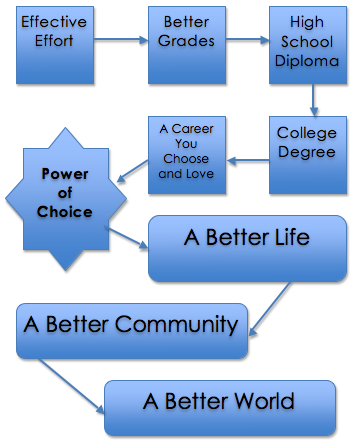
At the beginning of the second semester I like to take a time to remind my students of the purpose of school. Each student gets a blank version of the flowchart shown above and I put a copy up on the document camera. I talk them through each box and ask them not just to simply copy down what I have but to personalize it.

We begin by reviewing the six aspects of effective effort and students briefly jot them into the first box. Students then set a goal for their 3rd quarter grade for my class in the “Better Grades” (which I sometimes call “Academic Success”). In the High School Diploma box I ask students to write a description of how they will feel walking accross the stage on graduation day. I lead them through a visualization of this moment (ex. “You look out and see your family, they are smiling. You see your teachers, they are so proud. You feel the excitement of your classmates around you – you’re finally graduating!”) and then have them write. Next I ask them to write down one or two ideas they have for what they would like to study in college, where they would like to go, what activities they would like to be involved in, etc. Then I have them describe their dream jobs in the Career box. In the “Power of Choice” box I encourage them to think about all of the areas of their life they will have control over when they are financially independent: they can choose where to live, they can choose what kind of home to live in, they can support a family, they can provide for their children and their aging parents, they can help out a sibling who is in need, they can afford quality medical care, and so on. I have them write down at least 5 goals (such as “visit Paris” or “own a Mercedes” or “ensure my grandma is taken care of”) they have for their adult lives in the “A Better Life.” Next I push them to think about how their good choices will impact our community. How will they give back? How do they intend to address the problems they currently see around them? Finally, we reflect on how the world they leave their children (or others’ children) will be better because they have lived and made good choices.

I find this activity to be incredibly inspiring both personally and to my students. Try it out! Download the blank template here Success Map.

Why I will not carry a gun into my classroom

In the aftermath of the Sandy Hooks school shootings a number of politicians, particularly in my home state, have called for allowing public school teachers to be allowed to carry concealed handguns in their classrooms. Political figures like Texas governor Rick Perry argue such a move would empower teachers who legally own guns and are licensed to carry them to protect their students in a attack situation. Texas lieutenant governor David Dewhurst recently called for state funding to support teachers who want to receive firearm training. Before we all open our wallets, or strap a Glock next to them, let us pause and consider what it means to bring weapons in our classrooms.

Without a doubt, teachers have a sacred duty to protect – physically as well as psychologically - their students. We should strive to create safe and orderly classroom environments where students are able to focus on learning and be free from the distractions of bullies, unclear expectations, and their strong, unending desire to post to Facebook in the middle of the school day. When I first began teaching, I thought real classroom authority rested in my ability to raise my voice and be heard above my students; in other words, I was a yeller. A mentor quickly helped me see the power in waiting for total silence before you speak. I now know teachers with the best classroom management rarely raise their voices or become visibly frustrated. They administer consequences with consistency and a smile. Who among us has not learned the almost Jedi-Knight-worthy power of “the teacher look?”

Teachers can play an essential, life-saving role in a school shooting situation  I have written before about those heroic teachers who disarm shooters by persuasion or by physical restraint. We saw this again this past week when a California teacher convinced a 16 year-old boy to lay down his shotgun. But the school shooting story that springs to my mind when I think of arming teachers occurred in my community here in the Rio Grande Valley. Last January, 15 year-old Jamie Gonzales was shot multiple times by school security guards after brandishing a pellet gun at his middle school in Brownsville, Texas. On the one hand the boy’s teachers and family members described his actions as uncharacteristic and expressed shock at the lethal force used by the school security. On the other hand the security guards justify their actions as completely necessary. Who can blame them (except, perhaps, Jamie’s family)? What would you do if you had a gun and a student pointed a weapon at you? But what if you did not have a gun?

The German-American political theorist Hannah Arendt escaped the Holocaust and witnessed the harrowing testimony against the Nazi officers at the Nürenberg trials. In reflecting on these horrors she wrote “violence is mute.” Even having lived through one of the most horrific moments in human history Arendt specifically rejected the power of violence as impotent. To what extent would a teacher armed with a handgun attempt to talk down a shooter? I worry providing teachers with the option of shooting diminishes their willingness to negotiate with the shooter who is likely a merely child.

Experts seem to agree the incredible fire power used at Sandy Hooks could not have been stopped by handguns. Those who are not calling for tighter gun control focus their attention on the need to identify and provide support for the mentally ill. Regardless whether or not we should ban high capacity magazines and assault weapons or provide weapons training to teachers, we should certainly expect teachers to play a critical role in supporting young men and women with mental illness. However as a teacher my time and resources are overwhelmed by planning lessons, grading, tutoring, supervising, coaching, and other essential tasks that I overlook warning signs. I still feel deeply guilty about one student I taught who clearly exhibited obsessive-compulsive tendencies. He was “different” and “a bit odd” but he made really high grades and seemed functional - until the day he could not get out of bed and come to school. I never saw him again.

Teachers play a critical role in preventing school shootings. But instead of spending money on weapons training let us hire more social workers and licensed councilors to support our overworked educators. Let’s spend money training teachers to recognize the signs of mental illness and provide them with resources to help when needed. Perhaps guns are a necessary tool of school security guards or police but they are a poor fit for teachers. Our sphere of influence is our students’ minds and characters – a gun is ill suited to shaping these precious resources.

Sunday Night Inspiration: The Seattle Teachers’ Protest

Teachers at Garfield High School in Seattle announcing their collective refusal to administer a “flawed” standardized test. ERIKA SCHULTZ / THE SEATTLE TIMES

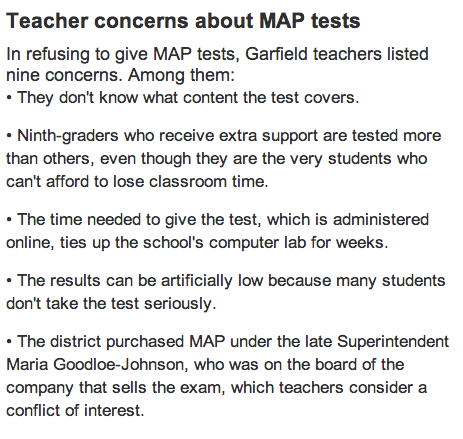
A group of teachers in Seattle is refusing to administer their district’s quarterly academic benchmark. On the one hand this is awesome on the other hand this is truly, deeply awesome. I believe, along with these protesting teachers, that there is a place for standardized testing. However, it feels horrible to administer an exam you believe to be a waste of your students’ time. Additionally, when you add up the amount of time our students spend taking official state exams, district internal assessments, actual exams for our courses, various placement exams, field tests, College Board exams, IB exams, etc. etc. it is truly breathtaking.

This story is incredibly exciting on a number of levels. Several months ago, I speculated that solving the education crisis in our country would involve a grassroots teachers effort much like the Civil Rights movement. I wrote:

So colleagues, I ask you: what does it look like for us to remain in our seat at the front of the bus? What does it look like for us to boycott an unjust system? What does it look like for us to carefully prepare to be non-violent when we are attacked by police and dogs so that the rest of the country will be appalled at the resulting images they see on the nightly news?

Does it look like refusing to give ridiculous exams? Maybe this is the beginning? I am inspired by a group of teachers taking their outrage beyond the teacher’s lounge by civilly articulating their grievances (see below) and actually taking action.

At any rate, I hope to God there comes a time when I can stand behind an articulate colleague, official school lanyard in place around my neck, cross my arms, and refuse to comply with an unjust system. What other problems could be tackled via whole-staff solidarity?

Screen Shot 2013-01-13 at 9.18.44 PM


“Inspiration is for amateurs”

“Inspiration is for amateurs. The rest of us just show up for work.” – Chuck Close

I came across this quote from the renowned painter in an article about increasing focus on art in schools. Call me a slightly-bitter/neglected social studies teacher but I always roll my eyes when I hear about a new STEM initiative. Students love the humanities and to divorce children from the arts, literature and their history is to raise little monsters that have nothing to talk about at parties, nothing to think about in lonely moments, and ultimately nothing to nourish their immortal souls. It is definitively dehumanizing.

Tirade aside, this quote got me thinking about what great teaching often looks like. It isn’t about having a really amazing lesson once a week or even a mind-blowingly-awesome lesson once in a while but good teaching is steady growth for each student over the course of a school year. It is a marathon not a sprint, as they say. Good teachers often feel uninspired and really strong lessons can look fairly pedestrian but it is not about the show. Professional teachers, like professional artists, “just show up for work.”

You Have More (or my former student kicked a robber’s butt and I am in awe)

One of my teaching mantras is this: each child has unlimited potential. I am not the judge of my students’ potential, I am the enabler. I like to come back after the holiday break and tell students that no one, including themselves, knows what they are capable of doing. I usually teach a mini lesson on someone like Helen Keller or Nelson Mandela who defied the odds and accomplished seemingly super-human feats.

We form a self-image at an early age and typically by upper elementary labels either from peers or teachers – like “smart” or “shy” or “lazy” – have become a part of our identity. As a white woman from a middle class suburban upbringing, I have to actively monitor the way I perceive students of color from low income backgrounds. It is easy to let stereotypes from the media or my own experience lead me to make unconscious judgements about students’ abilities simply because of how they are dressed or how they speak. This is even more complicated when students, because of failing school systems, are years behind in basic academics. In my class I post a sign that reads “You Have More” – it is intended to be a reminder for everyone. I finished Mindset by Carol Dweck over the holiday break (review coming!) and realized the approach I teach in my classroom is what she calls a “growth” mindset and is one of the keys to success in any endeavor.

So this brings me to Isaac Vargas. I taught Isaac two years ago as a senior (and a Sophomore and Junior actually) and know him fairly well. He is a steady student, always polite and soft spoken. When I saw this news story it totally, completely blew my mind. A carjacker held Isaac up at gun point and the mild, shy, kind-of-skinny Isaac noticed the gun was unloaded and proceeded to fight off the attacker and then hold him down until the cops arrived. If you have 2 minutes, go to the website and watch the new’s report (here) because seeing Isaac tell the story is so great. We do not know what is inside of us . . .

Screen Shot 2013-01-09 at 9.38.03 PM

I watched this clip thinking “Wow, I had NO idea this was in Isaac!” My husband, who was his soccer coach, called him Isaac Bourne. No kidding. Isaac’s story is a good reminder to be open to possibility and potential in our students’ academics. None of us know the limits of our own or our students’ potential.

How do you maintain belief in your students’ potential? How do you keep from judging your students? I would love to hear tips or ideas!

Happy New Year!

Me and my former students from last year who returned from college to receive their IB Diplomas today at IDEA - so proud!

Me and my former students from last year who returned from college to receive their IB Diplomas today at IDEA – so proud!

Happy 2013! I have been enjoying a lengthy holiday break here at the Sacred Profession but am excited to get back into the swing of things with daily (or at least, attempted daily) postings. Today was a wonderful and inspirational day as I spent almost the entire day catching up with former students. One of the advantages of teaching secondary students is getting to see a quicker return on your investment. I have struggled over the past few weeks to be optimistic about the future of our country (or heck even humanity in general) but visiting with these remarkable young men and women today was like medicine for my soul. Despite the challenges our community faces here in the Rio Grande Valley, these kids tackled one of the most rigorous college preparatory curriculums in the world (the International Baccalaureate Diploma Program) and were successful. Now in college, they are working hard, volunteering, earning passing grades in challenging classes, holding down thankless jobs for much needed textbook money, and generally kicking butt. I am so proud.

I was particularly proud to see so many of these college students come early to help tutor current high school seniors in Jenny Corroy’s IB English class. Many of them showed up as early as 7:45am this morning in order to help out with Ms. Corroy’s first period! Alumni are such a powerful – and often untapped – resource in our schools. It was amazing to watch the intensity and energy level in these student-to-student sessions.

IMG_2696

At the end of each class, Ms. Corroy thanked the alumni and pointed out how they were beginning to give back to a community that invested so much in them. She also charged her current students to plan on coming back this time next year to tutor next years students. It reminded me of the quote:

“If you have come to help me, then you are wasting your time…But if you have come because your liberation is bound up with mine then let us work together.” – Lila Watson

The more we can empower our students with a “give”, rather than a “take” or “receive,” mentality the more we work to build healthy, sustainable communities. This is often a difficult task but after visiting with my former students today I was inspired to move into 2013 looking for ways to work along side my students rather than always at the front of the room.

Happy New Year!


Follow

Get every new post delivered to your Inbox.

Join 234 other followers